
Luxury marble protection refers to the combined use of etch resistant coatings, penetrating sealers, and professional maintenance to prevent staining, acid etching, and surface wear on marble in New York City homes and properties. Most NYC homeowners assume a single sealer is enough. It is not. Most marble damage in NYC results from acid etching rather than staining, which means standard sealers leave surfaces exposed to the most common threat. Products like MORE® etch resistant® Next Gen and systems like Marble Armor address this gap directly. Understanding the difference between stain protection and etch prevention is the starting point for any serious marble care program.
What causes damage to luxury marble surfaces in NYC?
Marble is calcium carbonate, and that chemistry makes it uniquely vulnerable in a residential setting. When an acidic substance, such as wine, lemon juice, vinegar, or even many household cleaners, contacts the surface, it dissolves the calcium carbonate and leaves a dull, rough patch. This is etching. It is a chemical reaction, not a stain, and it happens within seconds of contact.
Staining works differently. Oils, pigments, and colored liquids absorb into the stone’s pores and discolor it from within. A coffee ring near the kitchen sink or a makeup spill on a bathroom vanity are classic examples. Both damage types are common in NYC kitchens, bathrooms, and foyers, but they require different solutions.
“Penetrating sealers fill the pores of the stone to block liquid absorption, but they do not create a barrier on the surface itself. Acid still reaches the calcium carbonate and etches the finish regardless of how recently the stone was sealed.” — Rose Restoration
This distinction matters because sealers prevent stain absorption but offer zero protection against etching. Property managers overseeing Upper East Side residences or luxury condos in Brooklyn often discover this the hard way after a single dinner party leaves a network of dull rings across a polished marble countertop. The fix requires understanding that dual protection, one layer for stains and one for acid, is the only complete answer.
The most common sources of acid etching in NYC homes include:
- Citrus fruits and juices left on countertops
- Wine, sparkling water, and carbonated beverages
- Tomato-based foods and sauces
- Bathroom products including toners, astringents, and some soaps
- Cleaning products not formulated for natural stone
Penetrating sealers vs. etch resistant coatings: which do you need?
The professional stone care industry distinguishes between two categories of marble protection: penetrating (impregnating) sealers and topical etch resistant coatings. Each serves a specific purpose, and the most effective programs use both.
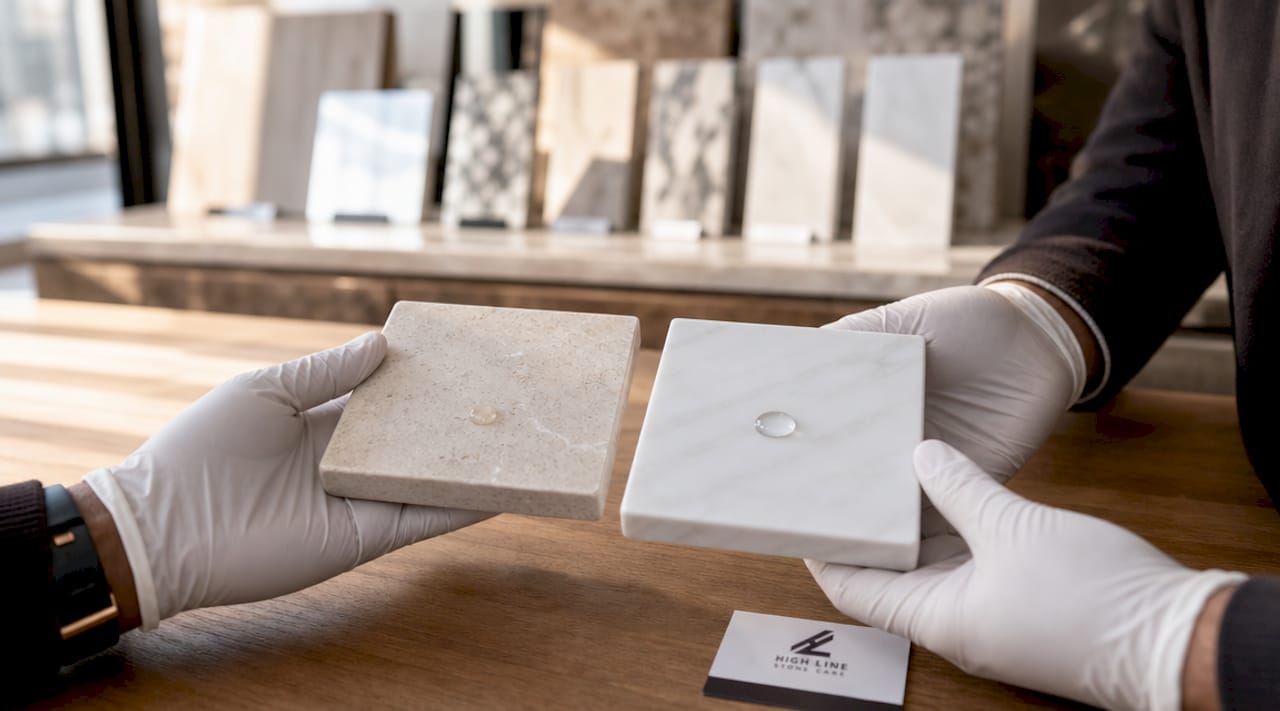
| Feature | Penetrating sealer | etch resistant coating |
|---|---|---|
| Protection type | Stain prevention | Stain and etch prevention |
| Application method | Absorbed into stone pores | Applied as surface film |
| Durability | 1–3 years typical | 10+ years or lifetime |
| Appearance change | None | Honed or gloss finish options |
| DIY-friendly | Possible with prep | Professional application required |

Penetrating sealers work by filling the microscopic pores of the marble, blocking oil and liquid absorption. They do not sit on top of the stone. etch resistant coatings, by contrast, form an ultra-thin film on the surface that physically separates the marble from acid contact. Topical protective films stand 10 or more years compared to 1 to 3 years for sealers, do not alter the stone’s appearance, and require professional application for reliable results.
MORE® etch resistant® Next Gen is the most recognized product in this category. It delivers a crystal-clear coating available in honed or gloss finishes and carries an industry-leading lifetime warranty. RAKU Etch is another professional-grade option used in high-traffic residential settings across Manhattan and Queens. Highlinestonecare’s Opal Luxury Anti-Acid Sealer takes a similar approach, offering permanent protection with a single application.
To determine whether your marble needs resealing, the water-bead absorption test is the standard field method. Pour a small amount of water on the surface and observe. If water absorbs within five minutes, resealing is recommended. This test removes guesswork and prevents unnecessary applications.
Pro Tip: Surface preparation is the single most important factor in coating performance. Any residue, wax, or old sealer left on the marble before application will prevent the new coating from bonding correctly. Always clean and assess the surface thoroughly before any product is applied.
How to apply sealers and etch resistant coatings step by step
Whether you are coordinating with a professional or overseeing a property manager’s maintenance schedule, understanding the application process helps you set realistic expectations and catch errors early.
- Clean the surface thoroughly. Use a pH-neutral, acid-free stone cleaner to remove all grease, residue, and prior product buildup. Any contamination left on the surface will compromise adhesion.
- Allow complete drying. Marble must be fully dry before any sealer or coating is applied. Moisture trapped beneath a sealer causes cloudiness and uneven coverage. Allow at least 24 hours after cleaning in humid NYC conditions.
- Assess the surface condition. Check for existing etching, chips, or cracks. Active damage should be addressed through honing or polishing before protection is applied. Sealing over damaged marble locks in the problem.
- Apply the penetrating sealer. Work in small sections, applying the sealer evenly and allowing it to penetrate for the manufacturer’s specified dwell time, typically 5 to 15 minutes. Wipe away excess before it dries on the surface.
- Apply the etch resistant coating (professional step). This layer requires trained application for uniform coverage. Uneven finishes or DIY errors can cause visible halos or blemishes that are difficult to correct without full repolishing.
- Allow full cure time. Most coatings require 24 to 72 hours before the surface can be used. Avoid water and foot traffic during this period.
Resealing frequency depends on use patterns. Kitchen countertops with frequent use typically require resealing every 6 to 12 months. Residential floors and foyers in Scarsdale or Westchester luxury homes may only need attention every 2 to 3 years. etch resistant coatings, once professionally applied, generally do not require reapplication on the same schedule.
Pro Tip: Never apply a sealer to marble that has just been polished without confirming the polish residue has been fully removed. Polish compounds can seal the pores from the outside and prevent the impregnating sealer from penetrating correctly.
Common mistakes to avoid include applying sealer to a damp surface, using too much product and leaving a hazy film, skipping the water-bead test before reapplication, and using acidic or alkaline cleaners during the preparation phase.
How to maintain and troubleshoot marble surfaces after protection
Ongoing maintenance is what separates marble that looks pristine after ten years from marble that shows wear within two. Daily care requires consistency, not complexity.
For day-to-day upkeep, the following practices protect both the stone and the coating:
- Wipe spills immediately, especially acidic liquids like citrus juice, wine, and vinegar
- Use only pH-neutral, stone-safe cleaners formulated for natural stone
- Place coasters and trivets under glasses and hot items
- Avoid dragging objects across polished surfaces
- Dry the surface after cleaning to prevent water spots
Identifying the difference between a stain and an etch is the first step in any troubleshooting response. A stain is a discoloration that sits within the stone’s pores. It often has a defined edge and may respond to a poultice treatment. An etch is a dull, rough patch where the surface finish has been chemically removed. It catches light differently than the surrounding stone and has no color of its own.
“Store-bought polishing powders work on polished marble for minor surface etching, but they can worsen damage on honed or matte finishes if misused. Deeper etching requires professional diamond honing and polishing to restore the surface correctly.” — Rose Restoration
Polishing powders are appropriate only for light etches on polished marble. Any etch that covers more than a few square inches, or any damage on honed marble, calls for a professional stone restoration specialist. NYC property managers overseeing multiple units in Brooklyn or Long Island should build professional marble polishing and restoration into their annual maintenance budgets rather than treating it as an emergency expense.
Integrating maintenance schedules with real use indicators, rather than rigid calendar dates, delivers better outcomes. Tailored maintenance routines based on traffic and use patterns produce the best longevity across NYC’s varied residential settings, from high-traffic kitchen countertops in Queens to low-use decorative floors in Westchester.
Comparing luxury marble protection services and warranty options in NYC
Not all marble protection services are equal, and the warranty attached to a product or service is often the clearest signal of its quality. The table below compares the two primary service approaches available in NYC.
| Criteria | Traditional sealing service | etch resistant coating service |
|---|---|---|
| Protection scope | Stains only | Stains and acid etching |
| Warranty duration | 1–3 years typical | Lifetime (select products) |
| Reapplication frequency | Annual to biennial | Rarely needed |
| Professional requirement | Recommended | Required |
| Cost profile | Lower upfront | Higher upfront, lower long-term |
Highlinestonecare offers expert sealing and etch protection services with industry-recognized warranties for NYC properties. Their Opal Luxury Anti-Acid Sealer is designed for permanent protection, meaning a single professional application addresses both staining and etching without requiring annual retreatment. For homeowners on the Upper East Side or property managers overseeing luxury buildings in Brooklyn, this long-term cost structure is significantly more favorable than repeated standard sealing cycles.
MORE® etch resistant® Next Gen, applied by certified professionals, carries a lifetime warranty that covers both staining and etching. This warranty is only valid when the product is applied by a trained applicator, which is why professional certification matters when selecting a service provider.
Pro Tip: Before booking any marble protection service, ask the provider to confirm which specific product they use, whether they are certified to apply it, and what the warranty covers in writing. Authentic etch resistant coatings have verifiable product documentation. A provider who cannot supply this information is likely using a standard sealer and calling it something else.
Natural stone sealing on Long Island and in Westchester follows the same product standards as Manhattan, but service frequency may differ based on the lower foot traffic typical in suburban luxury homes. The protection strategy remains the same: penetrating sealer for stain resistance, etch resistant coating for acid protection, and a professional maintenance schedule tied to actual use.
Key takeaways
Effective luxury marble protection in NYC requires both a penetrating sealer for stain resistance and a professional etch resistant coating for acid protection, since sealers alone cannot prevent etching.
| Point | Details |
|---|---|
| Dual protection is required | Penetrating sealers block stains; etch resistant coatings block acid damage. Both are needed for full protection. |
| etch resistant coatings outlast sealers | Topical coatings last 10 or more years; standard sealers require reapplication every 1 to 3 years. |
| Surface prep determines results | Cleaning and drying marble completely before application is the most critical step in any protection program. |
| Use the water-bead test | If water absorbs into marble within five minutes, the sealer has degraded and reapplication is due. |
| Professional application is non-negotiable | etch resistant coating warranties are only valid when applied by certified professionals. DIY application voids coverage. |
Why etch protection is the investment NYC marble deserves
Having worked with marble surfaces across Manhattan, Brooklyn, and Westchester, I have seen the same pattern repeat itself. A homeowner invests in beautiful Calacatta or Carrara marble, has it sealed once at installation, and then watches it dull and etch within a year. The frustration is real, and it is entirely preventable.
The conventional approach of annual sealing is not wrong. It is just incomplete. Sealers protect against one type of damage. In NYC kitchens and bathrooms, where acidic products are present every single day, that leaves the most common threat unaddressed. The properties I have seen maintain their marble in genuinely pristine condition over five or ten years are the ones where an etch resistant coating was applied at the outset and maintained properly.
The cost argument for etch resistant coatings is straightforward. A lifetime coating applied once costs more upfront than a standard seal. But compare that to the cost of professional diamond honing and repolishing after serious etch damage, which can run into hundreds or thousands of dollars per surface, and the math shifts quickly. Proactive protection is not a luxury add-on. For any property where marble is a significant design and financial investment, it is the responsible choice.
— High
Protect your marble with NYC’s premium stone care specialists
Highlinestonecare provides advanced marble protection services across New York City, including Manhattan, Brooklyn, Queens, Long Island, and Westchester. Their team specializes in professional etch resistant coatings, penetrating sealers, and full marble restoration for luxury residential and commercial properties.
Their Opal Luxury Anti-Acid Sealer delivers permanent protection against both staining and etching in a single professional application, backed by a satisfaction guarantee. Whether you are managing a luxury condo on the Upper East Side or a Scarsdale estate, Highlinestonecare tailors every service to the specific stone, finish, and use pattern of your property. Visit Highlinestonecare to request a consultation or learn more about their luxury stone protection services for NYC properties.
FAQ
What is the difference between marble sealing and etch resistant coating?
A penetrating sealer fills the stone’s pores to block stain absorption, while an etch resistant coating forms a surface barrier that prevents acid from reaching the marble’s calcium carbonate. Both are needed for complete protection.
How often should marble countertops in NYC be resealed?
Kitchen countertops with frequent use typically need resealing every 6 to 12 months, while floors and lower-traffic surfaces may only require attention every 2 to 3 years. The water-bead absorption test is the most reliable way to determine when resealing is due.
Can I remove etch marks from marble myself?
Light etching on polished marble can sometimes be addressed with a polishing powder, but deeper etches and any damage on honed or matte marble require professional diamond honing. Attempting DIY repair on honed surfaces often worsens the damage.
Does MORE® etch resistant® Next Gen really offer a lifetime warranty?
Yes. MORE® etch resistant® Next Gen carries a lifetime warranty covering both staining and etching, but only when applied by a certified professional. DIY application voids the warranty entirely.
Is marble protection worth the cost for NYC rental properties?
For rental properties with marble surfaces, professional etch resistant coating is a sound investment. It reduces the frequency of costly restoration work, maintains the property’s aesthetic value, and protects against tenant-related acid damage that standard sealers cannot prevent.
Recommended
- luxury-stone-protection-etch protection – Highline Stone Care
- Marble Restoration NYC | Polishing, Cleaning & Repair