
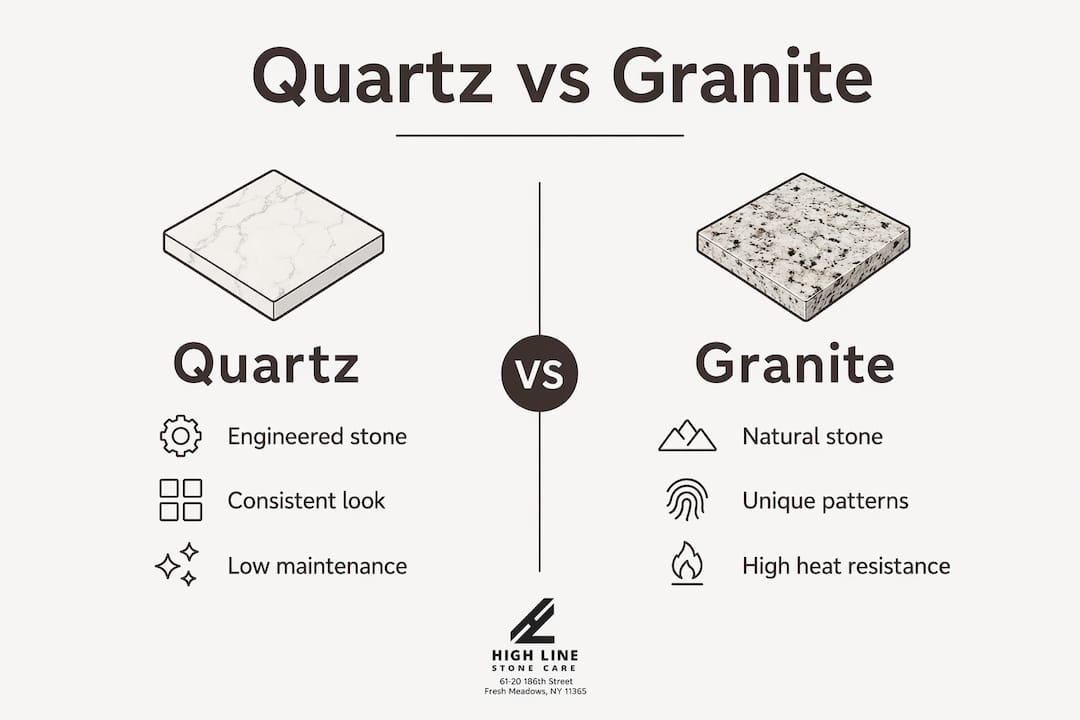
The difference between quartz and granite countertops begins with their fundamental makeup: quartz is an engineered composite, granite is a 100% natural igneous rock. Quartz consists of 90–94% ground natural quartz crystals bonded with 6–10% polymer resins and pigments, while granite forms entirely from minerals including quartz, feldspar, and mica. That single distinction drives every practical difference you will encounter, from how each surface handles a hot pan to how often you need to reseal it. Homeowners and designers who understand the granite and quartz differences before purchasing avoid costly surprises during renovation.
What are the compositional and appearance differences between quartz and granite?
Quartz and granite look similar at a glance, but their internal structures are completely different. Quartz is manufactured in controlled factory conditions, which means every slab comes out with a consistent, repeatable color and pattern. Granite is a geological artifact, meaning no two slabs are identical. Natural granite slabs require expert fabrication to match patterns across a kitchen island or long countertop run, a detail that surprises many homeowners during installation.
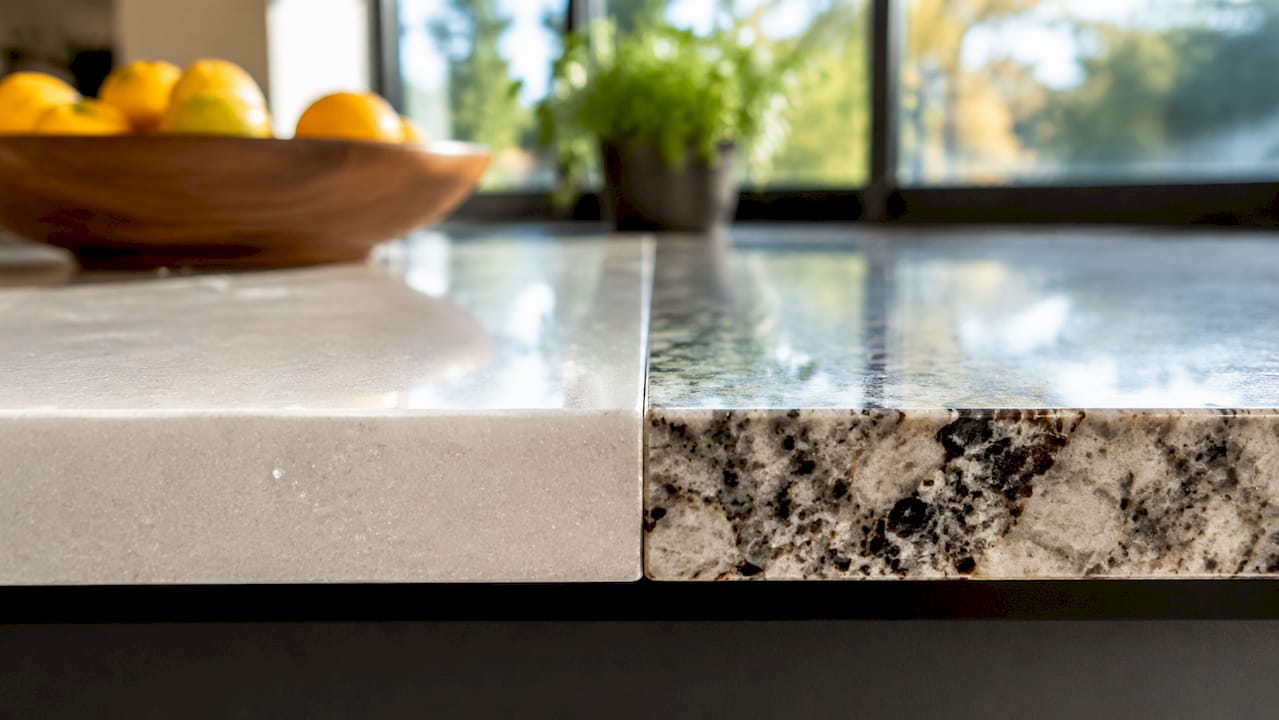
The visual implications are significant for designers. Quartz can be engineered to mimic marble veining, concrete tones, or solid colors that do not exist in nature. Granite delivers irregular veins, mineral flecks, and depth that no manufactured surface fully replicates. Both materials come in a wide range of finishes, including polished, honed, and leathered, but quartz offers a broader color palette overall.
Here is a quick breakdown of the key appearance and composition differences:
- Quartz composition: 90–94% crushed quartz crystals, 6–10% polymer resins and pigments
- Granite composition: 100% natural minerals, primarily quartz, feldspar, and mica
- Pattern consistency: Quartz is uniform and repeatable; granite is unique per slab
- Design flexibility: Quartz can be produced in colors not found in nature; granite cannot
- Finish options: Both offer polished, honed, and leathered finishes
- Mimicry: Quartz can approximate marble or other stones; granite stands on its own aesthetic
For homeowners who want a specific look repeated across multiple bathrooms or a large kitchen, quartz is the more predictable choice. For those who want a surface with genuine geological character, granite is unmatched. Understanding this distinction is the first step in any honest natural vs. engineered stone comparison.
How do quartz and granite compare in durability and heat resistance?
Heat resistance is where granite and quartz diverge most sharply. Granite handles direct heat from cookware up to approximately 1,200°F without damage, while quartz begins to scorch or crack above roughly 300°F. The polymer resins that make quartz non-porous are also its thermal weak point. A cast iron skillet pulled straight from the oven can permanently damage a quartz surface in seconds.
The damage from heat on quartz is not cosmetic. Thermal rings on quartz caused by direct heat exposure cannot be sanded out, unlike surface scratches on natural stone. That makes heat damage on quartz a permanent, irreversible problem. Granite, by contrast, absorbs and dissipates heat without structural change.
On scratch resistance, both materials perform similarly. Granite has a Mohs hardness rating of 6–7, and quartz rates comparably. However, abrasive cleaners can create micro-abrasions on quartz over time, while granite tends to hide fine surface marks better due to its natural pattern variation.
- Impact resistance: Quartz resin content provides slight flexibility, absorbing impacts better than granite and making it less prone to chipping at edges and cutouts.
- Heat tolerance: Granite is the clear winner for high-heat cooking environments. Quartz requires a trivet or heat pad for any hot cookware.
- Scratch resistance: Both rate similarly on the Mohs scale, but quartz shows micro-abrasions more visibly with harsh cleaners.
- Long-term surface integrity: Granite can develop hairline cracks from impact; quartz edges chip less but suffer permanent heat rings.
- UV resistance: Quartz should never be used outdoors because UV radiation breaks down the polymer resins, causing yellowing and fading not covered by warranties.
Pro Tip: Always keep a trivet or silicone heat pad on a quartz countertop. Placing a hot pan directly on the surface, even briefly, can cause a permanent thermal ring that no restoration service can fully reverse.
What maintenance and cleaning practices does each countertop require?
Granite is a porous natural stone, and that porosity is its primary maintenance challenge. Without proper sealing, liquids like red wine, coffee, and cooking oil penetrate the surface and cause permanent staining. Granite requires resealing every 1–2 years to maintain stain resistance, at a cost of roughly $20 per treatment. That is a modest investment, but it requires consistent attention over the life of the countertop.
Quartz requires no sealing at all. Its non-porous resin matrix blocks liquids from penetrating the surface, so daily cleaning with mild soap and water is sufficient. This is the core appeal of quartz for busy households: the surface stays stain-resistant without any periodic treatment. The tradeoff is that quartz cannot be restored the same way granite can when serious damage occurs.
Key maintenance differences to keep in mind:
- Granite sealing frequency: Every 1–2 years using a professional-grade spray-on sealant
- Granite sealing cost: Approximately $20 per bottle, sufficient for multiple treatments
- Quartz daily care: Mild dish soap and warm water; no sealants needed
- Abrasive cleaners: Avoid on both surfaces, but especially on quartz to prevent micro-abrasions
- Acidic spills: Wipe immediately on both surfaces; granite is more vulnerable without a fresh seal
Pro Tip: Use the water test to check if your granite needs resealing. Drip a few drops of water on the surface. If the water beads up, the seal is still working. If it absorbs and darkens the stone, reseal immediately.
Proper granite countertop care extends the life of the surface significantly. Sealing granite involves applying a professional-grade sealant that fills microscopic pores, then wiping it clean after a short dwell time. The process takes under 30 minutes and protects the stone for up to two years.
What are the cost considerations for quartz and granite in 2026?
Cost is one of the most searched aspects of the quartz vs. granite comparison, and the numbers are closer than most homeowners expect. Installed granite costs between $90 and $160 per square foot in 2026, while quartz runs $100 to $180 per square foot. Both materials typically account for 10–15% of a total kitchen renovation budget. Regional pricing and stone grade affect both figures significantly.
| Material | Installed cost per sq ft | Sealing required | Outdoor use |
|---|---|---|---|
| Granite | $90–$160 | Yes, every 1–2 years | Yes |
| Quartz | $100–$180 | No | No |
Quartz tends to cost slightly more upfront, but its lower maintenance expense narrows the gap over time. Granite’s periodic sealing adds a small recurring cost, but the material itself is often available at lower price points for standard grades. Premium exotic granite slabs can exceed quartz pricing considerably. For homeowners working within a defined renovation budget, mid-grade granite often delivers the most visual impact per dollar.
How does lifestyle influence the best countertop choice?
The quartz vs. granite comparison ultimately comes down to how you actually use your kitchen or bathroom. Quartz suits busy households wanting low-maintenance, consistent surfaces, while granite is preferred by serious cooks who use hot cookware frequently. Neither material is universally better. The right choice depends on your cooking habits, design goals, and willingness to perform periodic upkeep.
Here is how different lifestyle profiles map to each material:
- High-volume cooking households: Granite handles hot pans directly, making it the practical choice for serious home cooks.
- Families with young children: Quartz’s non-porous surface resists juice, sauce, and food stains without resealing.
- Outdoor kitchens and patios: Granite is the only viable option. UV radiation degrades quartz resins irreversibly outdoors.
- Design-focused renovations: Quartz offers consistent patterns ideal for matching across multiple rooms. Granite delivers one-of-a-kind character.
- Low-maintenance preference: Quartz wins clearly. No sealing, no periodic treatments, and no water testing required.
- Natural material preference: Granite is a geological product with authentic variation. For homeowners who value that uniqueness, no engineered surface competes.
Lifestyle-matched countertop selection also affects long-term satisfaction. Homeowners who choose quartz for a kitchen where they regularly cook with cast iron often regret the heat limitations. Homeowners who choose granite but dislike periodic maintenance tasks often wish they had chosen quartz. Matching the material to your actual behavior, not your aspirational behavior, is the most reliable decision framework.
Key takeaways
Granite is the superior choice for heat tolerance and natural character, while quartz delivers consistent appearance and lower maintenance across its lifetime.
| Point | Details |
|---|---|
| Composition drives everything | Quartz is engineered with resins; granite is 100% natural, and that difference shapes every other property. |
| Heat resistance favors granite | Granite withstands up to 1,200°F; quartz scorches above 300°F and the damage is permanent. |
| Quartz requires less upkeep | Quartz needs only soap and water; granite requires resealing every 1–2 years at roughly $20 per treatment. |
| Cost is comparable | Granite runs $90–$160 per sq ft installed; quartz runs $100–$180, both within 10–15% of a kitchen renovation budget. |
| Lifestyle should decide | Match the material to how you actually cook and clean, not to how you plan to cook and clean. |
What I have learned after years of working with stone surfaces
Homeowners consistently overestimate quartz’s invincibility and underestimate granite’s practicality. The phrase “low maintenance” gets applied to quartz as if it means indestructible. It does not. Quartz resists stains and requires no sealing, but it is genuinely fragile against heat and UV exposure in ways that granite simply is not. I have seen beautiful quartz countertops ruined by a single moment of carelessness with a hot pan.
Granite gets unfairly dismissed as high-maintenance. The reality is that resealing granite takes less than 30 minutes once a year or two, and the water test tells you exactly when it is needed. That is not a burden. For homeowners who cook seriously, granite’s heat tolerance is not a luxury feature. It is a functional necessity.
The misconception I encounter most often is that one material is objectively better than the other. Neither is. Quartz is the right answer for a household that wants a surface they can wipe down and forget. Granite is the right answer for a household that values natural beauty and cooks with real heat. The worst outcome is choosing based on aesthetics alone and discovering the maintenance or performance reality six months into daily use.
My honest recommendation: be honest about your cooking habits before you commit. If you regularly use cast iron, a wok, or a Dutch oven straight from the oven, choose granite. If you want a pristine, consistent surface with zero periodic treatments, choose quartz. Both are excellent materials. The difference is in the fit.
— High
How Highlinestonecare supports your stone countertops
Granite countertops deliver lasting beauty, but they need professional attention to stay that way. Highlinestonecare provides advanced stone sealing services tailored specifically for natural stone surfaces, using professional-grade sealants that fill microscopic pores and lock out stains. For granite that has already suffered etching, discoloration, or surface wear, Highlinestonecare’s restoration team can return the surface to its original finish.
For homeowners who want permanent protection without repeated sealing cycles, the Opal Luxury Anti Acid Sealer from Highlinestonecare offers a single-application solution designed to last a lifetime. It protects natural stone from acid-related surface damage and staining, making it a smart investment for any premium granite or marble surface in your home.
FAQ
What is the main difference between quartz and granite?
Quartz is an engineered composite made of 90–94% crushed quartz crystals bonded with polymer resins, while granite is a 100% natural igneous rock. That compositional difference drives all other distinctions in heat resistance, maintenance, and appearance.
Is granite stronger than quartz?
Both materials rate similarly on the Mohs hardness scale at 6–7, but granite handles heat far better, withstanding up to 1,200°F versus quartz’s 300°F threshold. Quartz edges out granite slightly on impact resistance due to its resin flexibility.
Which is better for a busy kitchen, quartz or granite?
Quartz is better for busy households that prioritize low maintenance, since it requires no sealing and resists stains from daily use. Granite is better for serious cooks who regularly use hot cookware directly on the surface.
How often does granite need to be resealed?
Granite requires resealing every 1–2 years to maintain stain resistance. The water test, where you drip water on the surface and watch whether it beads or absorbs, tells you exactly when resealing is needed.
Can quartz be used in an outdoor kitchen?
Quartz cannot be used outdoors. UV radiation breaks down the polymer resins in quartz, causing irreversible yellowing and fading that voids most manufacturer warranties. Granite is the correct choice for any outdoor kitchen application.