
Certified stone professionals are trained, accredited experts whose qualifications ensure the highest standards in stone care, making them the most reliable choice for maintaining and restoring natural stone surfaces. For homeowners and property managers, the question of why trust certified stone professionals comes down to one thing: accountability. Certification is not a formality. It represents documented proof that a contractor meets strict quality, safety, and technical standards set by recognized bodies like the Natural Stone Institute (NSI). Without that proof, you are relying on a contractor’s word alone.
Why trust certified stone professionals over uncertified contractors?
Certification in the stone care industry is defined as formal accreditation granted by the Natural Stone Institute, the leading professional body governing fabrication and installation standards in the United States. The NSI’s accreditation program has been active for nearly 20 years and is now required in 1,457 commercial project specifications nationwide. That number reflects how seriously architects, developers, and property managers treat verified credentials when specifying stone work.
The accreditation process evaluates contractors across four core areas: business practices, quality control, technical expertise, and customer service record. Each area carries weight. A contractor can be technically skilled but still fail accreditation if their business practices or safety protocols fall short. This multi-dimensional review is what separates certified stone professionals from general contractors who simply claim experience.
Nationally, there are 98 accredited stone fabricators and 23 accredited commercial installers. That relatively small number reflects how demanding the certification process is. It also means that when you find a certified professional, you are working with someone who has passed a genuinely rigorous review.
Pro Tip: Ask any stone contractor for their NSI accreditation number before signing a contract. Verified professionals will provide it without hesitation.
| Evaluation Area | What It Covers |
|---|---|
| Business practices | Licensing, insurance, and contract transparency |
| Quality control | Material sourcing, installation standards, and inspection protocols |
| Technical expertise | Stone-specific knowledge, tool proficiency, and restoration methods |
| Customer service record | Client feedback, dispute resolution, and project follow-through |
| Safety compliance | OSHA silica dust control and jobsite safety documentation |
What specialized knowledge do certified stone professionals bring?
Certified professionals identify problems that homeowners and property managers simply cannot see. Professional restoration detects hidden issues like micro-cracks and deep etching that are invisible to the untrained eye. Left unaddressed, micro-cracks allow moisture to penetrate the stone, accelerating structural degradation and staining from the inside out.
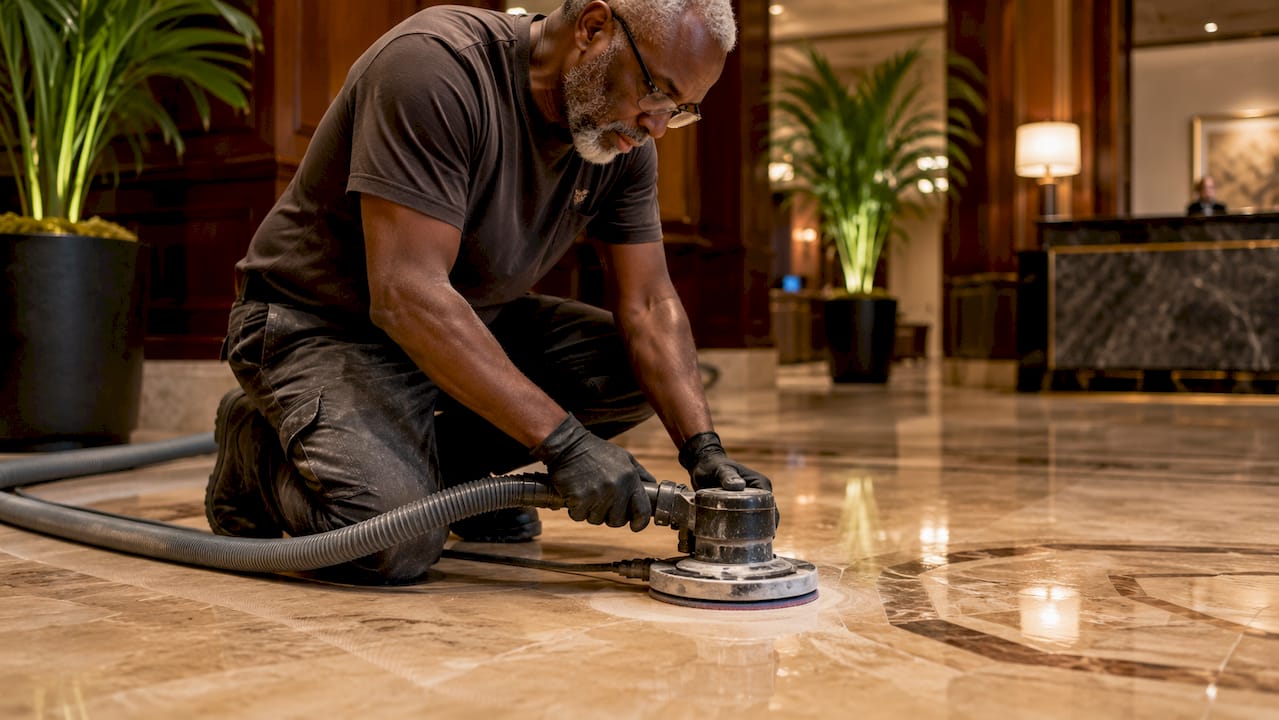
The expertise these professionals carry goes well beyond surface-level cleaning. Certified stone specialists understand the chemical composition of different stone types, including the calcium-rich structure of marble that makes it vulnerable to acid-related surface damage. They know which cleaning agents react with calcite, which sealers penetrate versus coat, and which restoration techniques restore a surface without removing too much material. That knowledge prevents the kind of irreversible damage that comes from using the wrong product on the wrong stone.
Certified professionals also build customized maintenance schedules based on the specific stone type, usage patterns, and environmental conditions in your property. A marble kitchen countertop in a high-use family home requires a different care plan than a limestone lobby floor in a commercial building. Generic maintenance advice does not account for those differences. A certified professional does.
The technical advantages of certified stone care include:
- Micro-crack detection using professional-grade inspection tools that identify subsurface fractures before they expand
- Etching assessment to distinguish surface-level dullness from deep acid damage requiring honing or polishing
- Impregnating sealer application using products formulated to penetrate the stone matrix rather than sit on top
- Controlled grinding and honing with calibrated diamond abrasives that remove damage without over-thinning the slab
- Preventative care planning that extends the life of stone surfaces and reduces the frequency of major restoration work
Professional restoration uses advanced equipment and techniques that DIY approaches cannot replicate. The gap between a rented floor buffer and a professional diamond-polishing system is not just technical. It is the difference between a surface that looks better temporarily and one that is structurally restored.
How do certified stone professionals ensure safety and regulatory compliance?
Stone work generates silica dust, and silica dust is a serious health hazard. Certified stone professionals must comply with OSHA silica dust regulations as part of their accreditation requirements. OSHA’s crystalline silica standard, which applies to construction and stone fabrication, sets strict permissible exposure limits and requires written exposure control plans on worksites. Uncertified contractors frequently skip these protocols, putting workers and building occupants at risk.
Certified professionals follow a structured safety approach on every project:
- Conduct a pre-project silica exposure assessment to identify cutting, grinding, or polishing tasks that generate respirable dust
- Implement wet methods or local exhaust ventilation to suppress dust at the source during all stone work
- Provide workers with NIOSH-approved respirators rated for crystalline silica when engineering controls alone are insufficient
- Document all safety measures in a written exposure control plan that meets OSHA’s Table 1 requirements for stone fabrication
- Conduct post-project air quality checks in enclosed spaces to confirm dust levels have returned to safe thresholds
The risk of hiring an uncertified provider is not just poor workmanship. It is potential liability for health violations on your property. Property managers in particular carry legal exposure when contractors perform work that violates OSHA standards on their premises. Certification removes that risk by guaranteeing that every professional on your project operates within documented safety protocols.
What practical benefits do homeowners and property managers gain?
Professional stone care prevents damage and increases durability in ways that extend the functional life of stone surfaces by years. That translates directly into cost savings. A homeowner who pays for professional restoration and sealing avoids the far higher cost of slab replacement when neglected stone deteriorates past the point of repair.
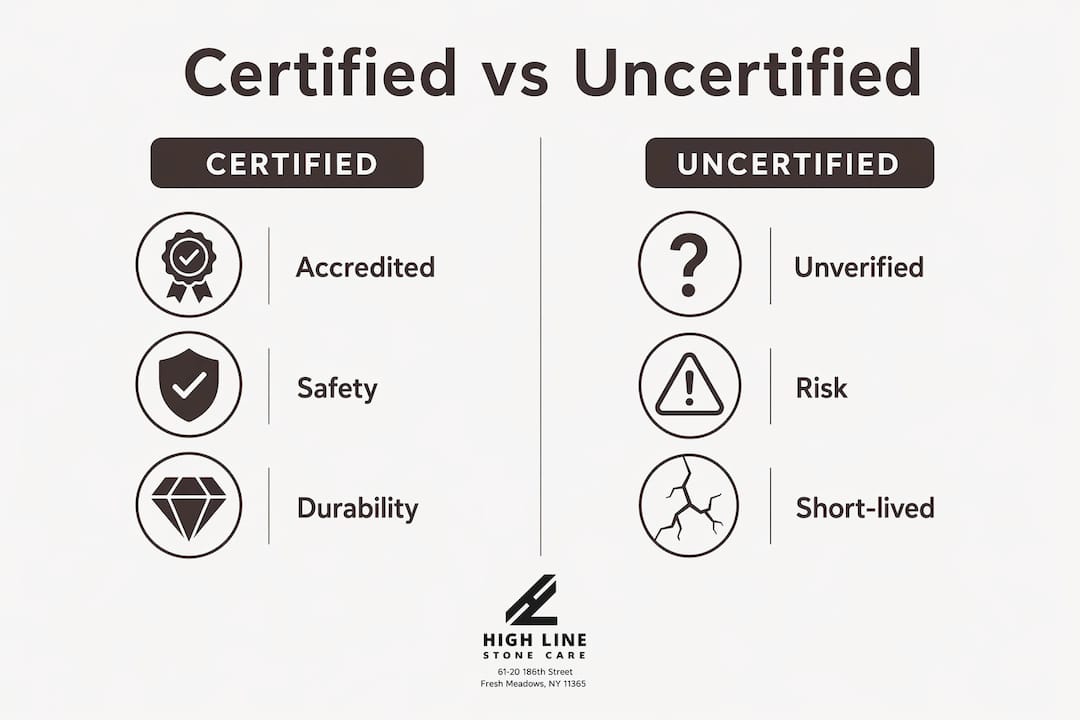
Property managers gain an additional layer of value: verified credentials they can present to building owners, insurers, and tenants. A certified professional’s work comes with documented quality control. That documentation supports property valuations, satisfies insurance requirements, and provides recourse if workmanship falls short. Uncertified work offers none of those protections.
Pro Tip: For commercial properties, request a written maintenance report after every certified service visit. That paper trail protects you during lease negotiations and property audits.
The aesthetic benefits are equally concrete. Properly restored marble or granite holds its polish longer, resists staining more effectively, and maintains the visual character that makes premium stone worth the investment. A dull patch on a marble floor or a ring near the sink signals neglected care to any prospective buyer or tenant. Certified professionals eliminate those signals before they affect property value.
For homeowners and property managers evaluating their options, the role of expert stone care extends beyond aesthetics. It is about protecting a long-term asset with the right expertise from the start.
| Approach | Outcome |
|---|---|
| Certified professional | Documented quality, safety compliance, lasting results, and warranty protection |
| Uncertified contractor | Variable quality, no safety guarantee, and no formal recourse for poor work |
| DIY maintenance | Surface-level results only, risk of irreversible damage from wrong products |
Key Takeaways
Certified stone professionals deliver measurably better outcomes than uncertified contractors because their accreditation covers safety, quality control, technical expertise, and customer service, all verified by the Natural Stone Institute.
| Point | Details |
|---|---|
| Certification means accountability | NSI accreditation covers business practices, safety, quality, and customer service, not just technical skill. |
| Hidden damage requires expert eyes | Certified professionals detect micro-cracks and deep etching that homeowners and property managers miss. |
| Safety compliance protects you | OSHA silica dust regulations apply to stone work; only certified professionals guarantee compliance on your property. |
| Professional care saves money | Proper restoration and sealing prevents premature slab failure, avoiding costly replacement. |
| Credentials support property value | Documented certified work strengthens property valuations, insurance claims, and tenant confidence. |
What I’ve learned from watching homeowners skip certification checks
The most expensive stone repairs I have seen were not caused by bad luck. They were caused by hiring the wrong person at the wrong price. A homeowner in a Manhattan co-op hired an uncertified contractor to refinish her Calacatta marble floors. The contractor used an aggressive acid wash to remove staining. The acid etched the calcium surface across the entire floor, creating a dull, uneven finish that required full honing and re-polishing by a certified team at three times the original cost.
Engaging an independent stone advisor early in a project, before contracts are signed, is the single most effective way to avoid that kind of outcome. Once the wrong product touches the stone, your options narrow fast. Certified professionals bring the knowledge to prevent those moments, not just respond to them.
The NSI’s accreditation program exists because the stone industry recognized that good intentions are not enough. Homeowners and property managers deserve professionals whose qualifications have been independently verified. Certification is that verification. Prioritizing it is not overcautious. It is the most practical decision you can make when protecting a surface that cannot be easily replaced.
— High
Highlinestonecare’s certified stone care for your property
Highlinestonecare brings certified expertise and advanced restoration techniques to homeowners and property managers across New York City who want lasting results, not temporary fixes.
Highlinestonecare’s team applies professional-grade stone restoration services to marble, granite, limestone, and other natural stone surfaces, backed by rigorous quality standards. For properties where marble protection is the priority, the Opal Luxury Anti Acid Sealer provides permanent defense against etching and staining from a single application. Property managers overseeing multiple stone surfaces can also benefit from Highlinestonecare’s commercial stone maintenance programs, designed to maintain consistent quality across high-traffic areas. Every service is delivered by professionals whose credentials and methods meet the standards this article describes.
FAQ
What is the Natural Stone Institute accreditation program?
The Natural Stone Institute’s accreditation program is a formal certification process that evaluates stone fabricators and installers across safety, quality control, business practices, and technical expertise. It has been active for nearly 20 years and is required in 1,457 commercial project specifications nationwide.
How does certification protect homeowners from poor stone work?
Certification requires contractors to meet documented standards for quality and safety before they work on your property. It provides a verified record of competence and gives homeowners formal recourse if workmanship falls short of those standards.
Why do certified stone professionals handle silica dust differently?
OSHA regulations require strict silica dust control during stone cutting, grinding, and polishing. Certified professionals implement written exposure control plans, wet suppression methods, and approved respirators, protocols that uncertified contractors routinely skip.
Can a certified professional restore stone that has already been damaged?
Certified professionals detect and address micro-cracks, deep etching, and staining that DIY methods cannot fix. Professional honing, grinding, and sealing can restore surfaces that appear beyond repair to homeowners.
How often should certified stone professionals inspect high-use stone surfaces?
Inspection frequency depends on stone type and usage. High-traffic commercial stone floors typically benefit from professional assessment every six to twelve months, while residential marble surfaces in moderate use may need annual professional evaluation and maintenance.
Recommended
- The Role of Experts in Stone Care for Homeowners
- Stone Care Services – Highline Stone Care
- Stone Repair Staten Island | Trusted Specialists – Highline Stone Care
- Stone Repair NYC | Expert Stone Restoration & Surface Repair Services