
Natural stone in interiors is defined as the use of quarried geological materials, including marble, granite, limestone, sandstone, and slate, as functional and decorative surfaces within built spaces. The history of natural stone in interiors stretches back more than 4,000 years, from the limestone corridors of Egyptian pyramids to the polished marble floors of contemporary Manhattan penthouses. This material has never been merely structural. It has always carried meaning, status, and aesthetic intent. Understanding that continuity helps homeowners and design professionals make more informed decisions about the stone surfaces they choose, preserve, and restore today.
How ancient civilizations shaped the history of natural stone in interiors
Ancient Egyptians pioneered large-scale stone use in monumental interiors, cutting limestone and sandstone into the walls and chambers of pyramids and palace complexes. These were not decorative choices alone. Stone was selected because it communicated permanence, a quality that aligned with Egyptian beliefs about the afterlife and divine authority. The material’s durability made it the only logical choice for spaces meant to last eternity.
Greek builders took that foundation further by introducing marble as a refined interior surface. The Parthenon’s interior columns and the cella walls of major temples used Pentelic marble, a white stone quarried from Mount Pentelicus near Athens. Greek craftsmen developed polishing techniques that revealed the stone’s natural veining, turning a structural material into a visual statement.
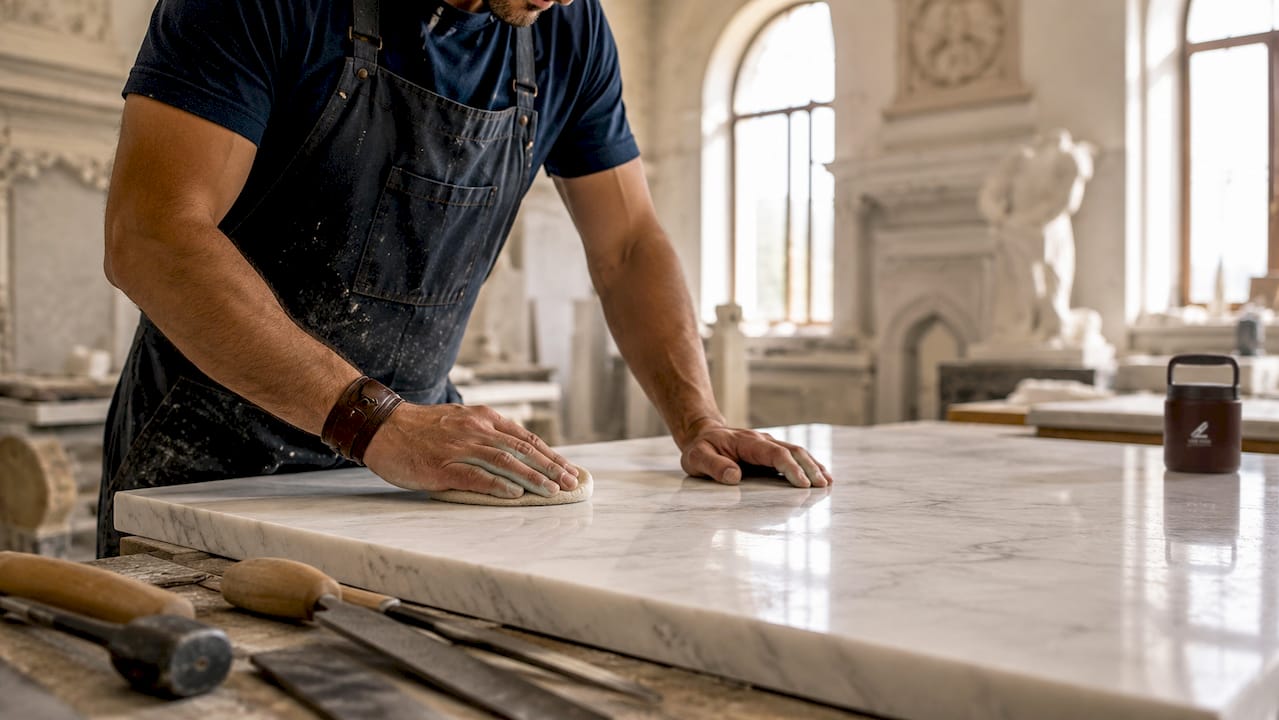
Rome transformed stone use from the monumental to the personal. Roman imperial monuments in the 1st century BCE primarily used Carrara marble, but by the 3rd century CE, Proconnesian marble became more prevalent due to economic and logistical factors. That shift reveals something important: even in antiquity, supply chains shaped design. Roman builders were pragmatic as much as they were ambitious.
The Romans also brought stone indoors in a way no civilization had done before. Private Roman residences used miniature monumentalization, incorporating the same imperial marbles found in public buildings to simulate grandeur within domestic spaces. A wealthy Roman citizen could walk across the same Proconnesian marble in his dining room that lined the floors of a public basilica. Stone became a private language of public power.
- Egyptian builders used limestone and sandstone for structural and symbolic purposes in pyramid interiors
- Greek craftsmen introduced polished Pentelic marble as a refined surface in temple interiors
- Roman architects sourced Carrara and later Proconnesian marble for both public monuments and private homes
- The import of exotic stones like Egyptian porphyry demonstrated imperial mastery through logistics and rarity
- Stone interiors in Rome directly communicated the owner’s social rank and political connections
Pro Tip: When restoring a historic interior with marble or limestone, research the original quarry source. Matching the geological origin of the stone preserves both visual continuity and material authenticity.
What material properties made certain stones the preferred choice?
Natural stone varieties including marble, granite, limestone, sandstone, and slate each carry distinct physical properties that determined where and how they were used indoors. Those properties were not incidental. They drove every major design decision across centuries.
| Stone type | Key properties | Historical interior use |
|---|---|---|
| Marble | Low porosity, high polish, calcium-based | Floors, columns, wall cladding in temples and palaces |
| Granite | Extreme hardness, coarse grain, acid-resistant | Thresholds, load-bearing elements, countertops |
| Limestone | Moderate porosity, warm tone, workable | Wall blocks, decorative carving, fireplace surrounds |
| Sandstone | High porosity, earthy color, soft texture | Interior wall facing, decorative panels |
| Slate | Fine grain, natural cleft surface, water-resistant | Flooring, roof transitions, wet area surfaces |
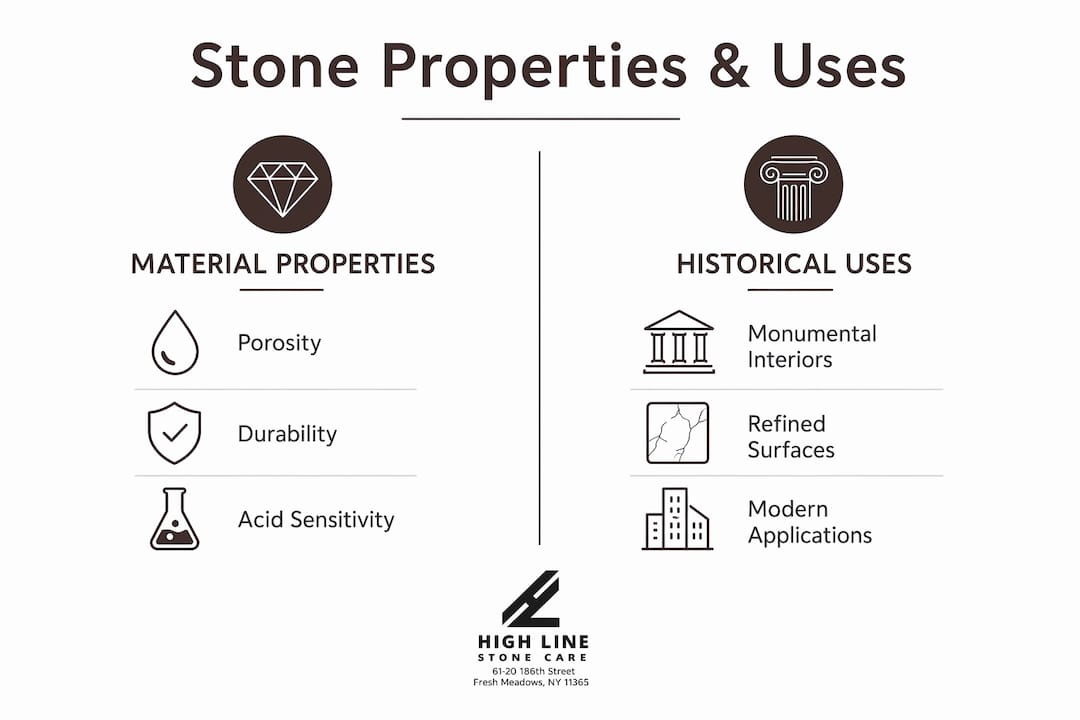
Marble’s calcium carbonate composition makes it responsive to acid, which is why etching from spilled wine or citrus juice appears as a dull patch on an otherwise polished surface. That vulnerability was less relevant in ancient temples than it is in a modern kitchen, but the chemistry has not changed. Granite’s silicate structure makes it far more resistant to acid-related surface damage, which explains its dominance in high-use countertop applications today.
Marmara Marble, quarried from the island of Proconnesus in the Sea of Marmara, deserves specific attention. Marmara Marble has been continuously used from Roman to Ottoman periods and remains part of modern restoration and cultural memory projects in Istanbul. Its consistent white color with fine gray veining made it the preferred material for large-scale interior surfaces where visual unity mattered. The stone’s compliance with ASTM and ISO dimensional standards in modern restoration work confirms that ancient quarrying intuitions align with contemporary engineering requirements.
For homeowners selecting natural stone types for their interiors, understanding porosity is the single most practical consideration. High-porosity stones like sandstone absorb liquids quickly and require more frequent sealing. Low-porosity stones like granite and dense marble resist staining but still need protection from acid etching.
How did stone use evolve from antiquity to the modern era?
The evolution of stone in interiors follows a clear arc: from load-bearing structural material to thin decorative surface. That shift reflects both technological progress and changing architectural priorities.
-
Ancient and classical period. Stone served as the primary structural and surface material simultaneously. Walls were stone. Floors were stone. The material carried the building’s weight and defined its appearance.
-
Medieval and Renaissance period. Stone remained structural in cathedrals and civic buildings, but craftsmen began treating it as a distinct decorative layer. Italian Renaissance interiors used pietra dura, an inlay technique combining colored stones into pictorial compositions on floors and furniture surfaces. This marked the first clear separation between stone as structure and stone as art.
-
18th and 19th centuries. Industrial quarrying expanded access to marble and granite beyond royal and ecclesiastical patrons. Grand European hotels and American Gilded Age mansions installed marble lobbies and granite staircases as signals of institutional prestige. Stone became aspirational for the emerging wealthy class.
-
20th century. Modernist architects like Mies van der Rohe used large slabs of onyx and travertine as feature walls, treating stone as a pure visual plane rather than a structural element. The Barcelona Pavilion’s onyx wall is the definitive example of stone used for its optical qualities alone.
-
Contemporary era (2026). The construction industry now favors lightweight, adaptable stone veneer cladding over heavy stone masonry. Structural weight requirements have dropped from 2.5 t/m to 0.25 t/m, enabling thin stone panels on surfaces that could never support traditional masonry. CNC machining and advanced polishing allow more intricate stone interior features at lower production costs. Stone is now accessible to a wider range of interiors without sacrificing authenticity.
The shift from load-bearing walls to cladding and surfacing represents a permanent change in how architects and designers think about stone. It is no longer a building block. It is a skin, chosen for what it communicates as much as what it does.
What cultural meanings has natural stone carried in interior spaces?
Stone has never been a neutral material. Every culture that used it indoors assigned it meaning beyond its physical properties.
In Rome, the presence of exotic imported stone in a private home was a direct political statement. The import of monolithic stones like Egyptian porphyry involved complex logistics that only the imperial administration could coordinate. When a private citizen displayed porphyry in his home, he was borrowing imperial authority. The stone itself was the message.
Religious architecture used stone’s natural patterns as cosmological symbols. The fluid veining of Marmara Marble in Hagia Sophia was read by Byzantine worshippers as a visual representation of divine order flowing through the material world. The stone was not just beautiful. It was theologically intentional.
“Natural stone carries the memory of geological time, cultural ambition, and human craft simultaneously. No manufactured material replicates that layered meaning. When you install stone in an interior, you are placing a piece of the earth’s history inside a human space.”
Contemporary design narratives have added a new layer of meaning to stone interiors. Architects in 2026 value transparency from quarry to installation as a core principle of sustainable design. The origin of the stone, the conditions of its extraction, and its carbon footprint are now part of the material’s story. Authenticity and ecological responsibility have become as important as color and texture in the selection process.
- Imperial associations: exotic stone in private Roman homes signaled access to imperial supply chains
- Religious symbolism: veined marble in Byzantine churches represented divine order and cosmic harmony
- Permanence and legacy: stone interiors in private homes communicated a family’s intention to endure
- Contemporary identity: natural vs. engineered stone debates reflect a broader cultural preference for authentic, traceable materials
- Ecological responsibility: ethical sourcing has become a core part of stone’s cultural meaning in modern design
Stone interiors contribute to home value by providing durability, timeless appeal, and a connection to cultural heritage. That combination of practical and symbolic value explains why stone has outlasted every design trend of the past four millennia.
Key Takeaways
Natural stone’s enduring role in interiors is defined by its unique combination of geological permanence, cultural symbolism, and material versatility across every major design era.
| Point | Details |
|---|---|
| Ancient origins | Egyptians, Greeks, and Romans established stone as the primary material for status-driven interior spaces. |
| Material properties matter | Porosity, hardness, and acid sensitivity determine where each stone type performs best indoors. |
| Structural to decorative shift | Stone evolved from load-bearing walls to thin veneer cladding, expanding its design applications significantly. |
| Cultural symbolism | Stone has carried meanings of power, spirituality, and permanence across every civilization that used it. |
| Modern relevance | Ethical sourcing and CNC technology have made natural stone more accessible and culturally meaningful in 2026. |
Why stone’s story is far from finished
Working with natural stone every day, I have come to believe that most people underestimate how much history they are managing when they own a stone interior. A marble floor in a Manhattan apartment is not just a surface. It is a material that connects the owner to a 4,000-year tradition of human beings choosing stone to express what matters to them.
The challenge I see most often is that owners treat stone as maintenance-free because it looks permanent. It is not. Marble etches. Limestone absorbs. Even granite, the most forgiving of the common interior stones, needs attention over time. The permanence of stone is geological, not domestic. In a kitchen or bathroom, it faces acids, moisture, and abrasion every day.
What gives me confidence about the future of stone interiors is the combination of better protection technology and growing appreciation for authentic materials. Homeowners who understand the aesthetics of luxury stone care make better decisions about both selection and maintenance. They choose stone for the right reasons and protect it with the right methods.
The ethical sourcing trend is also genuinely encouraging. When designers specify stone with full quarry transparency, they are extending the material’s cultural story rather than interrupting it. That is the right direction for an industry built on a material that has always been about meaning as much as beauty.
— High
Protecting the stone you have invested in
Natural stone surfaces represent centuries of design wisdom brought into your home or property. Preserving that investment requires more than routine cleaning.

Highlinestonecare specializes in advanced stone restoration and protection for marble, granite, limestone, and other natural stone surfaces across New York City. The Opal Premium Anti-Acid Sealer provides permanent protection against etching and staining, with a single application designed to last a lifetime. For homeowners and property managers who want to protect their stone without compromise, the Opal Luxury Anti-Acid Sealer is the definitive solution. Highlinestonecare’s team brings rigorous expertise and a satisfaction guarantee to every project, from historic marble floors to contemporary granite countertops.
FAQ
What is the oldest known use of natural stone in interiors?
Ancient Egyptians used limestone and sandstone in pyramid chambers and palace interiors more than 4,000 years ago, making these among the earliest documented examples of stone as an interior material.
Why did Roman builders switch from Carrara to Proconnesian marble?
By the 3rd century CE, Proconnesian marble replaced Carrara marble in Roman imperial monuments primarily due to economic and logistical advantages, as centralized quarrying from the Sea of Marmara proved more efficient at scale.
What makes marble more vulnerable than granite in interior use?
Marble is composed of calcium carbonate, which reacts with acids and causes etching, while granite’s silicate structure resists acid-related surface damage, making granite the more durable choice for high-use surfaces like kitchen countertops.
How has technology changed natural stone use in modern interiors?
CNC machining and advanced polishing techniques now allow thinner, more intricate stone panels, and structural weight requirements have dropped significantly, enabling stone veneer cladding on surfaces that could never support traditional masonry.
Does natural stone increase property value?
Natural stone is recognized as a lasting upgrade that combines visual appeal with durability and cultural heritage, and it positively affects property value in residential and commercial settings alike.
Recommended
- Natural stone types for NYC homes: features, care, and selection
- Natural Stone Patina Explained for Homeowners
- Natural vs. Engineered Stone: What Homeowners Must Know