
Most stains on natural stone come from liquids, oils, iron, or biological matter that penetrate the stone’s pores and leave residue behind. The single most important thing you can do after a spill is blot it immediately with a soft cloth. Do not wipe, which spreads the liquid and drives it deeper into the surface. The Natural Stone Institute distinguishes between true stains (absorbed substances that discolor from within) and etching (a chemical reaction on calcium-based stones caused by acids). Both look like damage, but they require completely different fixes. For homeowners with marble, limestone, or travertine, understanding that difference is the starting point for every good decision that follows.
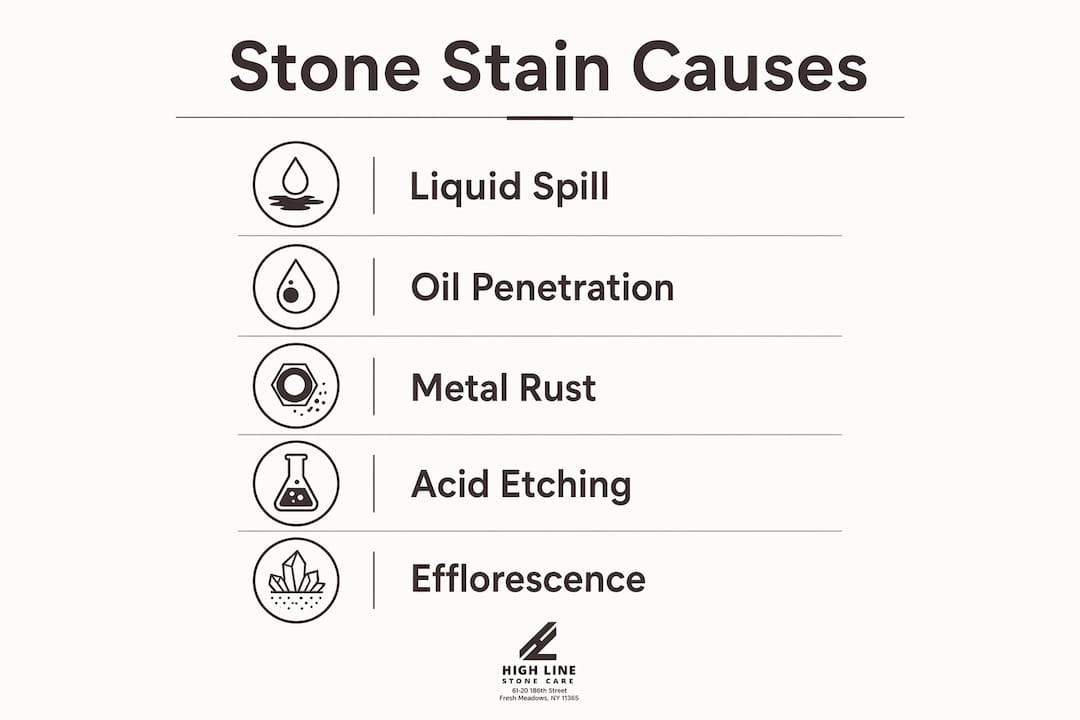
The main causes of stone stains at a glance:
- Liquids absorbed into porous stone: cooking oil, wine, coffee, tea, fruit juice
- Iron oxidation: rust from metal objects, fertilizer, or rusty water runoff
- Biological growth: mold, algae, and mildew in damp areas
- Dyes, inks, and paints that penetrate open pores
- Mineral salts drawn to the surface by moisture (efflorescence)
Highlinestonecare’s Opal Luxury Anti Acid Sealer offers homeowners a permanent protection option that goes beyond standard sealers, defending calcite-based surfaces against both staining and acid-related surface damage.
Table of Contents
- What causes stone stains and how does discoloration form?
- What are the most common types of stone stains?
- How do you tell a stain from an etch?
- What should you do immediately after a spill?
- How do you remove stone stains at home safely?
- When should you call a professional?
- How can you prevent stone stains going forward?
- What do industry pros recommend about sealers and anti-etch protection?
- Key Takeaways
- The case for treating prevention as the primary strategy
- Highlinestonecare restores, protects, and keeps your stone looking its best
- Sources and further reading
What causes stone stains and how does discoloration form?
Natural stone is porous. Even polished marble or honed granite contains a network of microscopic pores and channels, and any liquid that contacts the surface long enough will begin to move into that network through capillary action. Think of it the way a paper towel draws up water: the stone pulls the liquid inward, and when the liquid evaporates or dries, whatever was dissolved or suspended in it stays behind. That residue is the stain.
The core mechanisms:
- Absorption: Liquids carry pigments, oils, or dissolved minerals into the pore network. The deeper the penetration, the harder the stain is to remove.
- Oil infiltration: Cooking oil, butter, and cosmetics don’t carry strong pigment, but they darken the stone by filling pores with a substance that changes how light reflects. The result is a dark, greasy-looking patch.
- Oxidation: Iron particles in the stone itself, or iron deposited by metal objects and fertilizers, react with oxygen and moisture to form rust-colored iron oxides. These appear as orange-brown stains that follow the outline of whatever metal object caused them.
- Biological growth: Mold, algae, and mildew colonize damp stone surfaces and leave greenish, black, or pinkish discoloration.
- Dye/pigment penetration: Ink, paint, and strongly pigmented liquids like red wine deposit color directly into open pores.
Staining vs. etching: a critical distinction
| Mechanism | What happens | Visual result | Tactile result |
|---|---|---|---|
| Staining | Substance absorbs into pores | Darker patch, color change | No texture change |
| Etching | Acid dissolves calcium carbonate at the surface | Dull, whitish mark | Rough or matte feel |
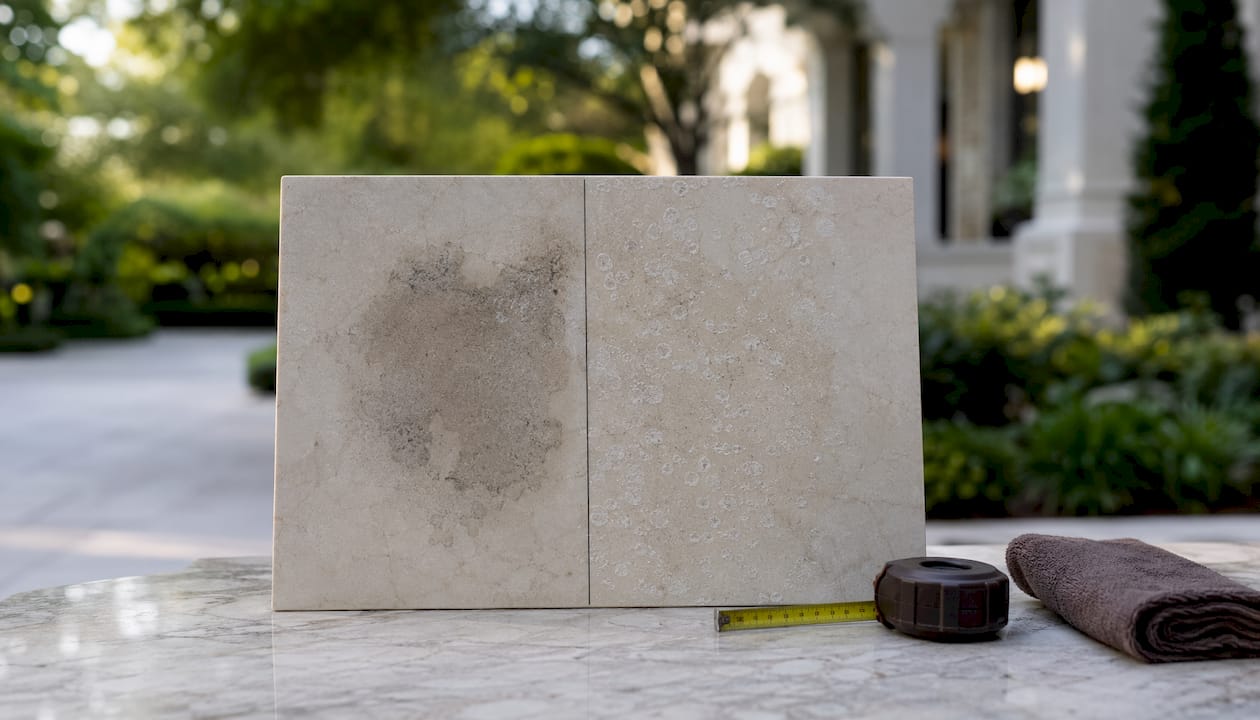
Etching is surface corrosion, not absorption. A poultice will not fix it. Repolishing or professional refinishing is the correct remedy. This distinction matters because marble, limestone, and travertine are all calcite-based and highly vulnerable to both mechanisms simultaneously.
What are the most common types of stone stains?
Knowing what you’re looking at speeds up the right response. Below is a practical catalog organized by stain category.
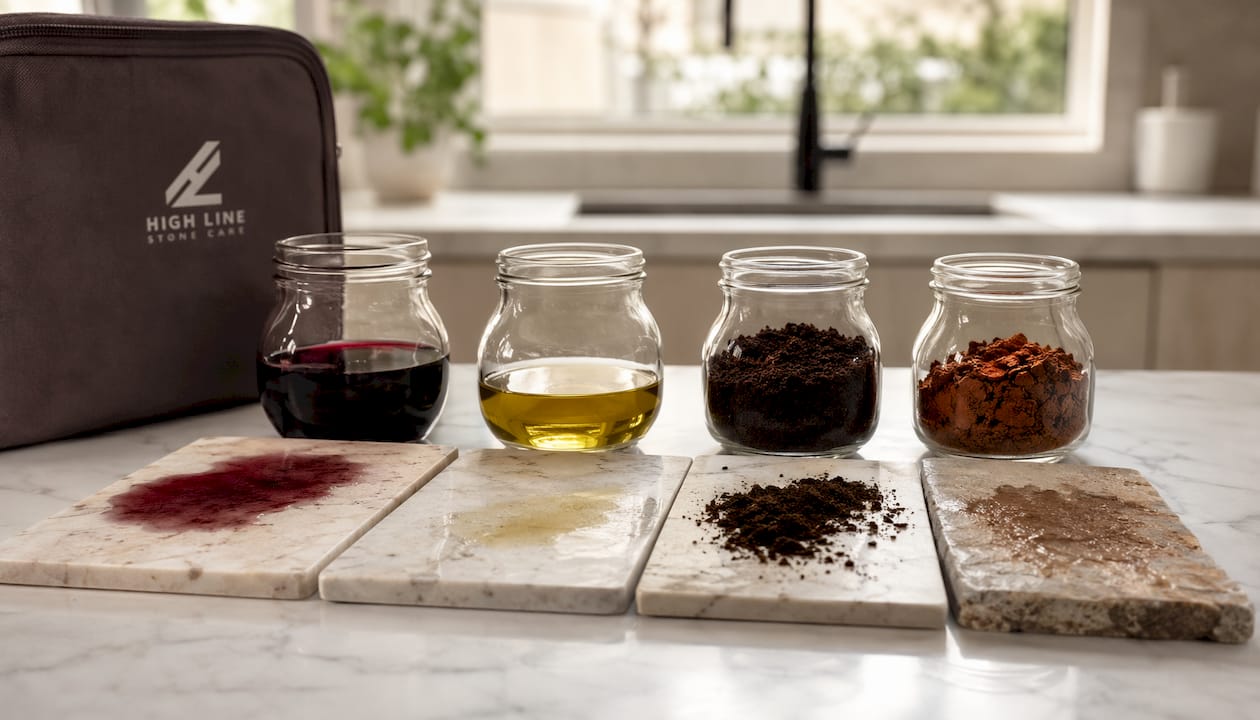
| Stain type | Common culprits | Typical color/appearance | Most vulnerable stone families |
|---|---|---|---|
| Oil-based | Cooking oil, butter, cosmetics, grease | Dark, greasy patch; no sharp edge | Marble, limestone, travertine, granite |
| Organic | Coffee, tea, wine, fruit juice, food | Yellow to brown; may fade with light | Marble, limestone, travertine |
| Water/mineral | Hard water, efflorescence | White rings, white powder | All porous stones |
| Metal (rust/iron) | Metal furniture, garden cans, fertilizer, rusty water | Orange to reddish-brown | Marble, limestone, granite |
| Metal (copper/bronze) | Bronze planters, copper pipes | Greenish to muddy-brown | Marble, limestone |
| Biological | Mold, algae, mildew | Black, green, or pinkish patches | All stones in damp areas |
| Dyes/ink/paint | Ink, markers, paint, hair dye | Vivid color matching the source | All porous stones |
A few points worth noting for specific stone families:
- Marble, limestone, and travertine are calcite-based. They stain readily because of their porosity and etch immediately on contact with acids. They need the most careful daily management.
- Granite has lower porosity than marble but is not impervious. Oil and dark liquids can still penetrate unsealed granite over time.
- Soapstone resists acid etching but will darken with oil absorption, which many owners actually treat with mineral oil to even out the color.
Efflorescence deserves special mention. It appears as a white powder on the surface, often on new installations or in areas with moisture intrusion. It is not a stain from an external substance but mineral salts migrating outward with water. Dusting it off is the right first step; washing it with water temporarily hides it and can worsen the underlying moisture issue.
Metal stains from iron and rust are among the most stubborn. Orange-brown marks that follow the shape of a planter, a can, or a piece of furniture are a reliable indicator. Copper and bronze leave a distinctly greenish residue.
How do you tell a stain from an etch?
Getting this right before you reach for any cleaner saves you from making the damage worse. Two quick checks work for most situations.
- Visual check: Stains are typically darker than the surrounding stone. Etches are lighter or dull, often appearing whitish or hazy. A dull ring near the sink after a lemon squeeze is almost certainly an etch, not a stain.
- Tactile check: Run a clean fingertip lightly over the mark. A stain leaves the surface texture unchanged. An etch feels rough, matte, or slightly gritty compared to the polished stone around it.
- Water test: Dab a small amount of distilled water on the mark and let it sit for 30 seconds. If the mark darkens slightly and then lightens as the water evaporates, you likely have a stain. If the mark looks the same wet or dry and feels rough, it is an etch.
- Mild soap rinse: Apply a small amount of pH-neutral stone cleaner with a damp cloth. If some color lifts, the mark has a staining component. If nothing changes and the surface still feels rough, etching is the primary issue.
Critical warning: Never apply vinegar, lemon juice, or any acidic solution to test whether a mark is an etch. On marble, limestone, or travertine, that test creates a new etch immediately. The Natural Stone Institute is explicit: acidic and caustic household cleaners damage stone finishes and should never be used on calcite-based surfaces.
What should you do immediately after a spill?
Speed matters more than the specific cleaner you reach for. The longer a liquid sits, the deeper it travels into the pore network.
Do:
- Blot the spill with a soft cloth or paper towel. Press down firmly and lift straight up; do not drag the cloth across the surface.
- Flush the area with plain water if the stone is not calcite-based, or if the spill was not acidic. Then dry thoroughly.
- Follow up with a pH-neutral stone cleaner when available.
- Work from the outside edge of the spill inward to avoid spreading it.
Don’t:
- Wipe or scrub, which spreads the liquid and pushes it further into the pores.
- Use lemon juice, vinegar, or any household cleaner with an acidic pH on marble, limestone, or travertine.
- Use bleach-and-ammonia combinations. Mixing these two creates toxic gas and can damage stone finishes.
- Leave any liquid sitting while you look for a cleaner.
Pro Tip: Keep a small stone-care kit in your kitchen and bathroom: two or three soft microfiber cloths, a bottle of pH-neutral stone cleaner, and a small bottle of distilled water. Having these within reach means you can respond in under a minute, which is often the difference between a surface stain and a deep one.
For more guidance on protecting your countertops day to day, protecting stone countertops covers the full routine.
How do you remove stone stains at home safely?
Not every stain requires a professional. For fresh or moderate stains, the right chemistry applied correctly can draw the contaminant out of the stone.
What is a poultice and how do you use one?
A poultice is a paste that combines an absorbent base (such as diatomaceous earth, kaolin clay, or white flour) with a chemical agent chosen to dissolve the specific stain type. The paste is applied over the stain, covered with plastic wrap, and left to dry. As it dries, it draws the dissolved contaminant out of the stone and into the paste. The correct chemistry is what makes it work; the wrong chemical can trap the stain or damage the finish.
Step-by-step poultice method:
- Clean the surface with a pH-neutral cleaner and dry completely.
- Mix the absorbent base with the appropriate chemical agent to a peanut-butter consistency.
- Apply the paste about ¼ inch thick over the stain, extending slightly beyond its edges.
- Cover with plastic wrap and tape the edges to slow drying.
- Leave in place for 24–48 hours.
- Remove the plastic, allow the poultice to dry fully, then scrape it off gently with a plastic scraper.
- Rinse with distilled water and dry. Repeat if the stain has lightened but not fully cleared.
Stain type to cleaner map
- Oil-based stains: Solvent-based poultice using acetone or mineral spirits as the chemical agent.
- Organic stains (coffee, wine, tea): Hydrogen peroxide-based poultice. For light-colored stones, 12% hydrogen peroxide (hair-bleaching strength) with a few drops of ammonia is the industry-standard starting point.
- Rust/iron stains: Specialized iron-removal poultice with a chelating agent. Do not use standard acidic rust removers on calcite stones.
- Biological stains: Diluted hydrogen peroxide or a stone-safe antimicrobial cleaner.
| Stain type | Recommended agent | Strength (DIY) | Notes |
|---|---|---|---|
| Organic (coffee, wine) | Hydrogen peroxide + ammonia | 12% (hair-bleaching grade) | For light stones only; test first |
| Oil/grease | Acetone or mineral spirits | Standard hardware grade | Ventilate well; avoid open flame |
| Rust/iron | Chelating iron-removal poultice | Per product label | Avoid acids on calcite stones |
| Professional organic removal | Hydrogen peroxide | 30 volume | Requires PPE; not for DIY use |
Warnings:
- Never use acidic cleaners on marble, limestone, or travertine, even for rust stains.
- Never mix bleach and ammonia.
- Always test in an inconspicuous area first.
- Incorrect DIY chemistry can set a stain permanently or damage the finish enough to require professional repolishing.
When should you call a professional?
Some situations are beyond what a careful homeowner can safely address. Recognizing them early prevents a manageable problem from becoming a costly one.
Call a professional when:
- The stain is old or has been treated unsuccessfully more than once.
- Rust stains won’t respond to a specialized poultice after two applications.
- Etching covers a visible or large area of the surface.
- You see widespread discoloration that suggests deep absorption or a moisture issue.
- The stone is high-value (a marble kitchen island, a luxury lobby floor) and the risk of DIY damage outweighs the cost of professional treatment.
Professionals bring industrial-strength poultices, controlled chemical stripping, and mechanical repolishing equipment that simply aren’t available at the consumer level. For etching specifically, stone polishing is the correct remedy, not a poultice. Pros can also apply advanced protections like Opal Luxury Anti Acid Sealer after restoration to prevent recurrence.
Expected outcomes vary by stain type. Organic and oil stains respond well to professional treatment in most cases. Deep rust stains may require resurfacing if the iron has oxidized within the stone’s crystal structure. Etching across a polished marble floor typically requires full mechanical repolishing to restore the original finish.
For a clearer picture of when restoration becomes necessary, signs your stone needs restoration walks through the key indicators.
How can you prevent stone stains going forward?
Prevention is far less expensive than restoration. A consistent routine reduces the risk of both staining and etching significantly.
Sealing:
- Apply an impregnating sealer to reduce liquid absorption. Properly sealed stone resists most common stains, but sealing does not prevent acid etching on calcite stones. The Natural Stone Institute recommends re-sealing at least annually or biennially for optimal protection.
- For calcite-based surfaces in high-use areas, consider an advanced anti-acid protection layer in addition to a standard sealer.
Daily care checklist:
- Use pH-neutral stone cleaner for all routine cleaning. Avoid anything with lemon, vinegar, or bleach.
- Blot spills immediately; never let liquids sit.
- Use trivets under hot pots and coasters under glasses, especially anything containing citrus or alcohol.
- Avoid abrasive scrubbing pads, which scratch polished surfaces.
- Dry stone surfaces after cleaning rather than letting them air-dry, which can leave mineral deposits.
Supplies to keep on hand:
- pH-neutral stone cleaner (spray or concentrate)
- Soft microfiber cloths (several)
- Distilled water
- Absorbent poultice powder or pre-mixed poultice for emergencies
- Professional contact information for stubborn stains
For a complete routine, maintaining marble surfaces properly covers the full schedule.
What do industry pros recommend about sealers and anti-etch protection?
The most common mistake homeowners make is assuming their sealer handles everything. It does not.
Impregnating sealers work by partially filling the pore network, which slows liquid absorption and gives you more time to blot a spill before it penetrates. They are effective and worth applying. But sealers do not prevent acid etching on calcite stones. A sealed marble countertop will still etch immediately if lemon juice or vinegar contacts it, because etching is a chemical reaction at the surface, not an absorption event.
Advanced anti-acid sealers and permanent protective films represent a distinct category of protection. They act as a physical or chemically resistant barrier on the stone’s surface, providing a level of defense against acid damage that standard impregnating sealers cannot offer. These are particularly recommended for:
- Marble and limestone kitchen islands and countertops
- High-use bathroom vanities with marble or travertine
- Luxury lobby floors and commercial stone surfaces
- Any calcite-based surface where acidic spills are routine
Common homeowner mistakes and corrections:
- Confusing etches for stains: Attempting a poultice on an etch wastes time and can introduce moisture that worsens the surface. Run the tactile test first.
- Using vinegar or lemon as a cleaner: These are acids. On marble or limestone, they etch the surface on contact. Use only pH-neutral products.
- Assuming one sealer application lasts indefinitely: Most impregnating sealers require reapplication annually or biennially depending on use and stone type.
- Skipping professional maintenance: Deep cleaning and re-sealing by a professional catches problems before they become permanent.
“Sealers are often overtrusted: impregnating sealers reduce liquid penetration but provide no defense against acid etching. For high-use, high-risk surfaces, professionals recommend anti-acid barriers as the next level of protection.” — Natural Stone Institute guidance
For a deeper look at protecting stone from acid damage, the mechanisms and product options are covered in detail.
Key Takeaways
Most stone stains form when liquids, oils, or iron penetrate porous stone; the single most effective protection combines immediate spill response with professional sealing and, for calcite stones, anti-acid barrier protection.
| Point | Details |
|---|---|
| Blot, don’t wipe | Blotting immediately after a spill limits how deep a liquid penetrates the pore network. |
| Stain vs. etch | Stains darken the stone with no texture change; etches leave a dull, rough mark requiring repolishing, not a poultice. |
| Sealers have limits | Impregnating sealers reduce absorption but do not prevent acid etching on marble, limestone, or travertine. |
| Call a pro for deep or old stains | Rust that won’t budge, widespread etching, or high-value surfaces warrant professional treatment to avoid permanent damage. |
| Highlinestonecare’s Opal Luxury Anti Acid Sealer | Offers permanent anti-acid protection for calcite surfaces, going beyond what standard sealers provide. |
The case for treating prevention as the primary strategy
Most of the stone damage seen in NYC homes and luxury properties could have been avoided with two things: a faster spill response and a more honest understanding of what a sealer actually does. The industry has done a reasonable job explaining that stone needs sealing. It has done a less thorough job explaining that sealing and acid protection are not the same thing.
Homeowners who invest in high-quality marble or limestone deserve to know that a standard impregnating sealer leaves their surface fully exposed to the one category of damage that is hardest to reverse: etching from everyday acids. Lemon from a cutting board, a splash of wine, a drop of vinegar-based salad dressing. These are not unusual events. They are Tuesday.
The practical recommendation is this: treat spill response as a daily habit, schedule professional maintenance at least once a year, and for any calcite-based surface that sees regular use, ask a professional specifically about anti-acid protection, not just sealing. The cost of a professional application is a fraction of the cost of resurfacing a marble countertop or repolishing a lobby floor.
Highlinestonecare restores, protects, and keeps your stone looking its best
Stone damage is rarely one problem. A marble countertop that looks dull may have both etching and oil staining, and each requires a different treatment. Highlinestonecare’s team works across New York City providing stain removal, rust extraction, mechanical repolishing for etched surfaces, and application of the Opal Luxury Anti Acid Sealer for homeowners who want lasting protection against the acids that standard sealers miss.
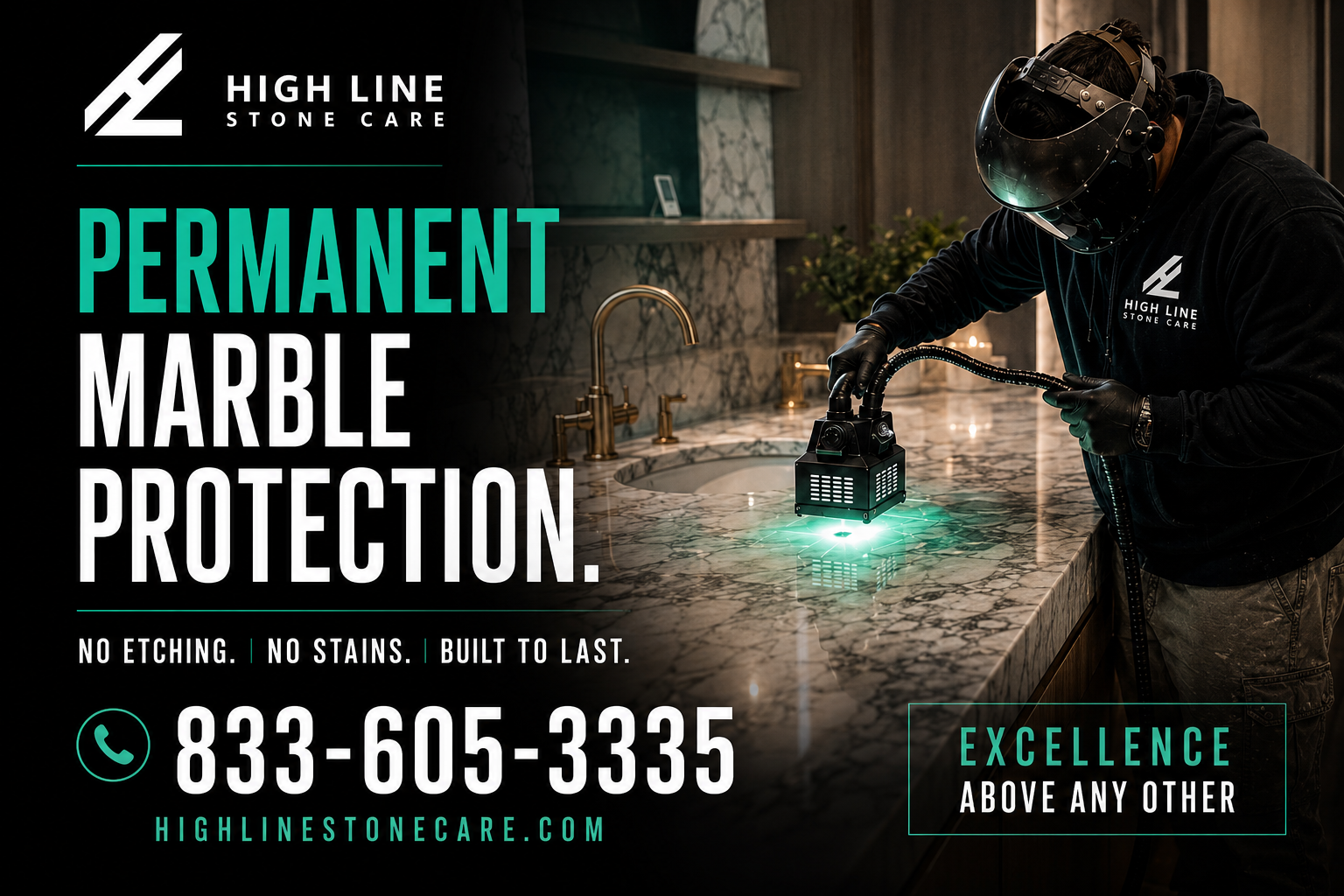
Preserving the value of premium stone is straightforward when the right expertise is applied before damage becomes permanent. A professional inspection gives you a clear diagnosis, a written recommendation, and a quote with no obligation.
What to expect at an inspection:
- A surface-by-surface diagnosis (stain type, etch extent, sealer condition)
- A written recommendation covering treatment options and priorities
- A transparent quote for restoration, protection, or both
Request an inspection or explore stone restoration services to get started.
Sources and further reading
- Natural Stone Institute — Stain Removal Guide: The primary industry reference for stain types, cleaning chemistry by category, and poultice guidance. Start here for any stain removal question.
- Arizona Tile — Natural Stone Stain Management: Practical guidance on poultice selection and stain-type chemistry mapping.
- Pro Tool Haus — Etch Mark vs. Stain: Clear diagnostic guidance distinguishing etching from staining and explaining why each requires a different fix.
- Chippewa Stone — Stone Surface Stains: Causes and How to Avoid Them: Covers environmental causes of metal stains and common homeowner errors, including the sealer misconception.
- Truclean Surface Care — Staining vs. Etching on Natural Stone: Accessible explanation of porosity, absorption, and the visual and tactile differences between stains and etches.
For stubborn stains or high-value surfaces, consult a qualified stone restoration professional rather than attempting repeated DIY treatments that may set the stain permanently or damage the finish.
Recommended
- Stone Damage Causes: A Homeowner’s Prevention Guide
- What Causes Marble Stains: a Homeowner’s Guide
- Signs Your Stone Needs Restoration: A Homeowner’s Guide
- What Is Stone Surface Etching: A Homeowner’s Guide