
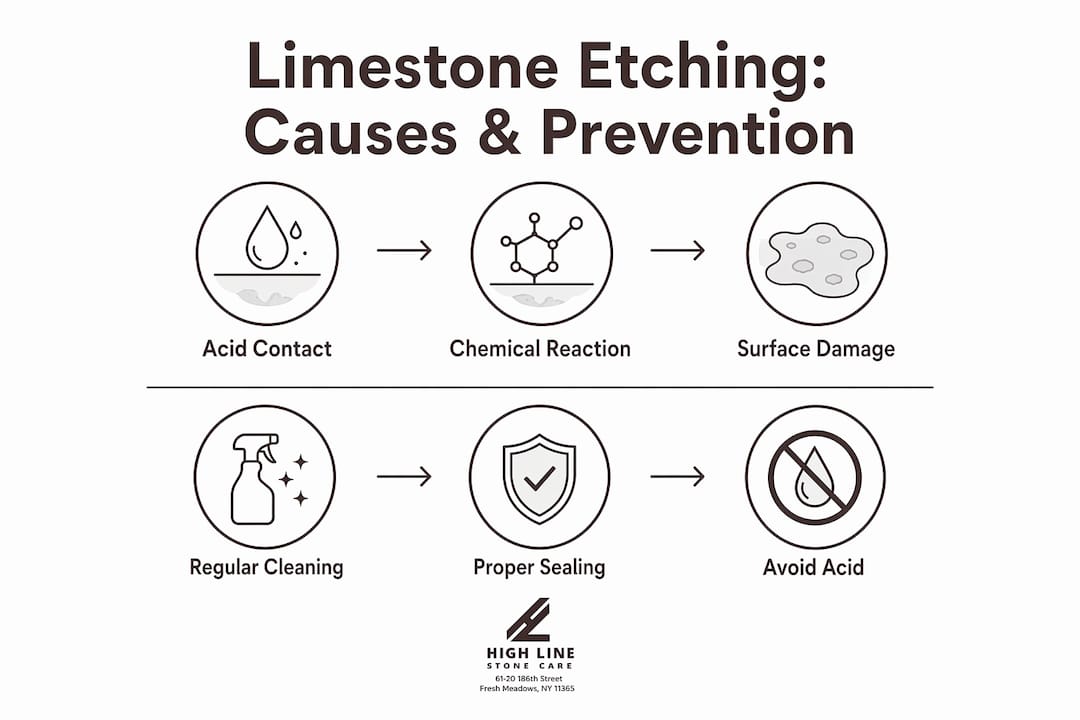
Limestone etching is chemical surface damage that occurs when an acidic substance reacts with the stone’s calcium carbonate, dissolving a thin layer of the surface and leaving a dull, cloudy mark. According to the Natural Stone Institute, even brief acid contact under 30 seconds can leave permanent dullness. This is not a stain you can wipe away. The stone itself has changed at a molecular level.
If you have just discovered a mark or spilled something acidic, act now:
- Blot the spill immediately with a dry cloth. Do not rub, which spreads the acid across a wider area.
- Rinse with plain water or a pH-neutral cleaner if available. Do not use vinegar, lemon juice, or any acidic product to “clean” the spot.
- Avoid abrasive scrubbing. A rough sponge or scouring pad will compound the surface damage.
- Photograph the area before touching it further. A clear photo helps a restoration professional assess depth and scope.
Table of Contents
- What causes limestone etching and how the chemical reaction works
- How to tell etching from a stain or scratch
- Everyday prevention and maintenance to reduce etching risk
- How limestone etching is repaired and why professionals are usually required
- When should you hire a stone restoration professional?
- Advanced protection options: how anti-acid sealers work
- What happens when limestone etching goes untreated
- DIY mild repair techniques for minor etching
- Not all limestone etches at the same rate
- Key Takeaways
- The prevention gap most homeowners miss
- Highlinestonecare: professional limestone restoration and lasting protection in NYC
What causes limestone etching and how the chemical reaction works
The limestone etching process begins the moment an acid contacts the stone. Limestone is composed largely of calcium carbonate (CaCO3). When an acid touches that surface, the reaction produces soluble calcium ions, water, and carbon dioxide, consuming the stone’s surface as it goes. The result is a microscopically eroded patch that scatters light differently from the surrounding stone, which is why etches look dull or cloudy.
Common household culprits include:
- Citrus juice, lemon wedges, and orange slices
- Vinegar and vinegar-based cleaning sprays
- Wine, tomato sauce, and coffee
- Carbonated sodas and sparkling water
- Acidic bathroom and kitchen cleaners
- Pet urine and some enzyme-based cleaner residues
Environmental factors compound the risk, particularly for exterior limestone. Airborne pollutants, acid rain, and repeated light exposures can accelerate surface dulling over time. Sulfurous and nitric acids in polluted air react with calcite in the same way a kitchen spill does, just more slowly. The U.S. Geological Survey documents this process on historic buildings and monuments, where exposed limestone shows roughened surfaces and loss of carved detail. Property managers overseeing exterior limestone facades or hardscape installations should factor environmental exposure into their maintenance planning.
How to tell etching from a stain or scratch
Misidentifying the damage leads to the wrong treatment. Applying a poultice to an etch does nothing. Applying an acid-based stain remover to an etch makes it worse.
The key visual and tactile differences:
- Etches appear dull, light, or cloudy. Run a fingertip across the area and it may feel slightly rough or matte compared to the surrounding surface.
- Stains are darker and color-saturated. They sit in the stone’s pores and do not change the surface texture.
- Scratches have a directional line or arc and are usually visible from an angle.
The wet-cloth test is the fastest homeowner diagnostic: dampen the area with a clean cloth. An etch often appears to vanish when wet and reappears as the stone dries. A stain typically looks the same wet or dry.
Pro Tip: Never apply an acid-based “stain remover” to a mark you have not yet identified. If the mark is an etch, acid contact will enlarge the affected zone and deepen the erosion. When in doubt, photograph the area and call a professional before attempting any treatment.
Everyday prevention and maintenance to reduce etching risk
Prevention is far less expensive than restoration. The habits below apply equally to kitchen countertops, bathroom vanities, and limestone floors.
Daily habits that protect your stone:
- Wipe spills within seconds, not minutes. Acid contact time matters.
- Use coasters under glasses, trivets under hot dishes, and cutting boards for food prep.
- Never cut citrus directly on limestone or let a lemon wedge rest on the surface.
- Keep vinegar-based sprays away from limestone entirely.
Cleaner selection matters. Even a diluted vinegar-and-water mix will etch calcium-carbonate stone. Use only pH-neutral stone cleaners formulated for natural stone. Avoid bleach, acidic bathroom sprays, and general-purpose kitchen degreasers.
Understanding what sealers actually do is critical. Impregnating sealers penetrate the stone’s pores and limit liquid absorption, which protects against staining. They do not form a top-surface barrier and offer no defense against acid-driven etching. A sealed limestone countertop can still etch from a lemon squeeze. Regularly resealing is a sound practice for stain protection, but it will not prevent etching. For guidance on protecting limestone walls and vertical surfaces, the maintenance approach is similar but requires attention to grout lines and mortar joints as well.
| Surface type | Etch risk | Sealer helps with stains? | Sealer prevents etching? |
|---|---|---|---|
| Polished limestone | High (damage is very visible) | Yes | No |
| Honed limestone | Moderate (damage blends more) | Yes | No |
| Brushed/tumbled limestone | Lower visibility | Yes | No |
| Exterior limestone | High (environmental exposure) | Partially | No |
How limestone etching is repaired and why professionals are usually required
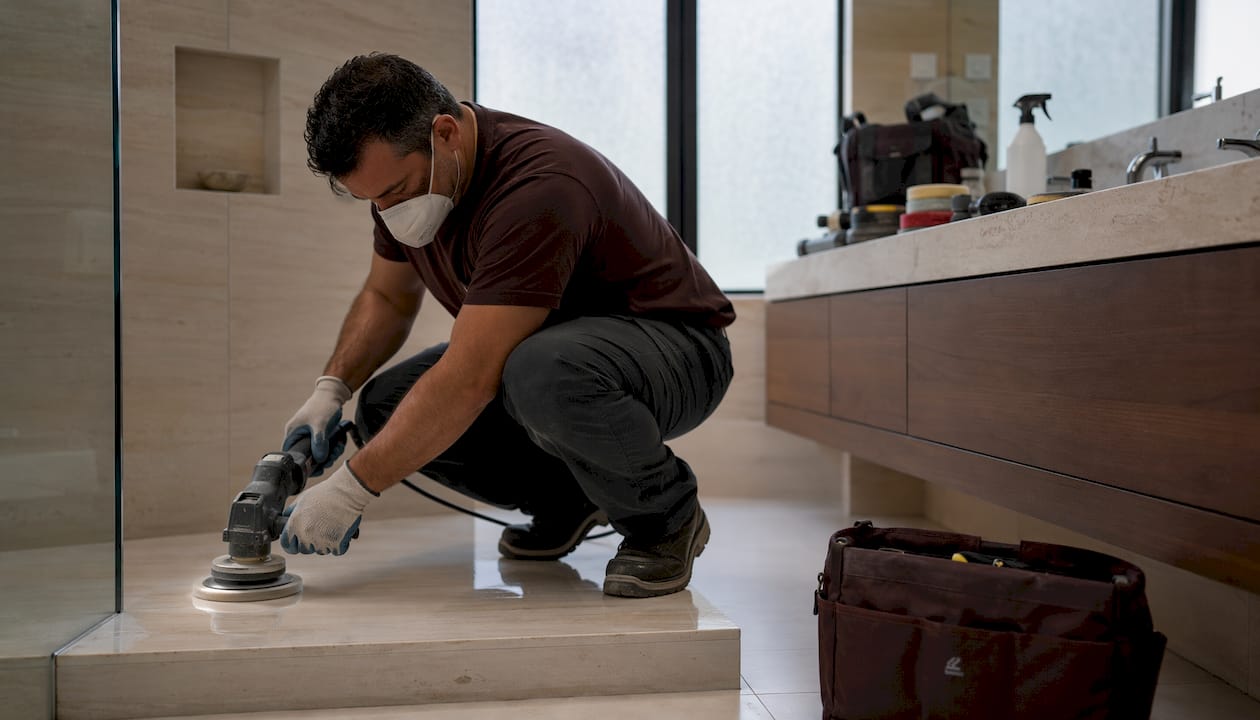
Repairing etched limestone is a mechanical process, not a chemical one. The damaged surface layer must be physically removed and the stone refinished to match the surrounding area. There is no product you apply and wipe off.
A typical professional restoration workflow:
- Diagnostic assessment. The technician examines the etch’s depth, size, and age, and identifies the existing finish.
- Test patch. A small, inconspicuous area is treated first to confirm the repair will blend.
- Diamond honing. Controlled mechanical abrasion with diamond-impregnated pads removes the damaged surface layer.
- Progressive polishing. Finer and finer polishing pads restore the original sheen, whether honed or polished.
- Final protectant application. A sealer or anti-acid treatment is applied to the restored surface.
“Professionals remove the damaged surface layer with controlled mechanical abrasion and re-polish to blend the finish. Spot repairs are possible for fresh, limited etches, but older or larger etches may require re-honing the full surface to avoid visible repair patches.” — Natural Stone Institute
DIY attempts with abrasive pads or acid-based products can worsen the damage by creating uneven texture or deeper erosion. A repair patch that does not blend is often more noticeable than the original etch. For a sense of what professional limestone restoration looks like in practice, before-and-after results depend heavily on the stone’s age, finish, and the extent of the damage. Broad cost ranges for professional repair vary widely based on surface area and finish type; a spot repair on a single countertop typically costs less than a full floor re-hone. Timelines range from a few hours for a spot repair to a full day or more for larger areas.
When should you hire a stone restoration professional?
Some etches are minor enough that a homeowner can address them with mild abrasive products designed specifically for stone (covered in the DIY section below). Others clearly require professional intervention.
Hire a professional when:
- The etch covers a large area or multiple surfaces.
- The damage is on a honed finish, where uneven DIY abrasion is immediately visible.
- The stone is high-value, historic, or irreplaceable.
- Previous DIY attempts have left visible repair patches.
- You cannot confidently identify whether the mark is an etch, scratch, or stain.
Questions to ask during an estimate:
- Do you have experience specifically with limestone (not just marble)?
- Can you describe your honing and polishing process step by step?
- Do you have photos from comparable limestone restoration projects?
- What is your warranty or satisfaction guarantee?
- Will you do a test patch before committing to the full repair?
Red flags to watch for: a contractor who refuses to show references, describes the process vaguely, or suggests applying an acid-based product to “lift” the etch without a proper diagnostic is not following industry-standard practice. Art Stone Restoration and similar specialists who work with historic or large-format stone can serve as a useful reference point for property managers evaluating contractors.
Advanced protection options: how anti-acid sealers work
Standard impregnating sealers fill the stone’s pores. Anti-acid barrier technology works differently: it forms a protective layer at the stone’s surface that helps buffer acid contact before it reaches the calcium carbonate beneath.
| Feature | Impregnating sealer | Anti-acid surface barrier |
|---|---|---|
| Protects against stains | Yes | Yes |
| Protects against etching | No | Significantly reduces risk |
| Application method | Penetrates pores | Top-surface layer |
| Reapplication cadence | Regularly | Longer-lasting per application |
| Effect on stone appearance | Minimal | May enhance or slightly alter sheen |
The Opal Luxury Anti Acid Sealer from Highlinestonecare is the brand’s premium offering in this category. It is designed to provide lasting protection against wine, lemon, vinegar, coffee, and other acidic spills that standard sealers cannot address. The industry is moving toward these specialized barrier technologies as a way to reduce the frequency of mechanical re-honing, which is the rationale behind products like Opal Luxury.
Pro Tip: Anti-acid protection is most effective when applied to a freshly restored surface. If your limestone already has existing etches, have it professionally honed and polished first, then apply the barrier treatment. Applying it over damaged stone locks in the damage rather than protecting against future harm.
What happens when limestone etching goes untreated
A single small etch left alone does not threaten the structural integrity of a limestone floor or countertop. But the cumulative effect of untreated etching is a different matter. Over time, repeated acid exposure removes progressively more surface material, making the stone increasingly porous and rough. That rougher texture traps dirt, bacteria, and moisture more readily, accelerating both staining and further chemical erosion.
On polished limestone, the aesthetic decline is rapid and obvious. The surface loses its reflective quality in patches, creating an uneven, worn appearance that no amount of cleaning will reverse. On exterior limestone, the USGS documents how untreated acid exposure leads to roughened surfaces, loss of carved detail, and in sheltered areas, the formation of gypsum crusts that eventually cause the stone to crumble beneath. Interior limestone does not face acid rain, but the principle is the same: untreated chemical erosion compounds.
DIY mild repair techniques for minor etching
For very light, fresh etches on polished limestone, a few homeowner-safe approaches can reduce visibility before professional intervention.
What you can safely try:
- Marble polishing powder: Products like Tenax Ager or similar stone-specific polishing compounds can be worked into a light etch with a damp cloth using small circular motions. Follow the product instructions exactly.
- Dry buffing: On honed limestone, a clean microfiber cloth worked in small circles over a very shallow etch can sometimes reduce its visibility without introducing new damage.
- Avoid: steel wool, sandpaper, baking soda pastes, vinegar, or any product not explicitly labeled safe for natural calcium-carbonate stone.
The honest caveat: DIY polishing works best on very fresh, very shallow etches on polished surfaces. Honed finishes are less forgiving because any variation in abrasion level creates a visible patch. If the etch is older than a few days, covers more than a few square inches, or sits on a honed or brushed finish, professional mechanical restoration will produce a far better result.
Not all limestone etches at the same rate
Limestone is not a single uniform material. Its composition, density, and finish all affect how quickly and visibly it etches.
Dense, fine-grained limestones (such as Jura Beige or Crema Marfil-adjacent varieties) tend to be more resistant to rapid surface erosion than softer, more porous types. Highly porous limestones absorb acid more readily, which can mean deeper damage from the same spill.
Finish type changes how visible an etch appears, not necessarily how deep it goes:
- Polished limestone shows etches immediately because the acid disrupts the mirror-like surface. Even a faint etch is obvious.
- Honed limestone has a matte finish to begin with, so light etches blend more easily. Deeper ones still show as rough patches.
- Brushed or tumbled limestone has an already-textured surface that masks minor etching well, though the stone is often more porous and may absorb acid faster.
Understanding your specific stone’s characteristics is part of what a professional assessment covers. The signs that your stone needs restoration vary by stone type and finish, and a trained eye can distinguish surface-level etching from deeper structural wear.
Key Takeaways
Limestone etching is irreversible chemical surface damage that requires mechanical restoration, not cleaning, to correct.
| Point | Details |
|---|---|
| Etching vs. staining | Etches are dull and rough; stains are dark and absorbed. The wet-cloth test tells them apart. |
| Immediate spill response | Blot dry, rinse with water, avoid acidic cleaners, and photograph the damage. |
| Sealers and their limits | Impregnating sealers protect against stains but offer no defense against acid-driven etching. |
| Anti-acid protection | Anti-acid barrier technology, such as Opal Luxury Anti Acid Sealer, reduces etching risk beyond what standard sealers can achieve. |
| Highlinestonecare | Highlinestonecare offers professional limestone assessment, mechanical restoration, and Opal Luxury Anti Acid Sealer application in New York City. |
The prevention gap most homeowners miss
The most common mistake is treating limestone like a durable, low-maintenance surface. It is beautiful precisely because it is reactive. That reactivity is the same property that makes it etch so easily.
What professionals see repeatedly are homeowners who sealed their limestone, assumed they were protected, and then discovered etching from a lemon wedge or a splash of wine. The sealer did its job: it prevented a stain. But etching is not a staining event. It is a chemical burn at the surface, and no impregnating sealer addresses that.
The second mistake is waiting. A fresh, shallow etch on a polished surface is a relatively straightforward spot repair. The same etch left for months, cleaned repeatedly with the wrong products, and joined by a dozen similar marks becomes a full re-hone job. The cost difference is significant. Prevention and early intervention are not just good habits; they are the most cost-effective approach to maintaining limestone over the long term.
Highlinestonecare: professional limestone restoration and lasting protection in NYC
Highlinestonecare provides on-site limestone assessment, professional mechanical restoration, and advanced anti-acid protection for homeowners and property managers across New York City. The process starts with a diagnostic visit: a technician examines the stone, identifies the finish, and evaluates the extent of the etching before any work begins. You receive a transparent quote and a clear timeline before the job starts.
For surfaces that have already been restored, Highlinestonecare applies the Opal Luxury Anti Acid Sealer as a final protective step, providing a lasting barrier against the acidic spills that standard sealers cannot stop. The satisfaction guarantee means the result meets expectations before the team leaves. To request an assessment or get a quote for limestone restoration in NYC, contact Highlinestonecare directly.
Recommended
- How to Protect Limestone Walls Properly – Highline Stone Care
- How to Prevent Etching on Natural Stone – Highline Stone Care
- Can Etching Be Prevented on Stone? – Highline Stone Care
- Limestone Restoration Nassau County | Skilled Services – Highline Stone Care