
How often you should seal a granite countertop depends on the stone’s porosity, surface finish, and how heavily it’s used — not a fixed annual schedule. The fastest way to know whether your countertop needs attention right now is the water-drop test: place a tablespoon of water on a clean section of the counter, wait 10–15 minutes, and watch what happens. If the stone darkens where the water sat, the sealer has failed in that spot and resealing is due. If the water beads and the stone stays the same color, you’re protected.
Quick reference ranges by use-case:
- Dense, dark granites (Absolute Black, Cambrian Black): often last several years between reseals; some may never need it
- Typical residential kitchen granite: only reseal when testing indicates it is necessary, which is usually multiple years apart with a quality penetrating sealer
- Light or porous granites (Kashmir White, Colonial Cream): need resealing more frequently, often within a couple of years, with some heavy-use kitchens requiring closer attention
- Outdoor counters and pool surrounds: typically require resealing more regularly due to UV exposure and weathering
- Commercial high-use surfaces (restaurant counters, hotel bars): require more frequent resealing due to heavy use, approximately within a range less than two years
If your fabricator sealed the slab at installation — which reputable fabricators typically do — you likely have a few years of protection before the water-drop test may show any depletion.
Table of Contents
- How do you know if your granite countertop needs resealing?
- What actually controls how long a granite sealer lasts?
- Typical resealing timelines by use-case
- Retail sealers vs. professional systems: what’s the real difference?
- How to reseal a granite countertop yourself
- When should you call a stone-restoration professional?
- Key Takeaways
- Why calendar sealing misses the point
- Lasting protection for your NYC granite starts here
- Useful sources and further reading
How do you know if your granite countertop needs resealing?
The water-drop test is the single most reliable method, and it costs nothing. Place a small drop of water on a clean, dry section of the counter. Wait 10–15 minutes. If the stone darkens beneath the drop, the sealer has failed there. If the water beads and the stone color stays unchanged, the seal is still working.
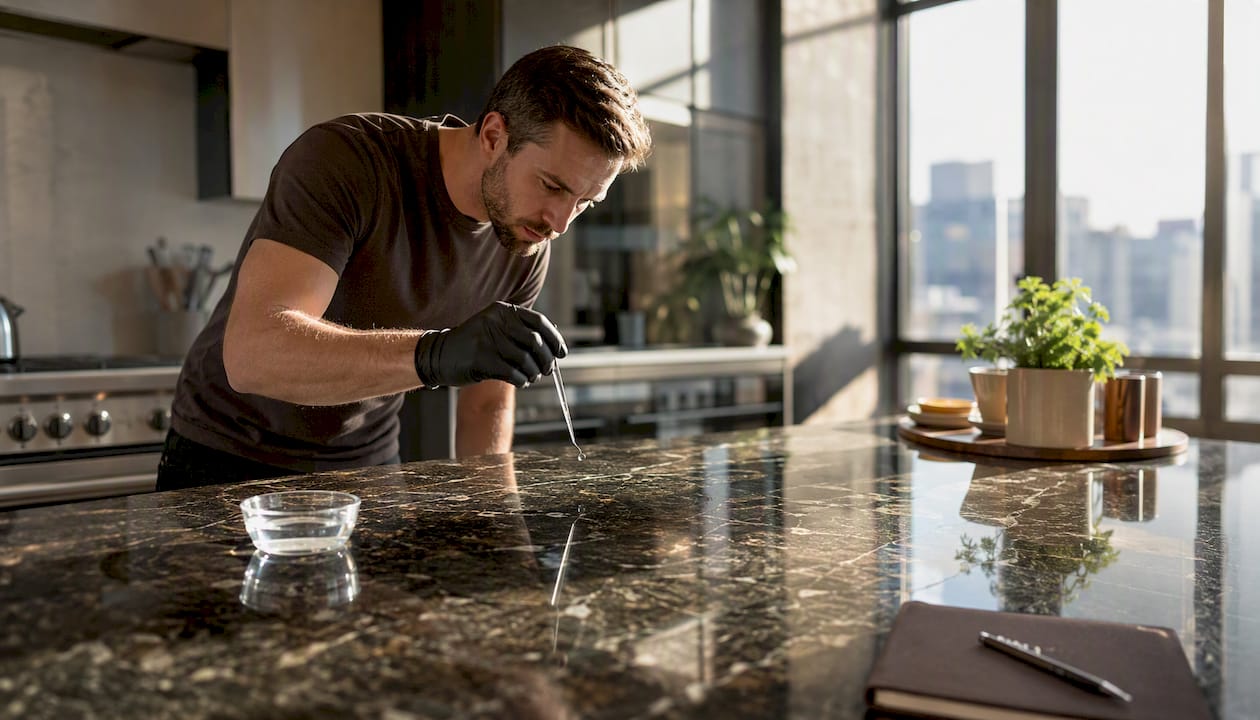
Run the test in multiple zones: near the sink, beside the cooktop, and on a low-traffic section of the same counter. High-use prep zones wear down faster than peripheral areas, so results often vary across a single slab.
Pro Tip: Test near the sink and cook zone first — these spots see the most spill exposure and cleaning product contact, so they’re almost always the first to lose protection. A low-traffic section that still beads water doesn’t mean the whole counter is sealed.
For slower-absorbing stones, a coffee or oil spot check can supplement the water test. Place a few drops of cooking oil on a dry area and wait 30 minutes. Darkening or a greasy shadow that doesn’t wipe clean indicates the stone is absorbing. Run the water-drop test every 6–12 months as a routine check, and always after a period of heavy use or aggressive cleaning.
What actually controls how long a granite sealer lasts?
Porosity is the primary factor. Dense, dark granites have a tight crystalline structure that leaves little room for a sealer to penetrate — which also means there’s little room for liquids to enter. Light-colored and white granites tend to be far more open-grained, absorbing liquids faster and depleting sealers sooner.
Several other variables shape the real-world lifespan of any sealer:
- Surface finish: Honed granite is more porous than polished granite and typically needs more frequent attention
- Traffic and use patterns: A prep zone beside the sink sees daily oil, citrus, and cleaning product contact; a decorative island edge may go years without stress
- Cleaning chemistry: Acidic cleaners (vinegar-based sprays, citrus degreasers) and abrasive scrubs break down sealer chemistry faster than pH-neutral stone-safe cleaners
- Outdoor exposure: UV radiation and temperature cycling accelerate sealer degradation significantly compared to indoor surfaces
- Sealer chemistry: Penetrating impregnating sealers bond below the surface and outlast topical coatings in most conditions; porosity is the deciding factor for how long either type performs
Commercial environments add another layer of stress. Heavier cleaning regimes, higher spill frequency, and industrial-strength degreasers mean commercial granite degrades its sealer faster than any residential surface.
Typical resealing timelines by use-case
| Use-Case | Typical Reseal Interval | Notes |
|---|---|---|
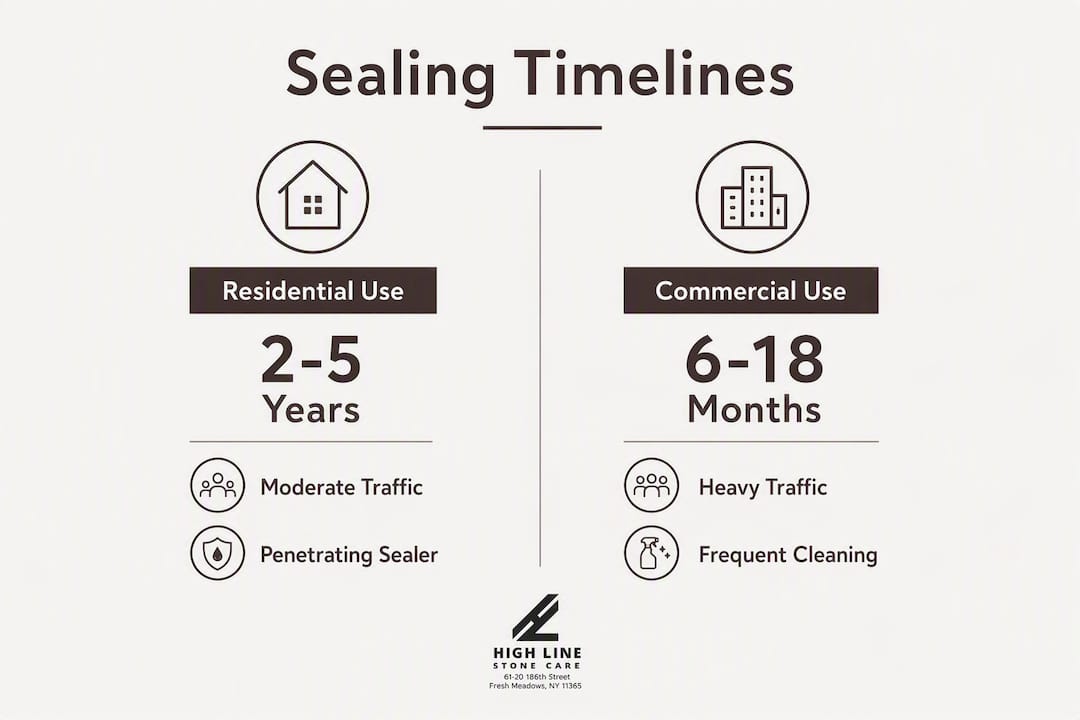
| Residential kitchen (mid-density granite) | 2–5 years | Test annually; prep zones may need earlier attention |
| Residential bathroom vanity | 3–5 years | Lower spill frequency extends protection |
| Light/porous granite (any location) | 1–2 years | Annual testing recommended |
| Dense dark granite (Absolute Black, etc.) | 5+ years | Some slabs may never show absorption |
| Outdoor counter / pool surround | 1–2 years | UV and weathering accelerate degradation |
| Commercial high-use surface | 6–18 months | Professional maintenance schedules recommended |
These ranges assume a quality penetrating impregnating sealer applied correctly. A basic retail sealer on a porous stone in a busy kitchen will land at the short end of any range. A professional-grade product on a dense slab in a low-traffic bathroom can comfortably reach the long end.
Retail sealers vs. professional systems: what’s the real difference?
Penetrating (impregnating) sealers
These bond below the stone surface, filling microscopic pores without forming a visible film. They’re the standard for granite countertop maintenance and typically last 3–10 years depending on stone porosity and use. Because they work invisibly beneath the surface, failure isn’t visible — only the water-drop test reveals it.
Topical/coating sealers
These sit on top of the stone and form a physical barrier. They tend to last 1–3 years and show wear visually: dull patches, uneven sheen, or a peeling film. Easier to assess by eye, but shorter-lived and more prone to surface damage from abrasion.
| Sealer Type | Typical Lifespan | Failure Signal | Acid/Etch Protection |
|---|---|---|---|
| Penetrating impregnating | 3–10 years | Water absorption (test only) | Partial — slows penetration |
| Topical/coating | 1–3 years | Visible dullness or peeling | Minimal |
| Professional anti-acid (Opal Luxury) | Long-term / extended | Professional inspection | Yes — defends against kitchen acids |
Professional anti-acid coatings
Standard retail sealers slow liquid absorption. They do not protect against etching, the dull marks left when kitchen acids (lemon juice, wine, vinegar, coffee) react with stone minerals. Highlinestonecare’s Opal Luxury Anti Acid Sealer is engineered specifically to address this gap, providing advanced protection against acid-related surface damage that ordinary impregnating sealers cannot reliably prevent. For high-value kitchens in NYC where the counter sees daily cooking activity, that distinction matters in a way a calendar-based retail sealer never will.
How to reseal a granite countertop yourself
DIY resealing is appropriate when the water-drop test confirms absorption, the stone has no deep stains or etching, and you’re working with a basic penetrating sealer on a standard residential surface. Avoid DIY if the counter shows persistent stains, etching, or patchy protection after a previous application — those conditions call for professional restoration before any new sealer goes down.
- Clear and clean the surface — remove everything and clean with a pH-neutral stone cleaner. Avoid soap residue, which prevents proper sealer bonding.
- Dry completely — the stone must be fully dry before application. Allow at least 24 hours after cleaning, or use a clean dry cloth and let it air out.
- Apply the sealer — spray or wipe a thin, even coat across the surface. Work in small sections to maintain control.
- Allow dwell time — follow the product’s specified dwell time (typically 15–30 minutes). Don’t let the sealer dry on the surface; it will leave a hazy residue.
- Wipe off excess — buff away any remaining sealer with a clean dry cloth before it dries.
- Cure fully — most penetrating sealers need 24 hours before contact with food, water, or wet items. Some premium products require 48 hours. Disturbing the curing process is the most common cause of patchy protection that fails the water test within months.
- Ventilate the space — open windows and use a fan during application; solvent-based sealers require adequate airflow. Wear gloves.
Cost comparison: A quality retail penetrating sealer runs roughly $20–$50 per bottle, sufficient for a standard kitchen counter. Professional resealing services in NYC typically range from $150–$400+ depending on counter size, stone condition, and whether restoration work is needed first. For a counter that needs stain removal or honing before sealing, professional service is the more cost-effective path.
When should you call a stone-restoration professional?
Some situations go beyond what a retail sealer and an afternoon can fix. Call a professional when:
- The water-drop test fails in multiple zones after a recent DIY reseal
- Persistent stains remain after cleaning — oil rings near the sink, wine shadows, or dark patches that don’t respond to standard stone cleaners
- Etching is visible: dull, flat marks where kitchen acids have reacted with the stone surface
- You manage a commercial property or multi-unit building where consistent, documented maintenance schedules are required
- The counter is a high-value luxury finish where a misapplied sealer or unaddressed stain would be costly to correct
Professional stone care involves more than applying a sealer. A qualified technician evaluates each zone of the counter separately, performs diagnostic absorption testing, and addresses stains or surface damage before any protective product goes down. For NYC properties, Highlinestonecare’s granite restoration services include stain removal, honing, polishing, and application of premium protection systems with longevity claims backed by a satisfaction guarantee.
Pro Tip: Property managers overseeing multiple units benefit most from a contracted maintenance schedule. A professional inspection every 12–18 months across multiple kitchens costs far less than emergency stain removal after a sealer failure goes unnoticed.
The Natural Stone Institute emphasizes a systems approach: the right sealer chemistry, proper application, and professional-grade products working together produce far longer real-world protection than repeated retail applications alone.
Key Takeaways
Test your granite with the water-drop method every 6–12 months — porosity and use, not a fixed calendar, determine when resealing is actually needed.
| Point | Details |
|---|---|
| Test, don’t guess | The water-drop test (10–15 minutes) is the reliable standard for confirming whether resealing is due. |
| Timelines vary widely | Dense dark granites can go 5+ years; light porous granites may need attention every 1–2 years. |
| Outdoor and commercial need more care | Outdoor counters and commercial surfaces typically require resealing every 6–18 months due to heavier exposure. |
| DIY works for simple cases | A penetrating sealer applied with proper prep and full curing handles most residential reseals. |
| Highlinestonecare for lasting protection | For NYC properties needing anti-acid defense and long-term results, Highlinestonecare’s Opal Luxury system goes beyond what retail sealers provide. |
Why calendar sealing misses the point
The “seal every year” rule persists largely because it’s easy to communicate and because sealer manufacturers benefit from higher product turnover. For the subset of porous stones where annual sealing genuinely is appropriate, the advice happens to be correct. For dense granites, it produces a different problem: over-application. New sealer applied over an intact existing seal can’t penetrate past it, so it sits on the surface and dries as a blotchy, hazy film that’s difficult to remove.
The porosity-first approach resolves this entirely. Test the stone, read the result, and act on what the stone actually tells you. For NYC homeowners managing high-value kitchens, that discipline also clarifies when a retail product is sufficient and when a professional anti-acid system is the more durable investment. A counter that sees daily lemon, wine, and coffee exposure isn’t just a sealing problem — it’s an etching problem, and no standard impregnating sealer addresses that. Highlinestonecare’s stone protection strategies are built around exactly this distinction: matching the protection system to the actual risk profile of the surface, not to a generic maintenance calendar.
Lasting protection for your NYC granite starts here
Highlinestonecare offers NYC homeowners and property managers a professional alternative to repeated retail resealing. The process begins with an on-site diagnostic inspection — testing absorption across multiple counter zones, identifying any staining or etching, and recommending restoration work if needed before protection is applied.
The signature Opal Luxury Anti Acid Sealer provides advanced protection against the kitchen acids that standard sealers cannot reliably stop: wine, lemon, vinegar, and coffee. For property managers overseeing luxury condominiums or commercial spaces in Manhattan, Highlinestonecare also offers contracted maintenance plans for commercial stone that document protection status across multiple units and reduce emergency repair costs. To request an on-site estimate or schedule a professional inspection, contact Highlinestonecare directly through the website.
Useful sources and further reading
The following resources provide authoritative guidance on granite sealing frequency, testing methods, and sealer chemistry:
- Natural Stone Institute — Industry technical standards and best practices for stone care, including the water-drop test methodology and porosity-first maintenance guidance
- Countertop Advisor: Sealing Granite Countertops — Detailed installer guidance on factory-applied sealers, application steps, and realistic lifespan expectations for residential granite
- Defusco Industrial Supply: How Long Does Stone Sealer Last? — Practical breakdown of penetrating vs. topical sealer lifespans and the role of porosity in determining reseal timing
- Dynamic Stone Tools: Do You Need to Seal Granite Countertops? — Honest, porosity-based guidance on which granite types benefit from sealing and which don’t
- Highlinestonecare: Ways to Protect Stone Countertops — Homeowner-focused guide covering maintenance habits, testing, and protection strategies for NYC properties
- Highlinestonecare: How to Remove Stains from Granite — Practical stain-removal steps and guidance on when to escalate to professional services
Recommended
- How Often Should You Seal Marble Countertops? – Highline Stone Care
- Ways to Protect Stone Countertops: A Homeowner’s Guide
- How Often Should Natural Stone Be Sealed? – Highline Stone Care
- How to Protect Stone Countertops Properly – Highline Stone Care