
Hire a specialist who uses controlled mechanical restoration (honing and polishing with diamond abrasives) and a penetrating anti-acid sealer for lasting results. That combination is the only approach that corrects etching, removes deep staining, and protects the surface going forward. The Natural Stone Institute confirms that limestone is composed of at least 50% calcium carbonate, which means acid contact causes a physical loss of surface material, not a removable stain. Chemical cleaning alone cannot fix that. Your immediate next step: request an on-site assessment or send photos for a free written quote before approving any scope of work.
What to confirm before you book:
- The contractor performs a site assessment and delivers a written scope with line items
- Mechanical honing and polishing are included for any etched or worn surfaces
- The sealer specified is a penetrating impregnator, not a topical coating
- Highlinestonecare offers limestone restoration in NYC with these standards built into every project
Table of Contents
- What do professional limestone cleaning services actually include?
- How professionals restore limestone: the step-by-step process
- When should you call a professional instead of cleaning it yourself?
- What does professional limestone restoration typically cost?
- How do you choose a qualified limestone restoration contractor?
- How to care for limestone after professional work
- Highlinestonecare’s approach and the Opal Luxury Anti Acid Sealer
- Key Takeaways
- Why mechanical restoration and penetrating protection are the only reliable path
- Book a limestone restoration assessment with Highlinestonecare
- Authoritative sources and further reading
What do professional limestone cleaning services actually include?
Professional limestone restoration covers a wider scope than most property owners expect when they first request a quote. Understanding each service category helps you verify that a contractor’s proposal is complete and appropriately priced.
Core services and what each one does:
- Site assessment and documentation: A technician inspects the stone, identifies damage types (etch, stain, lippage, cracks), and records the existing finish level. This step produces the written scope that protects you if disputes arise later.
- Deep cleaning and dirt/oil extraction: Hot-water extraction or controlled chemical cleaning removes embedded soil, grease, and surface contaminants before any mechanical work begins. Skipping this step risks grinding debris into the stone.
- Poultice stain removal: A drawing compound (typically a powder mixed with a chemical agent) is applied over oil-based or organic stains and left to absorb the staining material over 24–48 hours. Effective for isolated stains that pH-neutral cleaning cannot lift.
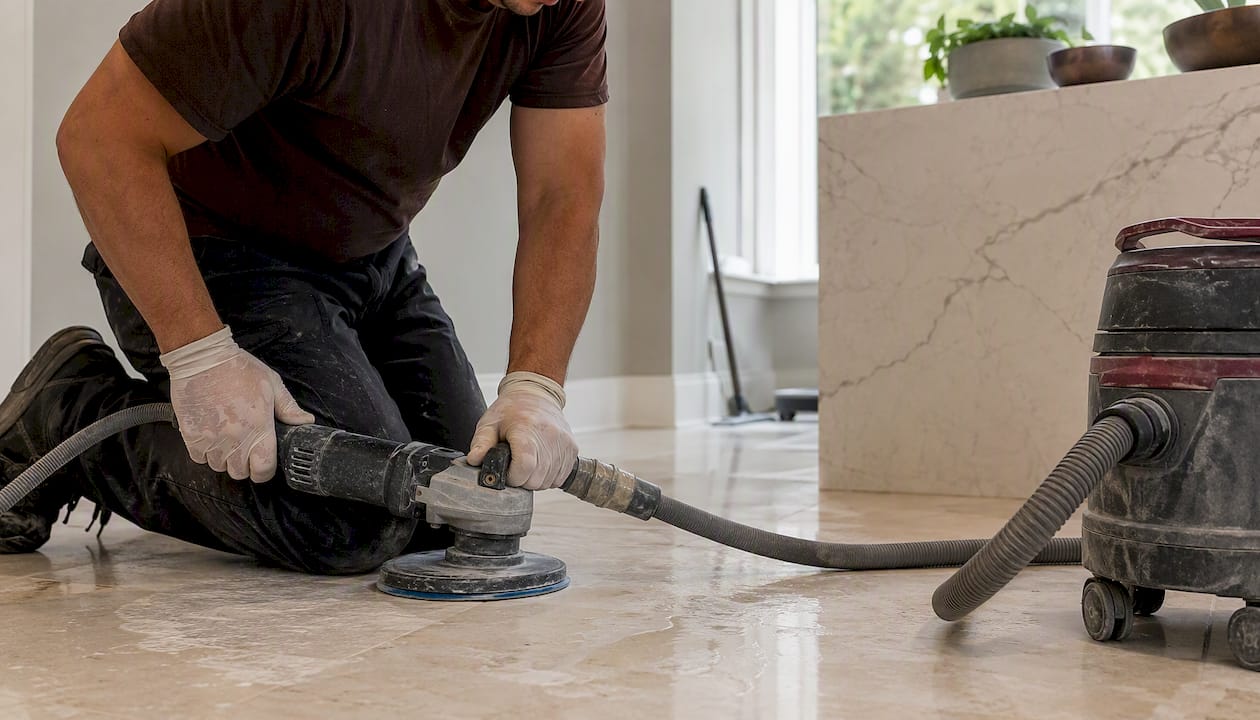
- Mechanical honing: Diamond abrasive pads, run in progressively finer grits, remove a microscopically thin layer of stone to eliminate etching, scratches, and uneven wear. Mechanical restoration is the only method that corrects physical surface loss.
- Polishing to finish level: After honing, finer diamond pads or polishing compounds bring the surface to the agreed finish, from a matte hone to a high-gloss mirror. The finish level should be specified in writing before work starts.
- Lippage removal and grinding: Where tile edges are uneven (lippage), coarser diamond tooling levels the floor before honing begins. Chip and crack repair uses color-matched epoxy or grout fillers.
- Penetrating sealer application: An impregnating sealer bonds inside the stone’s pores, protecting from within while allowing the stone to breathe. Penetrating impregnators are strongly preferred over topical coatings, which can trap moisture and eventually peel.
- Protective maintenance contracts: Property managers often benefit from scheduled inspection and reseal visits rather than waiting for visible deterioration.
Honing and polishing are almost always quoted together as a restoration package. Spot stain removal and chip repair are typically quoted separately, since their scope depends on the number and severity of affected areas.
How professionals restore limestone: the step-by-step process
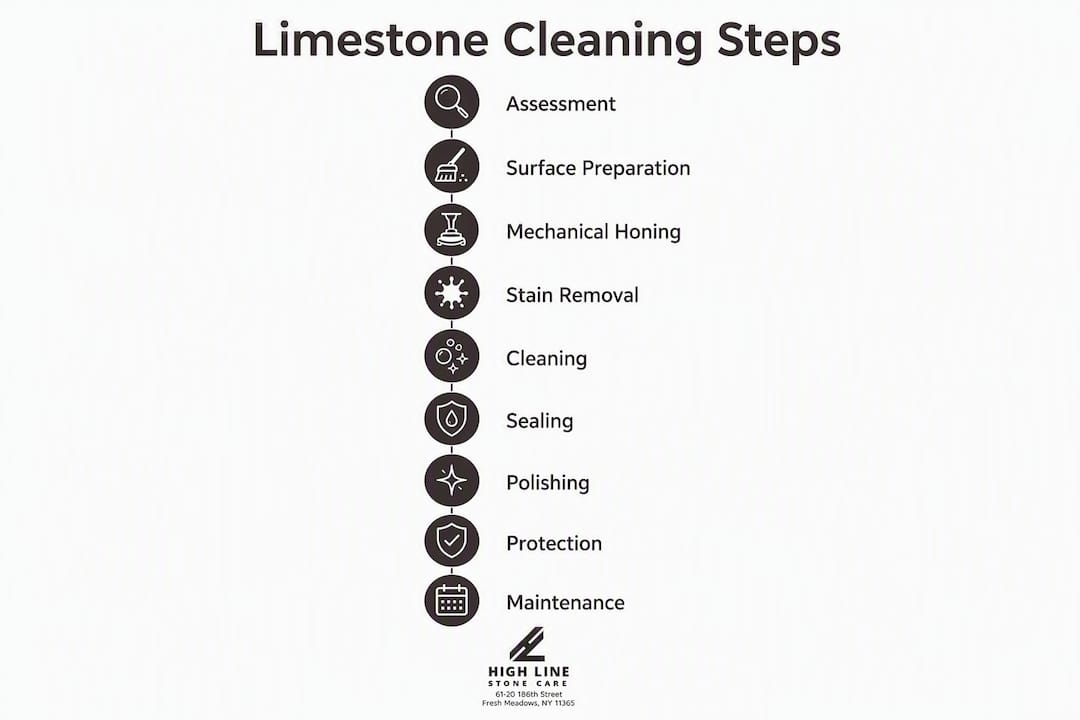
A well-run restoration follows a defined sequence. Knowing the order helps you judge whether a contractor’s proposed method is appropriate and safe for limestone.
- Initial assessment and protection setup. The technician inspects all surfaces, photographs damage, and agrees on the target finish level. Adjacent finishes, skirting boards, and cabinetry are masked and protected before any equipment is introduced. A documented scope and finish level in the written quote is standard practice for reputable contractors.
- Pre-cleaning. The stone is cleaned with a pH-neutral or alkaline cleaner to remove loose soil and surface contaminants. This prevents abrasive particles from being worked into the stone during mechanical steps.
- Poultice application (if needed). Oil-based or organic stains are treated with a drawing compound before mechanical work begins, since honing can drive an untreated stain deeper into the stone.
- Mechanical honing with diamond abrasives. Starting with a coarser grit appropriate to the damage level, the technician works progressively through finer pads. Diamond grinding and honing reveal fresh stone beneath worn or etched surfaces. Dust-controlled equipment (wet grinding or HEPA-filtered dry systems) keeps the work area safe and clean.
- Polishing. Finer diamond pads or polishing compounds bring the surface to the specified finish. The technician checks the result against the agreed finish level before proceeding.
- Final cleaning and pH neutralization. Residue from abrasives and compounds is removed, and the surface is rinsed to a neutral pH before sealing.
- Penetrating sealer application. The impregnating sealer is applied in thin, even coats, allowed to penetrate, and the excess is wiped off before it cures on the surface. Cure time varies by product, typically 24–72 hours before the surface returns to full service.
- Exterior rinsing (where applicable). For facade or patio work, the GSA’s technical guidance recommends keeping water pressure under 1,000 psi; professional practice for limestone commonly runs 300–600 psi to avoid surface erosion.
Pro Tip: Ask every contractor specifically about dust control and extraction before signing. Wet grinding or HEPA-filtered systems protect your property and your air quality. Also ask for the sealer’s product data sheet, including cure time and VOC content, so you know exactly when the space is safe to reoccupy.
When should you call a professional instead of cleaning it yourself?
Several signs indicate that pH-neutral mopping is no longer sufficient and that professional limestone cleaning and restoration is warranted.
Red-flag signs to watch for:
- Dull patches or wear paths. A surface that looks clean but has lost its luster in high-traffic areas has physical wear or etching. No cleaner restores that. Mechanical honing is required.
- Etching from acid contact. A dull ring near the kitchen sink, a faded mark where a citrus drink spilled, or a rough patch on a countertop are all etch marks, not stains. Because limestone reacts immediately with acids, the surface material is gone. Polishing is the fix, not scrubbing. For a detailed explanation of what etching looks like and how it differs from staining, see Highlinestonecare’s guide on limestone etching.
- Stains that don’t lift with pH-neutral cleaning. Oil-based stains (cooking grease, body oils) and organic stains (coffee, wine, rust) often require poulticing. If a stain persists after two or three attempts with a stone-safe cleaner, a professional poultice treatment is the next step.
- Chipped tiles or visible lippage. Chips and uneven tile edges are mechanical damage. They require epoxy repair and grinding, not cleaning products.
- Biological growth on exterior surfaces. Algae, moss, and lichen on exterior limestone indicate moisture retention and require staged chemical treatment followed by controlled rinsing, not a pressure washer at full force.
- Mortar joint damage or deep cracks. These are structural concerns that need immediate professional assessment. Delaying can allow water infiltration and accelerate deterioration.
Etch vs. stain: An etch is a physical change to the stone’s surface caused by acid dissolving calcium carbonate. It looks dull or rough and cannot be wiped away. A stain is a foreign substance absorbed into the stone’s pores and may respond to poulticing. Confusing the two leads to wasted effort and, in some cases, additional damage from the wrong treatment.
What does professional limestone restoration typically cost?
Pricing varies significantly based on the condition of the stone, the finish specified, the type of installation, and the scope of repairs required. No honest contractor quotes a firm price without an on-site assessment, but understanding the pricing models helps you evaluate bids intelligently.
Common pricing models:
- Per square foot: The standard model for floor restoration and exterior facade work. Price per square foot rises with damage severity, finish level, and the number of repair items.
- Per fixture: Countertops, vanities, and fireplace surrounds are often quoted as a flat fixture price rather than by area, since setup and protection time is similar regardless of the exact square footage.
- Project minimums: Most professional stone care companies apply a minimum charge that covers travel, setup, and equipment time. For small jobs (a single countertop or a bathroom floor), the minimum often determines the price rather than the area.
Factors that push the price higher: deep etching requiring multiple honing passes, lippage that needs coarse grinding before honing, stain removal requiring multiple poultice applications, repairs to chips or cracks, and exterior work requiring biological treatment before mechanical steps.
Typical job timelines:
- A standard residential floor restoration (honing, polishing, sealing) generally takes one to two days for a moderate-sized room, plus 24–72 hours of sealer cure time before the area returns to service.
- A countertop or vanity refinishing is usually completed in a few hours, with the same sealer cure window.
- A shower restoration, which involves more detailed work around fixtures and grout, typically runs one to two days.
- Exterior facade cleaning with biological treatment and controlled rinsing may require two or more staged visits.
Reseal interval: The Natural Stone Institute recommends resealing high-traffic limestone surfaces every 3–5 years, depending on use and exposure. Exterior surfaces and commercial floors may need attention at the shorter end of that range.
How do you choose a qualified limestone restoration contractor?
The difference between a contractor who restores limestone correctly and one who causes irreversible damage often comes down to their process and their willingness to document it.
Hiring checklist:
- Written scope of work before any deposit. The scope should list each service, the target finish level, the sealer product specified, and the timeline. Verbal promises are not enforceable.
- Before-and-after photos from comparable projects. Ask for examples from the same installation type (floor, countertop, shower, exterior). Photos confirm both technical skill and realistic expectations.
- Proof of insurance and licensing. Mechanical restoration involves heavy equipment and water. Verify general liability coverage before work begins.
- Sealer product disclosure. Ask for the product name and data sheet. Confirm it is a penetrating impregnator, not a topical coating. Insist on impregnating products for premium interiors and ask for VOC content and cure instructions.
- Dust control and extraction method. Wet grinding or HEPA-filtered dry systems are the professional standard. A contractor who cannot describe their dust control approach is a risk to your property.
- Warranty or satisfaction guarantee. A reputable contractor stands behind the finish level and the sealer application.
- References from similar projects. One or two references from property owners or managers with comparable installations confirm real-world results.
Questions to ask on the call and at the site visit:
- Do you test cleaners and abrasives on an inconspicuous area before full application?
- What grit sequence do you use for honing, and how do you determine the starting grit?
- How do you distinguish between an etch and a stain, and does your approach differ for each?
- What is the sealer’s expected service life, and what maintenance does it require?
- How do you protect adjacent surfaces and fixtures during mechanical work?
Red flags to avoid:
- Proposals that default to acid-based cleaning for limestone. Acid cleaners cause irreversible damage to mortar joints and the stone surface.
- Promises of very fast or very cheap results for a full restoration. Honing and polishing take time; shortcuts show up in the finish.
- Refusal to provide a written scope or references.
- High-pressure washing proposed as the primary cleaning method for interior or delicate exterior limestone.
When comparing bids, align the scopes first. A lower bid that omits honing, uses a topical sealer, or skips the site assessment is not a comparable offer.

How to care for limestone after professional work
Professional restoration is an investment. The aftercare routine that follows determines how long the results last.
Daily and routine care:
- Dust-mop or dry-sweep floors daily to prevent abrasive grit buildup. Fine particles act like sandpaper underfoot and accelerate surface wear.
- Damp-mop with warm water and a pH-neutral cleaner specifically labeled for natural stone (pH 7–9). Rinse residue thoroughly; soap film left on limestone dulls the finish over time.
- Wipe countertops and vanities promptly after any spill, especially acidic liquids (citrus juice, wine, vinegar, coffee). Even a brief contact window can etch unsealed or lightly sealed limestone.
What to avoid:
- Vinegar, lemon juice, or any acidic household cleaner
- Abrasive scrubbing pads or powders
- General bathroom cleaners, which are typically acidic or alkaline outside the safe range
- “Eco-friendly” or “natural” cleaners that are not explicitly labeled pH-neutral. Marketing claims do not guarantee pH neutrality; always read the product label before using any cleaner on limestone.
Maintenance schedule by installation type:
- Countertops: Wipe after every use. Reseal every 3–5 years, or sooner if water no longer beads on the surface. For practical countertop protection guidance, Highlinestonecare’s homeowner guide covers product selection and application timing.
- Floors: Daily dust-mopping, damp-mop as needed. Professional inspection and reseal at regular intervals based on use and exposure for residential; more frequently for commercial or high-traffic lobbies.
- Exterior surfaces: Inspect annually for biological growth and mortar joint condition. Biological growth should be treated promptly before it penetrates the stone. Reseal as recommended by the contractor based on exposure and porosity.
When spot damage appears (a new etch, a stubborn stain), call for targeted maintenance rather than waiting for the next scheduled restoration. Addressing isolated damage early is significantly less expensive than a full refinish.
Highlinestonecare’s approach and the Opal Luxury Anti Acid Sealer
Highlinestonecare serves residential and commercial properties across New York City, with a process built around the standards described throughout this guide: documented site assessment, mechanical honing and polishing with dust-controlled equipment, and penetrating protection that addresses limestone’s specific vulnerability to acid.
What the process includes:
- On-site assessment with photographic documentation before any work begins
- Mechanical honing and polishing using diamond abrasives, with HEPA-filtered or wet-extraction dust control
- Poultice stain treatment for oil-based and organic stains prior to mechanical steps
- Chip and crack repair with color-matched materials
- Application of a penetrating anti-acid sealer as the final protection step
- Written scope, before-and-after documentation, and a satisfaction guarantee
The Opal Luxury Anti Acid Sealer. Standard penetrating impregnators protect limestone from moisture and oil-based staining, but they do not address acid-related surface damage. The Opal Luxury Anti Acid Sealer goes further: it is formulated to provide lasting protection against the acidic spills (wine, lemon, vinegar, coffee) that cause etching on calcium carbonate stones. Unlike topical coatings, it bonds within the stone’s pores, preserves the natural appearance, and does not trap moisture or peel. For NYC properties where countertops and floors face daily exposure to acidic substances, this level of protection is a meaningful upgrade over a standard impregnator.
Why anti-acid protection matters for limestone: Because limestone is calcium carbonate, even a brief contact with an acidic liquid dissolves a thin layer of the surface. A penetrating anti-acid sealer does not make limestone indestructible, but it significantly extends the window between spill and damage, giving property owners time to wipe up before etching occurs.
Highlinestonecare works with homeowners, property managers, luxury condominium owners, and commercial clients throughout NYC. Insert proprietary data on years of experience and specific credentials of High. Insert case studies or detailed testimonials.
Key Takeaways
Professional limestone restoration requires mechanical honing, penetrating anti-acid sealing, and a documented scope to deliver results that last 3–5 years between service visits.
| Point | Details |
|---|---|
| Mechanical restoration is required for etching | Chemical cleaning cannot fix physical surface loss; diamond honing removes the damaged layer. |
| Penetrating sealers outperform topical coatings | Impregnators bond inside pores, allow the stone to breathe, and resist peeling. |
| Reseal every 3–5 years | The Natural Stone Institute recommends this interval for high-traffic limestone surfaces. |
| Written scope protects you | Require a documented scope, finish level, and sealer product name before any deposit. |
| Highlinestonecare’s Opal Luxury sealer | Provides anti-acid protection for NYC limestone surfaces, backed by a satisfaction guarantee. |
Why mechanical restoration and penetrating protection are the only reliable path
Most property owners who contact Highlinestonecare have already tried the wrong approach. They have used a household cleaner, a “stone-safe” spray from a hardware store, or even a steam mop, and the dull patches remain. That outcome is predictable, because the damage was never a cleaning problem to begin with.
Limestone loses its appearance in two ways: physical wear from foot traffic or abrasion, and etching from acid contact. Both are losses of surface material at a microscopic level. No product applied on top of the stone can restore what is no longer there. The only path to a restored finish is removing a controlled, thin layer of stone with diamond abrasives until fresh, undamaged material is revealed. That is what honing does.
The protection question is equally specific. A standard penetrating sealer reduces moisture and oil absorption, which matters. But limestone in a kitchen, a bathroom, or a lobby faces acidic exposure daily. A sealer that does not address acid reactivity leaves the stone vulnerable to the most common source of damage in those environments. Highlinestonecare’s Opal Luxury Anti Acid Sealer was developed precisely for that gap.
One more point that often gets overlooked: occupied properties require contractors who take dust control and chemical safety seriously. Mechanical grinding generates fine stone dust, and some sealers have meaningful VOC content during cure. Asking for the product data sheet and the dust control method before signing is not excessive caution. It is the right question for any property where people live or work.
Book a limestone restoration assessment with Highlinestonecare
Highlinestonecare provides limestone restoration and protection services across New York City, including Manhattan, Brooklyn, Queens, and surrounding areas. For property owners and managers ready to move from evaluation to action, the process starts with a free photo quote or an on-site inspection, typically scheduled within a few business days for NYC properties.
What to expect from the estimate: a technician reviews photos or visits the site, identifies damage types, and delivers a written scope with line items, the specified sealer product, timeline, and pricing. No vague verbal estimates. The scope covers every service from deep cleaning and honing through Opal Luxury Anti Acid Sealer application, with before-and-after documentation and a satisfaction guarantee included.
For countertops, floors, showers, fireplace surrounds, lobby stone, or exterior limestone, contact Highlinestonecare to request your assessment. Visit highlinestonecare.com to submit photos or schedule an on-site visit.
Authoritative sources and further reading
The following sources provide technical depth on limestone chemistry, cleaning methods, and maintenance standards for property owners and managers who want to verify the guidance in this article.
- Natural Stone Institute — Limestone: The industry’s primary reference for limestone composition, maintenance intervals, and care standards. Useful for verifying reseal recommendations and understanding how calcium carbonate chemistry affects cleaning product selection.
- Natural Stone Institute — Care and Cleaning of Natural Stone: Practical guidance on pH-neutral cleaners, routine maintenance, and what to avoid. The starting point for any property owner building a daily care routine.
- GSA Technical Procedures — Cleaning Historic Masonry: The U.S. General Services Administration’s technical guidance on cleaning masonry, including limestone. Covers pressure thresholds, chemical treatment staging, and the risks of acid cleaners and high-pressure washing. Authoritative for both interior and exterior applications.
- USGS Fact Sheet 2008-3089: Background on limestone geology and composition across the United States, including calcium carbonate content. Useful context for understanding why limestone behaves differently from granite or engineered stone.
- Highlinestonecare — Limestone Restoration NYC: Service details, process overview, and contact information for NYC property owners seeking professional restoration, sealing, and polishing.
- Highlinestonecare — Opal Luxury Anti Acid Sealer: Product page covering the anti-acid sealer’s formulation, application, and protection scope for limestone and other calcium carbonate stones.
Recommended
- Limestone Restoration LIC: Expert in Long Island City, New York – Highline Stone Care
- Limestone Restoration & Care NYC – Highline Stone Care
- Limestone Restoration Nassau County | Skilled Services – Highline Stone Care
- Stone Cleaning Queens | Specialized Services – Highline Stone Care