
For high-traffic commercial stone, the Opal Luxury Anti Acid Sealer from Highlinestonecare is the recommended professional-grade option. It delivers durable protection against etching, staining, and acid-related surface damage, aligning with ASCC sealer selection guidance and Natural Stone Institute best practices for penetrating, breathable protection.
At a glance:
- Who should use it: Property managers and facilities teams overseeing marble, granite, travertine, or limestone in commercial settings
- Where it fits best: Building lobbies, food-adjacent areas, hospitality interiors, and any surface exposed to acidic spills or heavy foot traffic
- Penetrating vs. topical: Choose a penetrating impregnating sealer for durability and breathability; reserve topical coatings for decorative or low-traffic applications only
- Professional application: Opal Luxury Anti Acid Sealer is a professional-grade product, not a consumer shelf item; certified application is strongly recommended
- Reseal cadence: High-traffic commercial surfaces typically require resealing every 1–2 years, depending on traffic and cleaning regime
Table of Contents
- What is the SAP framework for selecting commercial stone sealers?
- How do penetrating and topical sealers compare for commercial use?
- How should facilities teams plan reseal schedules and manage VOC risks?
- When should you hire a stone restoration specialist instead of applying in-house?
- Key Takeaways
- Why the “best sealer” question misses the point
- Highlinestonecare’s Opal Luxury Anti Acid Sealer for commercial properties
- Authoritative technical sources to consult next
What is the SAP framework for selecting commercial stone sealers?
No single product is the best sealing solution for commercial stone across every scenario. Selection must begin with three variables: Substrate, Application, and Performance, a framework the ASCC Comprehensive Sealer Selection Guide formalizes for exactly this purpose.
Substrate refers to the stone’s porosity and density. A simple water-drop test on a clean, dry surface reveals a great deal: if water absorbs within two minutes, the stone is porous and will accept a penetrating sealer readily. Dense, polished surfaces like honed black granite absorb slowly or not at all, requiring a different chemistry and application approach. Visual cues help too: travertine and limestone show obvious open pores; polished marble and granite appear tight and reflective.
Application maps the environment. Consider foot traffic volume, exposure to UV or freeze-thaw cycles for outdoor pavers, proximity to food service or beverage stations, and the cleaning products your janitorial team already uses. A lobby floor in a Manhattan office building faces different stressors than an exterior limestone facade or a restaurant kitchen floor.
Performance defines what the sealer must deliver: oil repellency, color enhancement, abrasion resistance, or acid resistance. Premium penetrating sealers address multiple performance criteria simultaneously. Standard sealers may cover basic stain resistance but fall short under acidic spills or heavy cleaning chemical exposure.
SAP decision checklist for on-site use:
- Run a water-drop test and time absorption
- Identify stone type and finish (polished, honed, brushed, natural cleft)
- Map traffic level and spill risk (food/beverage, chemicals, outdoor exposure)
- Confirm existing sealer condition and any prior coating layers
- Match performance requirements to sealer chemistry (penetrating vs. topical, standard vs. premium)
- Verify VOC compliance for indoor applications
Pro Tip: Align your sealing schedule with existing janitorial and maintenance cycles. Scheduling sealing during planned deep-clean or restoration windows eliminates redundant surface prep costs and reduces building downtime.
How do penetrating and topical sealers compare for commercial use?
Penetrating sealers, also called impregnating sealers, are generally preferred for commercial stone. They absorb below the surface, fill pores without forming a film, and allow the stone to breathe. Topical coatings sit on the surface, alter the appearance, and can trap moisture if applied to stone that still holds residual water or vapor. The Natural Stone Institute specifically cautions against film-forming coatings on moisture-sensitive or historic stone for this reason.
Water-based vs. solvent-based chemistry is a secondary but meaningful choice. Historically, solvent-based formulas were recommended for very dense, polished surfaces because smaller solvent molecules penetrate more deeply. Water-based formulas were preferred for porous stone. Modern water-based penetrating sealers have narrowed that gap considerably, and many now match solvent-based performance while producing lower VOC emissions, an important factor for indoor commercial spaces with air quality requirements. MAPEI’s technical guidance notes that choosing the wrong sealer chemistry can cause irreversible damage, which makes pre-application testing non-negotiable.
| Feature | Penetrating sealer | Topical/film-forming coating |
|---|---|---|
| Appearance change | Minimal to none | Visible sheen or gloss |
| Peel/flake risk | None | Present over time |
| Breathability | High | Low |
| Oil repellency | Good to excellent | Variable |
| Indoor VOC concern | Low (water-based) / moderate (solvent) | Moderate to high |
| Typical lifespan | multiple years, varying by product quality and conditions | 1–2 years before recoating |
Risk callouts:
- Film-forming coatings on exterior stone or wet areas trap moisture and accelerate spalling
- Non-pH-neutral cleaners degrade sealer chemistry faster, shortening effective protection life
- Solvent-based penetrating sealers still outperform water-based formulas on very dense, highly polished stone under extreme wear conditions, per MAPEI guidance
How should facilities teams plan reseal schedules and manage VOC risks?
Reseal frequency and cleaner compatibility drive lifecycle cost more than the upfront price of any sealer product. A premium sealer applied correctly and maintained with the right cleaners will outlast a budget product reapplied twice as often.
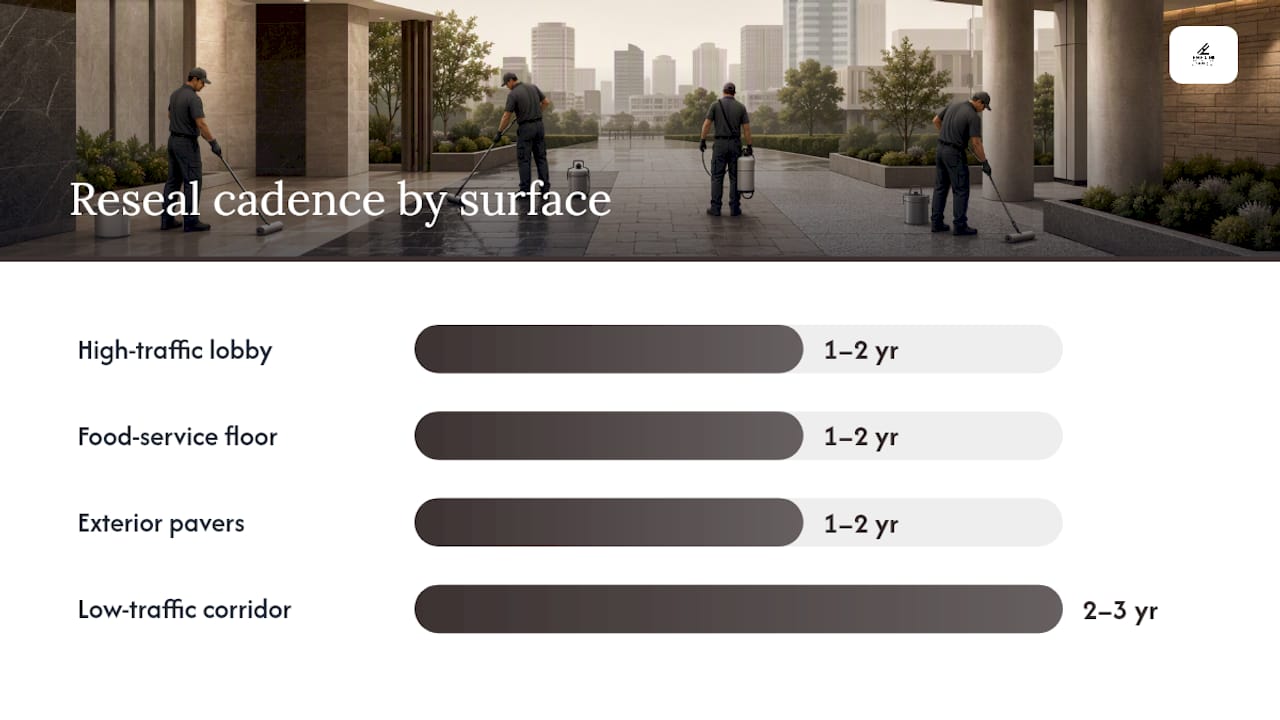
Township Services’ facility manager guide identifies typical reseal frequency for commercial high-traffic surfaces at every 1–2 years, with exterior pavers and food-service floors often falling at the shorter end of that range. The water-drop test is the most practical trigger: when water absorbs in under two minutes on a sealed surface, resealing is due.
Cleaner pH is equally critical. The NPS stone preservation guidelines warn explicitly against acidic or highly alkaline cleaners on sensitive masonry. For commercial stone, this means specifying neutral-pH, stone-specific cleaners for daily janitorial use and training cleaning crews to avoid vinegar-based, citrus, or bleach solutions. As XL North notes, high-quality stone cleaners include chelating agents that manage hard water minerals without disrupting stone chemistry.
For solvent-based sealers applied indoors, review the Safety Data Sheet (SDS) before scheduling. Ventilation requirements vary by product, and some formulas require building occupants to vacate during application and curing. Water-based formulas generally present fewer IAQ concerns, though curing time still applies.
| Surface type | Typical reseal cadence | Notes |
|---|---|---|
| High-traffic lobby (marble/granite) | Every 1–2 years | Water-drop test annually |
| Food service floor (limestone/travertine) | Every 1–2 years | Acid exposure accelerates wear |
| Exterior pavers | Every 1–2 years | Freeze-thaw and UV exposure |
| Low-traffic corridor | Every 2–3 years | Confirm with water-drop test |
When should you hire a stone restoration specialist instead of applying in-house?
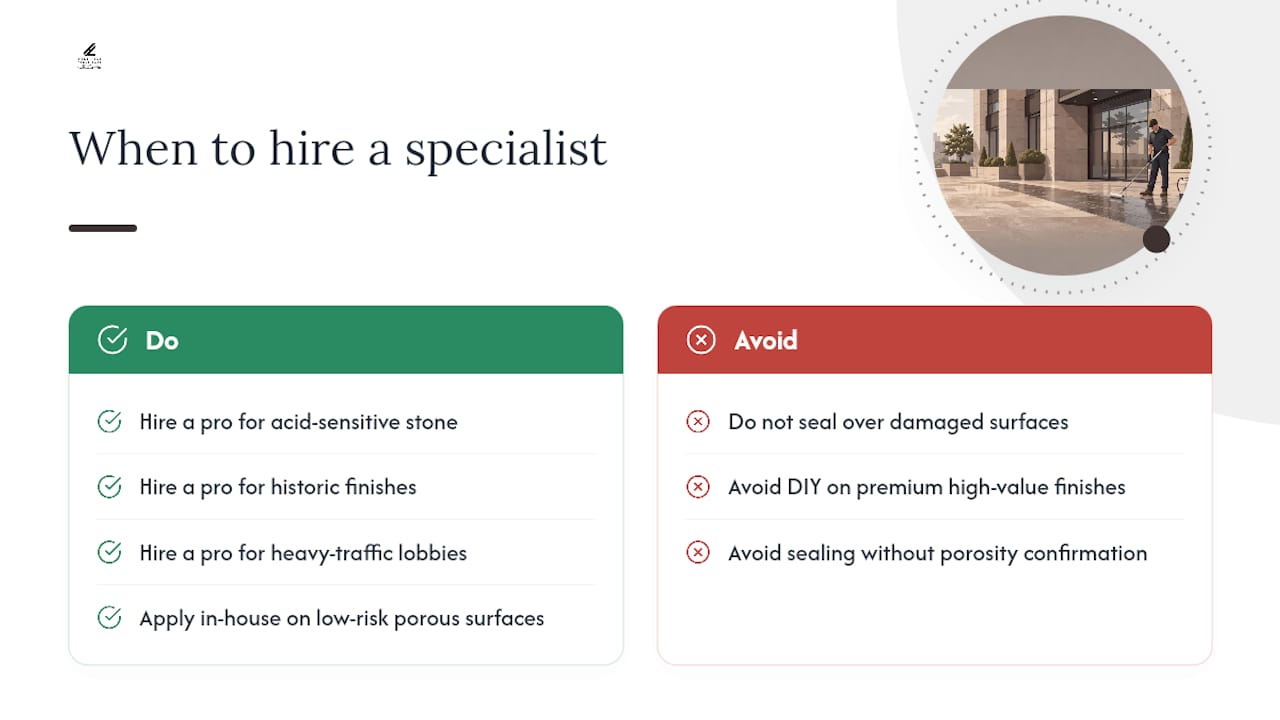
Hire a professional for acid-sensitive stone, historic finishes, heavy-traffic lobbies, food service floors, or any surface where previous coatings exist and need removal. In-house application is reasonable for low-risk surfaces with confirmed porosity and no prior treatment history, but the margin for error narrows quickly on premium stone.
The decision criteria are straightforward. Stone type sensitivity matters most: marble and limestone etch from acid contact, and an incorrect sealer applied without proper surface prep can lock in existing damage. Existing surface damage, such as etching, scratching, or efflorescence, requires restoration before sealing, not sealing over. Risk tolerance for downtime is also a factor; a professional scope includes surface prep, application, curing management, and post-application verification, reducing the chance of a costly redo.
A professional restoration and sealing scope typically includes on-site assessment, porosity and damage mapping, surface preparation (grinding, honing, or polishing as needed), certified sealer application, and a maintenance plan. For property managers overseeing multiple buildings or high-value finishes, a contracted maintenance agreement with a specialist like Highlinestonecare delivers documentation, warranty backing, and predictable scheduling. The Opal Luxury Anti Acid Sealer is applied exclusively by Highlinestonecare’s certified technicians, providing a professional-grade result with guaranteed coverage and acid resistance that standard consumer products cannot replicate. You can review restoration vs. protection scopes to clarify which service your property needs before scheduling.
Key Takeaways
Penetrating, breathable sealers matched to substrate porosity and maintained with neutral-pH cleaners deliver the lowest lifetime cost and most reliable protection for commercial stone surfaces.
| Point | Details |
|---|---|
| Use the SAP framework | Match sealer chemistry to Substrate, Application, and Performance before purchasing any product. |
| Penetrating over topical | Impregnating sealers preserve breathability and avoid moisture-trapping film failures on commercial stone. |
| Reseal periodically, with frequency dependent on traffic and maintenance conditions | High-traffic commercial surfaces need resealing based on water-drop porosity test results and surface condition. |
| Cleaner pH matters | Neutral-pH, stone-specific cleaners with chelating agents protect sealer integrity and extend protection life. |
| Highlinestonecare’s Opal Luxury | Professional-grade acid and stain resistance, applied by certified technicians with warranty backing for commercial properties. |
Why the “best sealer” question misses the point
The stone care industry sells the idea that finding the right product solves the problem. It rarely does. The product is maybe 40% of the outcome. The rest is surface preparation, correct porosity assessment, application technique, and what happens in the weeks after, meaning which cleaners go on the floor and whether the maintenance crew knows the difference between a stone-safe neutral cleaner and a citrus degreaser.
Property managers who focus on product selection without auditing their janitorial protocols often find that a premium sealer fails in six months because it is being cleaned with an acidic floor stripper. Integrating sealing schedules with maintenance cycles, as Highlinestonecare recommends for its commercial clients, consistently reduces long-term surface costs because it eliminates the mismatch between protection and daily care. The commercial stone maintenance guide covers this integration in practical detail.
The other underestimated factor is documentation. Properties that keep application logs, TDS records, and water-drop test results make better decisions at reseal time. Those that do not end up guessing, and guessing on marble in a high-traffic lobby is expensive.
Highlinestonecare’s Opal Luxury Anti Acid Sealer for commercial properties
For property managers who need permanent acid and stain protection on commercial stone, Highlinestonecare’s Opal Luxury Anti Acid Sealer is the professional solution. Unlike standard penetrating sealers that protect against water and oil but leave stone vulnerable to wine, coffee, lemon, and vinegar, Opal Luxury is formulated specifically to resist acid-related etching, the damage type that standard products miss entirely.
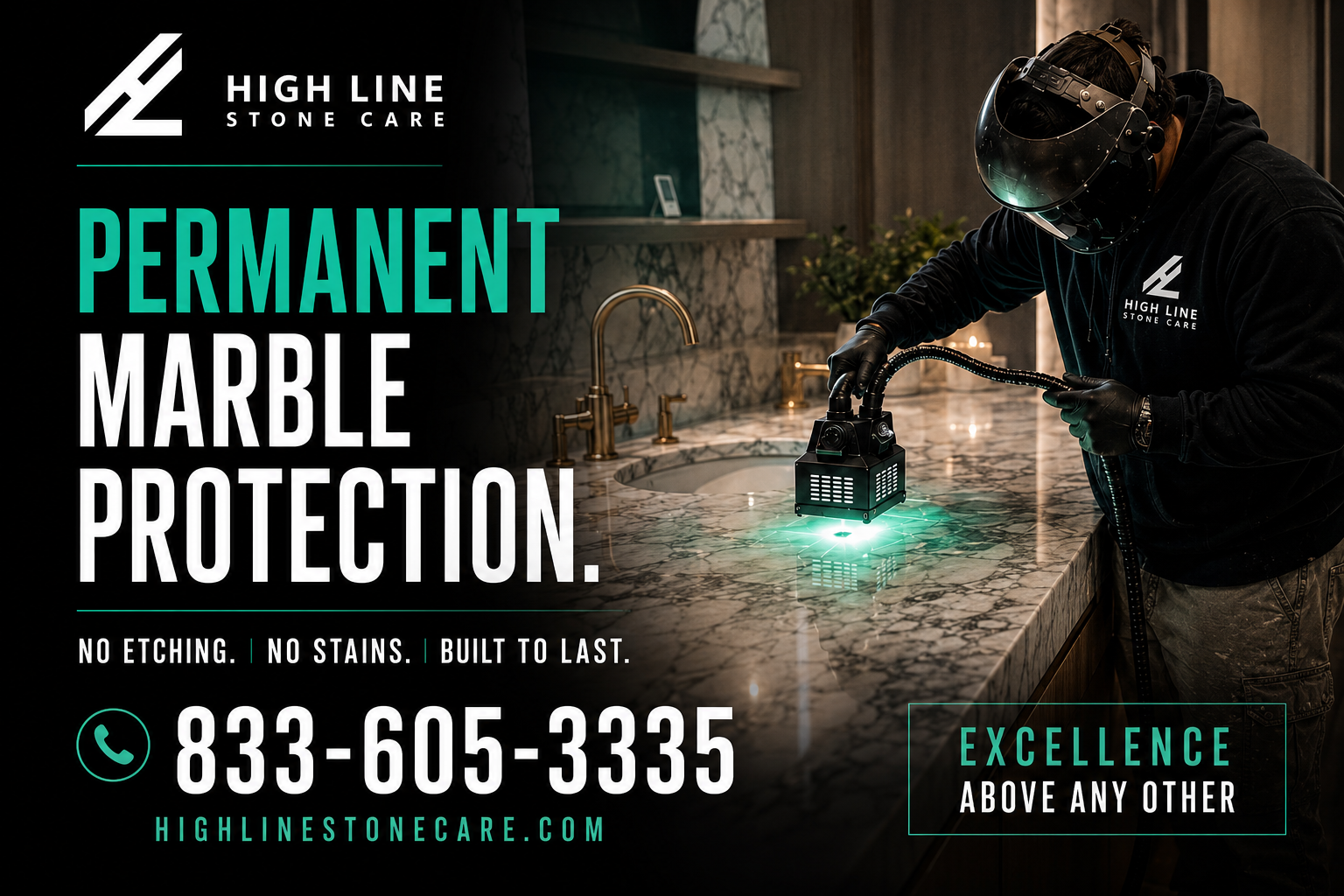
Highlinestonecare’s commercial service includes on-site assessment, porosity and damage mapping, certified application by trained technicians, and a maintenance plan tailored to your building’s traffic and cleaning regime. The result is documented, warranty-backed protection that holds up under the demands of NYC commercial properties, from lobby floors to food-service countertops.
Contact Highlinestonecare for a commercial quote or to schedule a professional stone sealing assessment for your property.
Authoritative technical sources to consult next
The following documents and organizations are the most reliable references for specifying, procuring, and applying commercial stone sealers.
- SEALER SELECTION &
- Natural Stone Institute
- Choosing the right sealer
- Stone building preservation: best practices (NPS)
- Commercial Stone & Metal Restoration: Facility Manager Guide
- Stop Treating Natural Stone Like Resilient Flooring
- Choosing the Best Sealant for Natural Stone in 2025
Recommended
- Commercial Stone Maintenance: A Property Manager’s Guide
- Best Practices for Stone Protection: A Homeowner’s Guide
- Stone Care Tips Every Property Manager Should Know
- Stone Sealing Services NYC | Natural Stone & Countertop Sealer