
Natural stone patina is defined as the gradual surface transformation that occurs through daily use, environmental exposure, and chemical interaction over time. It softens tone, adds depth, and gives stone a lived-in character that many homeowners and property managers find more appealing than a factory-fresh finish. Understanding patina separates informed stone owners from those who panic at the first dull patch on their marble countertop. Stones like marble, soapstone, and weathered granite facades all age and change differently, and knowing what drives those changes is the first step toward managing them well.
What is natural stone patina and how does it form?
Natural stone patina is not damage. It is a gradual, cumulative surface change driven by three forces: environmental exposure, chemical reactions, and mechanical wear. Each force acts on the stone differently, and understanding all three helps you explain natural stone patina to anyone responsible for maintaining a high-end surface.
Environmental exposure plays a constant role. Light, humidity, and air contact cause slow oxidation and mineral shifts across the stone’s surface. On outdoor facades, this process unfolds over decades. Indoors, moisture from cooking, cleaning, and ambient humidity accelerates the process in kitchens and bathrooms.
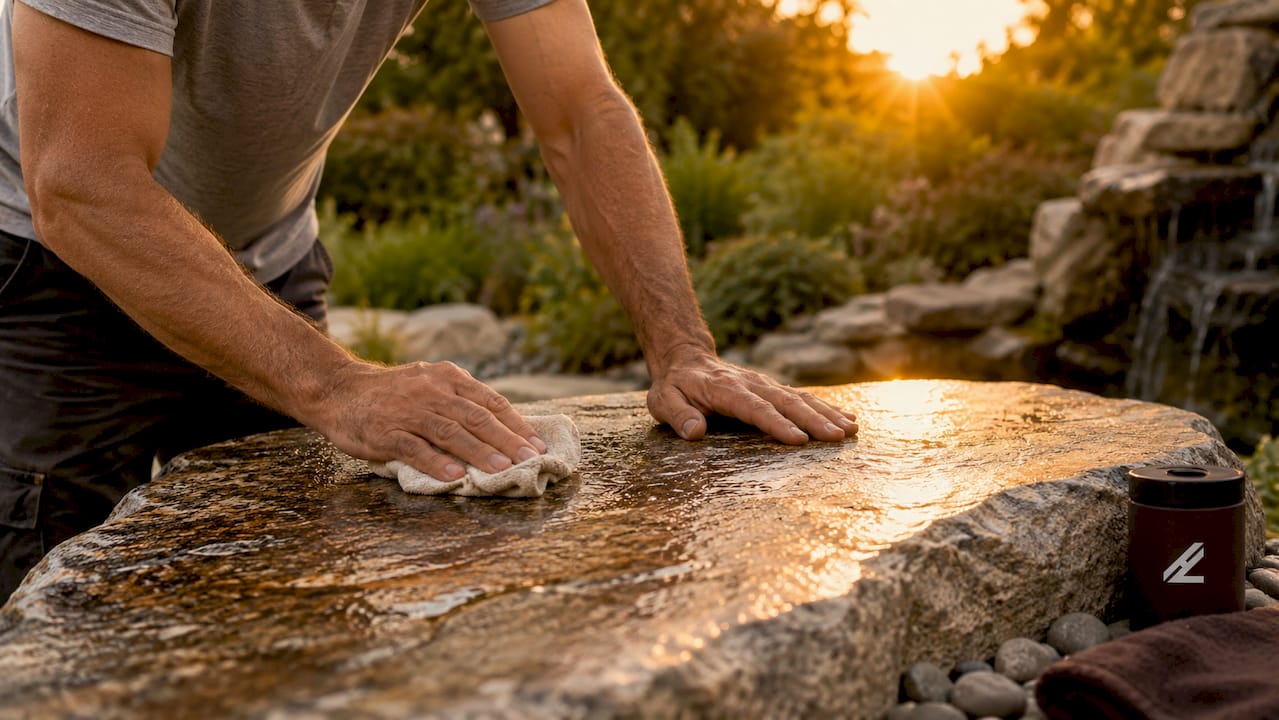
Chemical reactions are the most visible driver on interior stone. Marble is composed largely of calcium carbonate, which reacts with acids. Acid sources like lemon juice, vinegar, wine, tomato sauce, and some household cleaners dissolve a microscopic layer of the surface, leaving dull or matte etch marks. This is called etching, and it is the primary contributor to patina on marble countertops and floors. Etching differs from staining, which involves a substance penetrating the stone’s pores, and from scratching, which is purely mechanical.
Microscopic abrasion from daily handling and cleaning also contributes. Foot traffic on stone floors, wiping countertops with abrasive cloths, and repeated cleaning all gradually alter the surface texture at a microscopic level.
Pro Tip: Never use vinegar, lemon-based sprays, or “natural” citrus cleaners on marble or limestone. They etch the surface on contact, regardless of how diluted they are.
The key distinction for homeowners and property managers is this: patina is the broad, gradual softening of a surface over time. Etching is a localized chemical attack. Staining is liquid penetration into pores. All three contribute to how a stone looks as it ages, but each requires a different response.
How patina looks and behaves across marble, soapstone, and granite
Patina on natural stone does not look the same across stone types. The mineral composition, porosity, and finish of each stone determine how aging shows up visually and how quickly it develops.
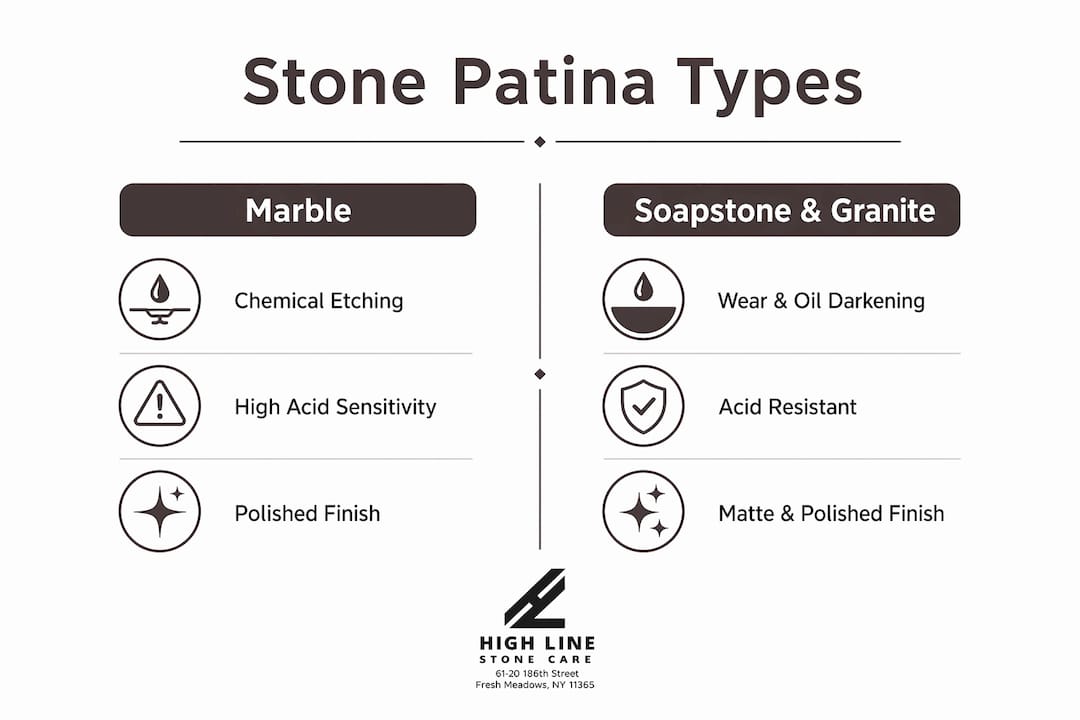
Marble
Marble develops patina primarily through chemical etching from acid contact. On a polished marble countertop, etching appears as dull, lighter patches that contrast sharply with the surrounding gloss. Over time, repeated etching across the whole surface creates a mellowed, softer sheen that many designers consider elegant. The finish you choose affects how visible this process is. Honed marble etches chemically just as polished marble does, but the visual contrast is reduced because the starting surface is already matte. This makes honed finishes a practical choice for kitchens where acid exposure is frequent.
Soapstone
Soapstone behaves very differently. It is composed primarily of talc and magnesite, making it resistant to acid etching unlike marble. Its patina develops through moisture and mineral oil absorption, which gradually darkens the surface over months. During early use, darkening can be uneven, creating a patchy appearance. Applying mineral oil monthly during the first year, then every 2–3 months afterward, evens out the absorption pattern and accelerates darkening to a consistent, rich tone. Consistent oiling reduces patchiness and gives the patina a uniform, intentional appearance.
Granite and quartzite
Granite and quartzite are significantly more resistant to both etching and staining than marble or soapstone. Their patina develops slowly and subtly, usually as a slight softening of surface sheen from foot traffic or cleaning over many years. For most homeowners, granite and quartzite require less active patina management.
| Stone type | Primary patina driver | Acid resistance | Finish impact | Key maintenance |
|---|---|---|---|---|
| Marble | Chemical etching from acids | Low | High: polished shows etching clearly | Neutral pH cleaning, honed finish option |
| Soapstone | Moisture and oil absorption | High | Low: darkening is uniform with oiling | Monthly mineral oil application |
| Granite | Mechanical wear over time | High | Minimal | Periodic sealing, neutral cleaning |
| Quartzite | Slow surface abrasion | Moderate to high | Low | Sealing, avoid abrasive cleaners |
How to care for stone patina: protection, cleaning, and restoration
Managing patina on natural stone requires a clear understanding of what sealers can and cannot do, how to clean without causing damage, and when professional restoration is the right call.
What sealers actually do
Stone sealers slow liquid penetration and reduce staining, but they do not prevent patina. A sealer protects the stone’s pores from absorbing liquids like wine or oil. It does not coat the surface in a way that blocks acid contact. Acid dissolves calcium carbonate directly at the surface level, bypassing the sealer entirely. Homeowners who believe sealing their marble makes it acid-proof will be disappointed when a lemon wedge still leaves a dull ring.
The water bead test is a reliable way to check seal condition. Pour a small amount of water on the stone. If it beads up, the seal is intact. If it soaks in within a few minutes, resealing is due. You can learn more about protecting stone from stains through proper sealing routines.
Daily cleaning practices
- Use only neutral pH stone cleaners or plain warm water for daily cleaning.
- Wipe spills immediately, especially acidic liquids like citrus juice, wine, or coffee.
- Avoid abrasive scrubbing pads, which accelerate mechanical wear.
- Never use vinegar, bleach, or ammonia-based cleaners on calcareous stones.
- Dry the surface after cleaning to reduce moisture exposure, particularly on soapstone.
Neutral pH cleaning combined with immediate spill response is the single most effective daily practice for preserving both the seal and the stone’s surface appearance.
Restoration options when patina becomes damage
Light to moderate etching can be restored through professional honing. Honing removes a thin layer of the stone surface to eliminate etch marks, then polishing restores the desired sheen. Heavy etching requires both honing and re-polishing. Sealers applied after restoration help slow future staining, but they will not prevent new etching if acid exposure continues. Professional stone polishing services address dullness and surface wear that cleaning alone cannot reverse.
Pro Tip: For property managers, create a written SOP that distinguishes patina (broad surface softening) from etching (localized dull marks) and staining (dark penetration). This prevents staff from using the wrong treatment and causing further damage.
Property managers should educate staff and tenants to recognize the difference between these three conditions. A dull overall softening across the whole surface is patina. A localized white or dull mark near the sink is an etch. A dark spot that does not wipe away is a stain. Each condition calls for a different response, and misidentifying them leads to unnecessary restoration costs or, worse, damage from the wrong treatment.
Should you embrace or slow patina on your stone surfaces?
The decision to embrace or slow patina is a personal and practical one. Patina adds depth and character that reflects the natural story of the stone and the space it inhabits. Many architects and interior designers actively value aged stone for this reason. The question is whether that character aligns with your aesthetic goals and how much maintenance effort you want to invest.
Reasons to embrace patina:
- Aged marble develops a warm, softened appearance that polished new stone cannot replicate.
- Patina reduces the visual impact of new scratches and etch marks over time.
- Soapstone’s darkening patina is widely considered its most attractive quality.
- Embracing patina reduces the frequency of professional restoration needed.
Reasons to slow or manage patina:
- High-traffic commercial or rental properties require consistent appearance standards.
- Polished marble in formal spaces like lobbies or dining rooms may need to maintain a uniform sheen.
- Landlords and property managers may face tenant expectations for pristine surfaces.
- Some stone types, like light-colored polished marble, show patina more dramatically than others.
The most practical middle ground for most homeowners is to choose a finish that reduces visible etching, maintain a consistent neutral pH cleaning routine, and schedule professional honing every few years to reset the surface when needed. Finish choice is a genuine control lever. Honed finishes reduce visible etching contrast without changing how the stone ages chemically, making them a lower-maintenance option for busy kitchens and bathrooms.
Key Takeaways
Natural stone patina is a chemical and environmental surface transformation that adds character over time, not a sign of damage, and managing it well requires distinguishing patina from etching and staining.
| Point | Details |
|---|---|
| Patina is not damage | Gradual surface softening from use and environment adds depth and character to natural stone. |
| Sealers do not stop etching | Sealers protect pores from staining but do not prevent acid from dissolving the stone surface. |
| Finish choice matters | Honed marble shows etching less visibly than polished marble, making it a practical option for high-use areas. |
| Soapstone needs oiling | Monthly mineral oil application during the first year evens out darkening and reduces patchiness. |
| Restoration is reversible | Professional honing and polishing can remove light to moderate etching and restore surface appearance. |
What working with natural stone has taught me about patina
Most homeowners come to us at Highlinestonecare convinced that the dull ring near their kitchen sink is a disaster. The first thing I tell them is that it is not. It is chemistry. Marble is calcium carbonate, and acid dissolves calcium carbonate. That is not a flaw in the stone. It is the stone behaving exactly as its mineral composition dictates.
What I have found over years of working with high-end stone surfaces is that the biggest source of unnecessary damage is not acid spills. It is the cleanup attempt afterward. Homeowners reach for whatever cleaner is under the sink, and many of those products contain acids or abrasives that compound the original etch. A dull mark becomes a dull patch. A dull patch becomes a restoration job.
The second thing I have learned is that finish choice is undervalued in the design conversation. Architects and designers specify polished marble for its visual impact, but they rarely tell the homeowner that a honed finish would age more gracefully in a kitchen. That single decision affects years of maintenance expectations.
For property managers, the most valuable investment is not a sealer or a restoration service. It is a one-page SOP that tells your cleaning staff exactly what products to use, what to avoid, and how to tell the difference between patina, etching, and a stain. That document prevents more damage than any product on the market.
Patina, when understood and managed well, is not the enemy of a beautiful stone surface. It is the evidence that the surface has been lived in. The goal is not to stop it. The goal is to guide it.
— High
Highlinestonecare’s professional stone care services
Highlinestonecare works with homeowners and property managers across New York City to restore, protect, and maintain premium natural stone surfaces. Whether your marble countertop has developed heavy etching or your floors need a full professional stone restoration, the team brings advanced expertise to every project.
For homeowners who want lasting protection against acid etching and staining, Highlinestonecare offers the Opal Luxury Anti-Acid Permanent Sealer, a single-application treatment that the brand states can last a lifetime. For surfaces already showing etching or wear, marble restoration services include professional honing, polishing, and resealing to bring stone back to its best condition. Contact Highlinestonecare to schedule a consultation and get a personalized assessment of your stone surfaces.
FAQ
What is natural stone patina?
Natural stone patina is the gradual surface transformation caused by environmental exposure, daily use, and chemical reactions over time. It typically softens the stone’s tone and adds visual depth rather than causing structural damage.
Is patina the same as etching on marble?
Patina and etching are related but distinct. Etching is a localized chemical reaction where acid dissolves the calcium carbonate surface, leaving a dull mark. Patina is the broader, cumulative softening of the whole surface over time, which etching contributes to.
Does sealing stone prevent patina?
Sealing slows staining by protecting the stone’s pores from liquid penetration, but it does not prevent patina. Acid contact still etches the surface directly, regardless of seal condition.
How do I care for soapstone patina?
Apply mineral oil monthly during the first year of use, then every 2–3 months afterward. This evens out the darkening pattern and reduces patchiness as the soapstone develops its natural patina.
When should I call a professional for stone restoration?
Call a professional when etching is widespread, deep, or uneven across the surface. Light to moderate etching can be honed and re-polished by a specialist. Attempting DIY restoration on marble or other calcareous stones risks permanent surface damage.
Recommended
- Different Stone Polishing Methods for Homeowners
- Stone care terms explained: Expert guide for NYC homes
- The Role of Polishing in Stone Care for Homeowners
- How to Protect Natural Stone from Stains Effectively