
Honed vs polished stone surfaces represent two distinct finishing stages of the same fabrication process, producing results that differ sharply in appearance, texture, and maintenance demands. A honed finish stops grinding at 400–800 grit, leaving a matte or satin surface. A polished finish continues to 3,000 grit or higher, creating a mirror-like shine. The choice between them shapes everything from daily cleaning routines to long-term sealing costs. Homeowners, designers, and property managers who understand these differences make better decisions about which finish belongs in each space.
What is the difference between honed and polished stone surfaces?
The difference between honed and polished stone surfaces comes down to one thing: where the fabricator stops grinding. Both finishes are endpoints of the same production sequence, using the same diamond abrasive tools on the same stone slab. Honed surfaces stop at 400–800 grit. Polished surfaces continue past 3,000 grit with additional buffing.
Honed stone has a soft, flat appearance with no reflective sheen. It feels smooth but not glassy. Polished stone, by contrast, catches light and amplifies the depth of color and veining in the material. The same marble slab looks like two different materials depending on which finish it receives.
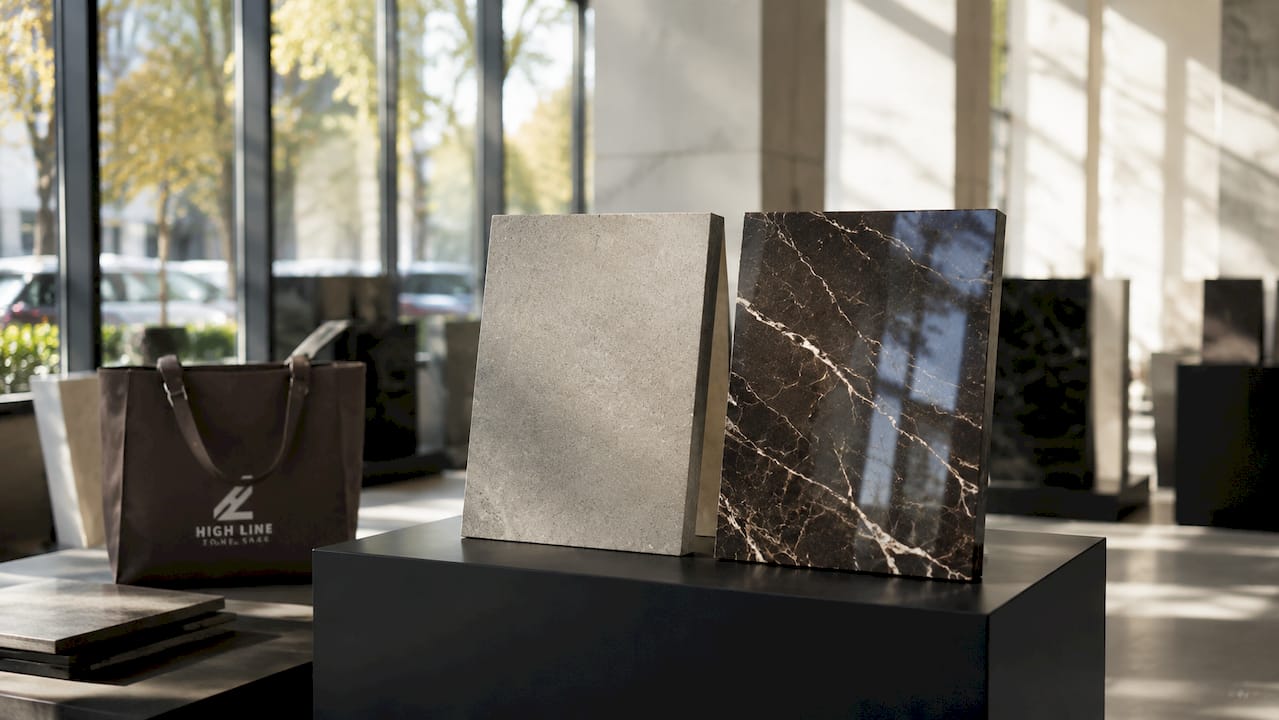
This distinction matters because it affects porosity, slip resistance, stain vulnerability, and visual impact. None of these factors are minor. Each one has real consequences for how a surface performs in your home or property over years of use.
How are honed and polished stone surfaces made?
Stone finishing follows a precise grit progression using diamond abrasive pads. The fabricator moves through increasingly fine grits, removing surface irregularities at each stage. The sequence typically runs as follows:
- Coarse grinding (50–200 grit): Removes saw marks and levels the slab surface.
- Medium grinding (200–400 grit): Smooths the surface and begins to refine texture.
- Honed finish stop (400–800 grit): Produces a matte or satin surface with no reflectivity. This is where honed stone finishes are completed.
- Fine polishing (800–1,500 grit): Begins to develop surface sheen and close pores.
- High-gloss polishing (3,000+ grit with buffing): Achieves a mirror-like surface with maximum color depth and reflectivity. This is the polished finish.
The burnishing effect at the final polishing stage partially closes the stone’s pores. That physical change improves stain resistance without any sealer applied. Honed surfaces skip this stage entirely, leaving pores more open and the surface more absorbent.
Cost follows the same logic. Polished stone arrives finished from the quarry as the default product, making it the less expensive option. Honed finishes require additional fabrication steps as a special order, which raises labor costs. Homeowners and property managers who want honed stone should factor that premium into their budgets.
Pro Tip: If you are ordering honed stone for a large floor installation, request samples at both 400 grit and 800 grit. The visual difference between these two stopping points is significant, and the right choice depends on how much sheen you want in the finished space.
What are the visual and tactile differences?
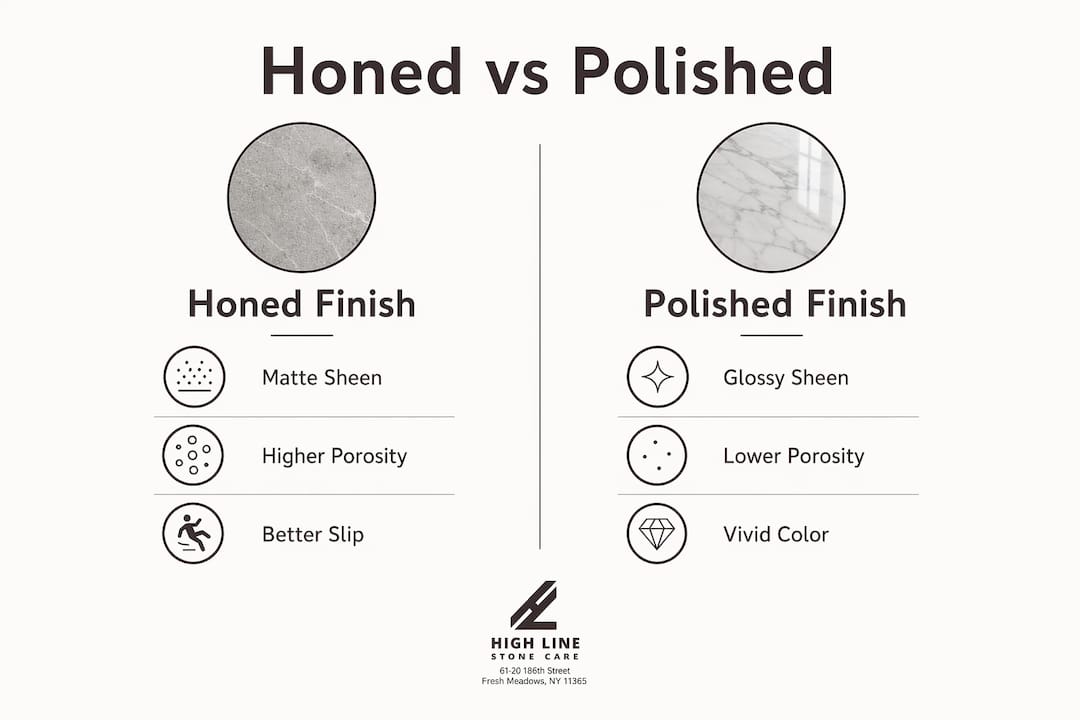
Polished surfaces maximize color depth and reflectivity, making dramatic veining in marble and granite appear vivid and three-dimensional. Honed surfaces present the same stone in a quieter, more understated way. The color reads as slightly lighter and the veining appears softer.
The tactile experience also differs. Polished stone feels glassy and cool. Honed stone feels smooth but more natural, closer to the raw material. Many designers describe honed surfaces as warmer in character, even though both finishes are physically smooth.
Here is a direct comparison of the key visual and tactile properties:
| Property | Honed finish | Polished finish |
|---|---|---|
| Surface sheen | Matte to satin | High-gloss, mirror-like |
| Color saturation | Lighter, more muted | Deep, vivid, saturated |
| Vein visibility | Soft and subtle | Bold and dramatic |
| Tactile feel | Smooth, natural | Smooth, glassy |
| Fingerprint visibility | Low | High |
| Scratch visibility | Low | High |
| Design style | Contemporary, organic, spa-like | Formal, luxurious, classic |
Fingerprints and surface scratches are far more visible on polished stone. The mirror finish amplifies every mark. Honed surfaces absorb minor scratches into their matte texture, making them far less noticeable in daily use. Honed surfaces hide scratches and etches better than polished surfaces, which show etching distinctly because of the reflective finish.
Key visual and tactile considerations at a glance:
- Polished finishes suit formal dining rooms, decorative feature walls, and luxury countertops where visual drama is the goal.
- Honed finishes suit spaces where a calm, organic aesthetic is preferred, such as spa bathrooms and contemporary kitchens.
- Polished stone shows water spots and smudges more readily, requiring more frequent wiping in high-use areas.
- Honed stone reads as more forgiving in busy spaces because surface imperfections blend into the matte texture.
How do honed and polished finishes perform in durability and maintenance?
Performance differences between the two finishes are significant and practical. Honed stone is more porous than polished stone because the final buffing stage that closes pores never occurs. That porosity means liquids absorb faster, raising the risk of staining from oil, wine, coffee, and acidic substances.
Sealing is not optional for honed stone. Honed surfaces require sealing every 1–2 years to prevent oil and liquid absorption. Polished surfaces, with their partially closed pores, can tolerate longer intervals between sealing applications. Skipping sealing on honed stone, especially in kitchens, leads to staining that is difficult to reverse without professional restoration.
Slip resistance is another critical factor. Honed finishes provide higher slip resistance than polished surfaces, making them the preferred choice for wet areas like bathrooms, shower floors, and entryways. Polished stone in a wet bathroom floor is a safety risk. This is not a stylistic preference. It is a functional requirement.
Pro Tip: For kitchen countertops in honed marble or limestone, use a high-quality impregnating sealer rather than a topical coating. Impregnating sealers penetrate the stone and protect from within, without altering the matte appearance that makes honed stone attractive.
Here is a side-by-side performance comparison:
| Factor | Honed finish | Polished finish |
|---|---|---|
| Porosity | Higher, more absorbent | Lower, more resistant |
| Stain resistance | Moderate (sealer required) | Good (sealer still recommended) |
| Slip resistance | Medium to high | Low |
| Sealing frequency | Every 1–2 years | Less frequent |
| Etch visibility | Low | High |
| Scratch visibility | Low | High |
| Best environment | Wet areas, high-traffic floors | Decorative walls, formal rooms |
Etching deserves special attention. Both finishes etch when exposed to acids like lemon juice or vinegar, because etching is a chemical reaction with the calcium in the stone, not a surface scratch. The difference is visibility. On polished stone, an etch mark appears as a dull patch against the glossy background. On honed stone, the same etch blends into the matte surface and is far less noticeable. Homeowners who cook frequently or have young children often find honed stone far more forgiving in practice.
Which finish should you choose for different spaces?
The right finish depends on how the space is used, who uses it, and what aesthetic the homeowner or designer wants to achieve. The choice between honed and polished stone is fundamentally a lifestyle decision that balances appearance, maintenance habits, and tactile preference.
Best applications for honed stone finishes:
- Bathroom floors and shower surrounds, where slip resistance is a safety priority
- Kitchen countertops in active households, where etch marks from cooking acids are common
- High-traffic hallways and entryways, where foot traffic and moisture combine
- Spa-style bathrooms and wellness spaces, where a calm, organic aesthetic is the design goal
- Commercial lobbies and property common areas managed by property managers who need forgiving surfaces
Best applications for polished stone surfaces:
- Decorative feature walls and fireplace surrounds, where visual impact matters most
- Formal living and dining rooms with low daily wear
- Luxury countertops in low-acid-use kitchens or bathrooms
- Hotel lobbies and high-end retail environments where the mirror finish signals prestige
Design trends show that polished finishes dominate luxury projects globally, while honed finishes are gaining ground in spa-like and organic design environments. This shift reflects a broader move toward quieter, more tactile interiors. Designers working on residential projects increasingly specify honed marble for master bathrooms and honed limestone for kitchen islands, reserving polished finishes for statement pieces.
Property managers overseeing multiple units benefit from knowing that honed floors in common areas require a consistent sealing schedule. Without it, the open pores absorb foot traffic grime and become difficult to restore. A commercial stone maintenance plan that accounts for finish type is the most cost-effective approach over time.
Key Takeaways
The most effective approach to choosing between honed and polished stone is to match the finish to the function of the space, then build a sealing and maintenance routine around that choice.
| Point | Details |
|---|---|
| Finish is a fabrication decision | Honed stops at 400–800 grit; polished continues to 3,000+ grit with buffing. |
| Porosity drives maintenance | Honed stone requires sealing every 1–2 years due to open pores; polished stone needs it less often. |
| Slip resistance favors honed | Honed finishes offer better grip in wet areas; polished surfaces carry a slip risk in bathrooms. |
| Etch visibility differs sharply | Etch marks blend into honed surfaces but stand out clearly on polished finishes. |
| Cost and availability vary | Polished is the default quarry finish and costs less; honed requires special fabrication and carries a labor premium. |
What I have learned after years of working with both finishes
Most homeowners come to us having already decided on polished marble because it photographs beautifully. That is a reasonable starting point. But the conversation changes quickly when they describe their kitchen habits or mention that they have children. The finish that looks best in a showroom is not always the finish that holds up best in a real home.
The sealing question is the one most people underestimate. A honed surface without a proper impregnating sealer is not just vulnerable. It is actively absorbing whatever touches it. I have seen beautiful honed limestone countertops stained beyond recovery because the homeowner assumed the stone was sealed when it was not. That is a restoration job that costs far more than a proper sealing routine would have.
Polished finishes are rising in luxury applications globally, but honed finishes are gaining real momentum in residential design. The organic, anti-glare quality of honed stone fits the way people want their homes to feel right now. That trend is not going away.
My honest advice: choose your finish based on the room’s function first, your aesthetic preference second. Then protect whichever finish you choose with a professional-grade sealer applied on schedule. A surface that looks good on day one but degrades within two years is not a good investment. A surface that is properly maintained looks exceptional for decades.
— High
Protecting your stone surfaces with Highlinestonecare
Whether your space features a honed finish or polished stone, the right protection makes the difference between a surface that ages gracefully and one that requires costly restoration.
Highlinestonecare offers professional stone sealing services designed for both honed and polished natural stone, including the Opal Luxury Anti Acid Permanent Sealer. This advanced impregnating sealer provides lasting protection against acid etching and staining, with a single application that Highlinestonecare claims can last a lifetime. For surfaces that have already suffered etching, scratching, or staining, Highlinestonecare’s stone restoration services return them to their original finish. Homeowners and property managers in New York City can contact Highlinestonecare directly to schedule a consultation and protect their investment.
FAQ
What is the main difference between honed and polished stone?
Honed stone stops the grinding process at 400–800 grit, producing a matte or satin finish. Polished stone continues to 3,000 grit or higher, creating a mirror-like, high-gloss surface.
Which finish is better for bathroom floors?
Honed finishes are better for bathroom floors because they provide higher slip resistance than polished surfaces, making them safer in wet conditions.
How often does honed stone need to be sealed?
Honed stone requires sealing every 1–2 years due to its open pores, which absorb liquids and oils more readily than polished stone.
Does polished stone etch more visibly than honed stone?
Yes. Etch marks appear as dull patches against the glossy background of polished stone and are highly visible. On honed stone, the same etching blends into the matte surface and is far less noticeable.
Is honed stone more expensive than polished stone?
Honed stone typically costs more because it requires additional fabrication steps as a special order. Polished stone arrives finished from the quarry and is the standard, less expensive option.
Recommended
- Different Stone Polishing Methods for Homeowners
- The Role of Polishing in Stone Care for Homeowners
- Stone Polishing NYC | Countertop & Floor Polishing Services
- Stone care terms explained: Expert guide for NYC homes