
A property manager can protect natural stone across a portfolio with a three-part routine: daily dust-and-blot, scheduled neutral-cleaning and reseal inspections, and professional restoration when surface gloss or stains persist. The Natural Stone Institute, the Marble Institute of America (MIA), and Highlinestonecare’s Opal Luxury Anti Acid Sealer each represent a layer of that protection: industry standards, procedural guidance, and advanced surface defense.
Staff-ready checklist (print and post):
- Dust mop all stone floors daily with a microfiber head
- Blot spills immediately; never wipe or spread
- Clean weekly with a pH-neutral cleaner (pH 6–8)
- Inspect sealer performance quarterly using the water-bead test
- Schedule professional reseal every 3–5 years, sooner in high-traffic zones
- Escalate to professional restoration when polish reads below ~45 gloss units or stains persist after poultice
Table of Contents
- What are the best property manager stone care tips for daily and weekly cleaning?
- How should you schedule stone maintenance across a full property?
- What do sealers actually do, and when should you reapply them?
- What products and practices should you never use on natural stone?
- When should you call a professional stone restoration contractor?
- How do you handle stains and etching on stone surfaces right away?
- Why does documentation protect your property and your budget?
- What tools and equipment should property teams use on stone?
- When does advanced anti-etch protection make sense for your property?
- How do you clean oil, wine, and coffee spills from stone surfaces?
- How do you train staff to handle stone surfaces correctly?
- What should a routine stone inspection checklist include?
- Key Takeaways
- What property managers consistently get wrong about stone care
- How Highlinestonecare protects high-value stone in NYC properties
- Useful sources for property managers
What are the best property manager stone care tips for daily and weekly cleaning?
Daily stone maintenance comes down to two actions: dry dusting and immediate spill response. Weekly care adds a pH-neutral damp mop and a thorough rinse. That sequence, followed consistently, prevents the grit abrasion and acid etching that drive most restoration costs.
Step-by-step sequence for staff:
- Dry-sweep or dust mop the entire stone surface with a microfiber mop head before any wet cleaning.
- Walk the area and inspect for spills or residue.
- Blot any spill with a clean, dry cloth using gentle downward pressure. Do not wipe.
- Dilute the approved pH-neutral cleaner per label instructions.
- Apply with a damp (not soaking) microfiber mop; work in sections.
- Rinse with clean water using a second mop or bucket.
- Dry the surface to prevent moisture from reabsorbing into porous stone.
The Natural Stone Institute specifies pH 6–8 as the safe range for routine cleaning. Anything below pH 6 can chemically etch calcium-carbonate stones like marble, limestone, and travertine, leaving permanent dull patches. Products labeled “all-purpose cleaner” or “bathroom cleaner” almost always fall outside that range.
Role assignments:
- Porter/housekeeper: daily dust mop and spill blot
- Janitor: weekly neutral-clean rinse and drying
- Supervisor: verify product pH before restocking; sign off on weekly log
Pro Tip: Never use polypropylene or grit-enhanced scrubber brushes on polished stone. These create micro-scratches that progressively dull the finish. Use microfiber pads or soft nylon brushes only, and keep a separate labeled “stone-only” cleaning kit to prevent cross-contamination from other floor types.
How should you schedule stone maintenance across a full property?
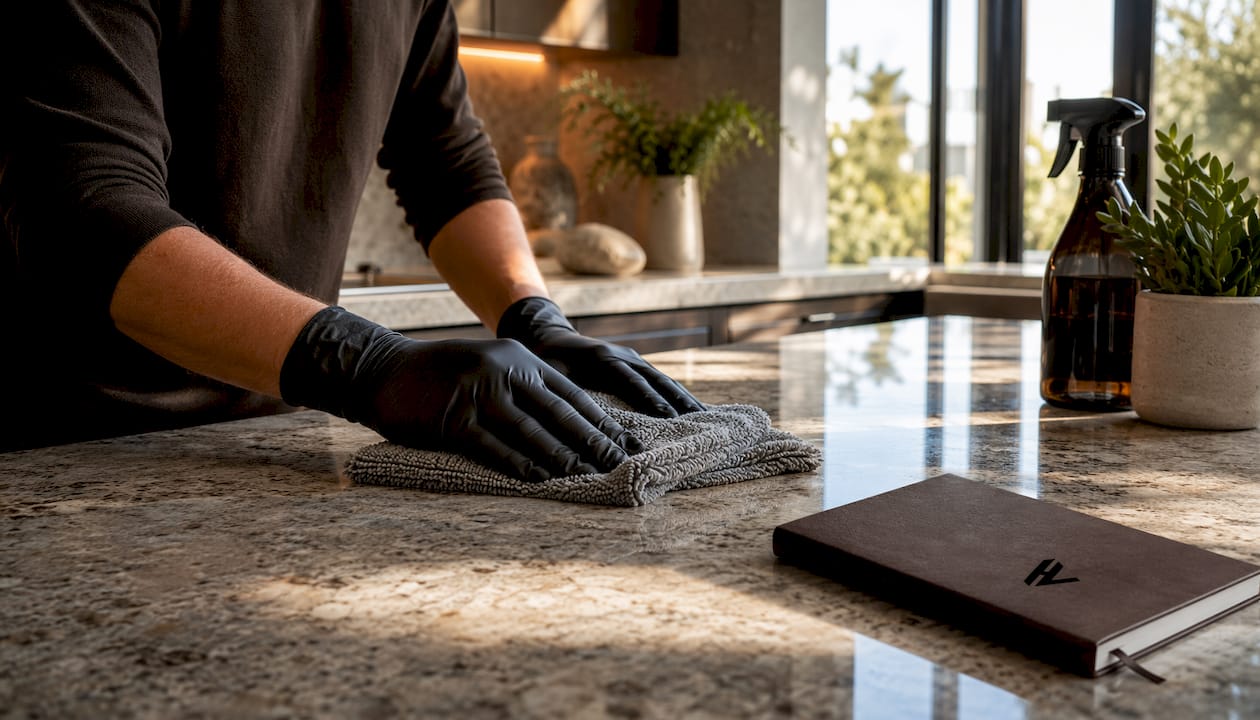
Adopt a tiered cadence: daily quick care, weekly neutral-clean, monthly spot deep-clean, quarterly inspections, and an annual professional review. Each tier catches what the previous one misses.
| Frequency | Task | Owner |
|---|---|---|
| Daily | Dust mop; blot spills | Porter / housekeeper |
| Weekly | pH-neutral damp mop + rinse + dry | Janitor |
| Monthly | Deep-clean grout lines; inspect high-wear zones | Contracted janitor |
| Quarterly | Water-bead sealer test; visual gloss check; grout cleanliness score | Supervisor + stone tech |
| Annually | Professional honing/polishing review; reseal assessment | Licensed stone restoration contractor |
Exterior stone cladding warrants at least two inspections per year, with probe checks at mortar joints to detect hidden moisture before freeze-thaw cycles cause spalling. Pool and chlorine-exposure zones, high-traffic lobbies, and restaurant surfaces should move to quarterly professional review rather than annual.
Three simple metrics make audits objective: the water-bead test (pass/fail), a visual gloss check against a reference photo, and a count of stain incidents per quarter. When any metric trends negative, accelerate the cadence rather than waiting for the scheduled date.
What do sealers actually do, and when should you reapply them?
Impregnating sealers increase stain and moisture resistance by penetrating the stone’s pores, but they are not permanent. The Natural Stone Institute advises re-application every 3–5 years, with frequency adjusted for porosity and traffic. High-traffic lobbies may need inspection annually.
Penetrating (impregnators) vs. topical sealers:
- Penetrating impregnators: absorb below the surface; preserve natural texture; best for interior countertops, floors, and most commercial applications; do not alter appearance
- Topical sealers: sit on the surface; can enhance gloss; may trap moisture on exterior cladding and degrade in freeze-thaw cycles; not recommended for outdoor use per MIA guidance
| Stone type | Traffic level | Suggested reseal interval |
|---|---|---|
| Dense granite | Low–medium | 4–5 years |
| Dense granite | High | 3 years |
| Marble / limestone | Low–medium | 3–4 years |
| Marble / limestone | High | 2–3 years |
| Travertine (filled) | Any | 2–3 years |
Pro Tip: Use the water-bead test during every quarterly inspection rather than relying on a fixed calendar alone. Pour a small amount of water on the stone. If it absorbs within a few minutes instead of beading, reseal promptly. Waiting for visible staining means damage has already occurred.
For a deeper look at how restoration and protection differ in practice, that distinction matters when budgeting for a portfolio.
What products and practices should you never use on natural stone?
Do not use acids, abrasive powders or pads, or harsh rust removers. Each one causes a specific, often irreversible type of damage.
- Vinegar and lemon juice: acidic; chemically etch calcium-carbonate stones, leaving permanent dull spots. Alternative: pH-neutral stone cleaner.
- Bathroom and grout cleaners (pH below 6): dissolve the stone surface on contact. Alternative: stone-specific neutral cleaner.
- Scouring powders and abrasive pads: scratch polished surfaces; accelerate gloss loss. Alternative: microfiber pad or soft nylon brush.
- Steel wool: leaves iron particles that oxidize and stain. Alternative: soft cloth or microfiber.
- Rust removers containing hydrofluoric acid: chemically attack silica-based stones and etch all stone types. Alternative: professional rust removal only.
- Bleach and ammonia mixtures: degrade sealer and can discolor stone. Alternative: hydrogen peroxide (diluted) for organic stains on light stone, applied carefully.
For a full breakdown of preventing marble etching, including acid-sensitivity by stone type, that resource covers the chemistry in plain terms.
When should you call a professional stone restoration contractor?
Call a professional when routine cleaning no longer restores appearance. Specific triggers include permanent dull spots that remain after neutral cleaning, etch rings around sinks or counters, grout that stays discolored despite deep scrubbing, a gloss meter reading below approximately 45 units, repeated staining after poultice application, deep scratches, chips, or substrate moisture issues.
Observable signs checklist:
- Visible etch rings or dull patches that do not respond to cleaning
- Grout lines that appear dark or stained after professional cleaning
- Gloss meter reading below ~45 units
- Stains that return within days of poultice treatment
- Chips, cracks, or lippage at tile edges
- Efflorescence or moisture staining on exterior cladding
Before the vendor arrives:
- Photograph every affected area with a timestamp.
- Limit foot traffic in the zone and place protective barriers.
- Stop using any cleaning product that may have caused or worsened the damage.
- Pull the service log to confirm cleaning history and products used.
Vendor questions for accurate bids:
- What stone type and finish will you be working with?
- What restoration steps do you propose (honing, polishing, crystallization)?
- What is the estimated timeline and will the area be accessible during work?
- What warranty do you provide on the restoration?
- Can you supply references from comparable commercial properties?
- Are you fully insured, and can you provide a certificate?
RFP scope template: “We require restoration services for [stone type] surfaces in [location/area]. The affected area is approximately [sq ft]. Issues include [etching/staining/loss of gloss/chips]. Please provide a written scope of work, proposed restoration method, timeline, warranty terms, and proof of insurance. An on-site assessment is required before final pricing.”
Signs your stone needs restoration covers additional indicators that help managers distinguish routine wear from damage requiring professional intervention.
How do you handle stains and etching on stone surfaces right away?
Contain and blot immediately. Do not rub. The first five minutes after a spill determine whether the damage is temporary or permanent.
Emergency response sequence:
- Isolate the area with a wet-floor sign or barrier if the spill is large.
- Blot with clean, dry absorbent cloth or paper towels using straight downward pressure.
- Flush with clean water if the spill is water-based and the stone is not porous enough to absorb quickly.
- Apply a poultice for oil-based stains: mix an absorbent powder (diatomaceous earth or kaolin clay) with a stone-safe degreaser, apply a thick layer, cover with plastic, and leave 24–48 hours. Poultice application often needs repeating for deep stains.
- For organic stains (coffee, wine, food) on light-colored stone, diluted hydrogen peroxide can help lift the stain. Ventilate the area and test in an inconspicuous spot first.
- Document the incident with photos and note the substance, response time, and products used.
- Escalate if the stain persists after two poultice cycles or if etching is visible.
When etching is suspected, a marble polishing powder applied with a damp cloth can reduce the appearance of light etch marks. Stop and call a professional if the etch is deep, covers a large area, or the surface loses significant gloss.
Spill response kit contents (place near kitchens, bars, and restrooms):
- Clean white cloths or paper towels
- pH-neutral stone cleaner (pre-diluted in a labeled spray bottle)
- Poultice powder and plastic wrap
- Printed spill response card with the steps above
Why does documentation protect your property and your budget?
Keep a centralized, dated service log that records every cleaning session, product used, sealing date, and restoration event. That log protects manufacturer warranties, supports insurance claims, and gives incoming vendors the context they need to quote accurately.
Service log template fields:
- Date and time
- Location (building, floor, zone)
- Stone type and finish
- Task performed (routine clean, deep clean, reseal, restoration)
- Product name and pH
- Staff member or vendor name
- Photos (timestamped)
- Next scheduled review date
During tenant turnover, pull the log to document the stone’s condition at handover. During an insurance incident, the log demonstrates due diligence and establishes a baseline condition. Detailed documentation of cleaning frequencies and sealing dates is commonly overlooked but often required for warranty support.
Pro Tip: Store timestamped photos in a shared cloud folder organized by property and zone. Create a separate “condition at handover” record for each vacant unit so disputes about pre-existing damage are resolved with evidence, not memory.
For broader interior surface care that complements stone maintenance, cleaning interior finishes follows similar principles of pH-appropriate products and gentle application.
What tools and equipment should property teams use on stone?
Choose microfiber dust mops, soft-bristle brushes, and pH-neutral cleaners as the foundation of any stone-safe cleaning program. The wrong equipment causes more damage than the wrong schedule.
Recommended equipment:
- Microfiber dust mop heads: trap grit rather than pushing it; replace heads frequently
- Two-bucket mopping system: one bucket for cleaning solution, one for clean rinse water; change rinse water often
- Soft nylon scrub brushes: safe for grout lines on polished stone; never polypropylene
- Microfiber cloths: for spill blotting and surface drying
- pH-neutral stone cleaner: verify pH 6–8 on every product before purchasing
- Entrance matting: minimum 6–8 feet at all exterior doors to capture grit before it reaches stone floors
Reserve for professionals only:
- Diamond abrasive pads and honing discs
- High-speed burnishers and crystallization machines
- Chemical strippers and heavy-duty rust removers
- Low-speed orbital polishers with abrasive compounds
Keep a dedicated “stone-only” cleaning kit, clearly labeled and stored separately from general janitorial supplies. Cross-contamination from a mop used on concrete or tile can introduce grit and residue that scratches polished stone.
When does advanced anti-etch protection make sense for your property?
Premium anti-etch protection is justified when high-value stone surfaces face frequent acid exposure or when owners want to reduce restoration cycles over a multi-year horizon. Luxury lobbies, restaurant bar tops, hotel countertops, and high-end residential kitchens are the clearest candidates.
Highlinestonecare’s Opal Luxury Anti Acid Sealer is positioned as advanced protection specifically for these environments. It is designed to defend marble and other calcareous stones against wine, lemon, vinegar, coffee, and other acidic substances that standard impregnators do not address. For a property manager running a luxury residential building or a commercial space with a food-and-beverage component, the reduction in etch-repair frequency translates directly to lower restoration costs and fewer tenant complaints.
Use-case fit:
- Luxury lobby marble with daily foot traffic and beverage service
- High-end residential countertops in units with frequent turnover
- Restaurant and bar stone surfaces exposed to citrus and alcohol
- Hotel vanities and bathroom stone in premium suites
Questions to ask before purchasing any advanced sealer:
- What is the expected lifespan, and under what conditions?
- What is the cure time before the surface can be used?
- Does the product alter the finish (gloss, texture, color)?
- What warranty does the manufacturer provide?
- Are third-party test results or case studies available?
Pro Tip: Before full application, test any new sealer on an inconspicuous area and document the water-bead response before and after. That baseline photo becomes part of the service log and confirms the product performed as specified.
For a broader view of acid-resistant surface protection options and how they compare, that resource covers the technical distinctions in plain terms.
How do you clean oil, wine, and coffee spills from stone surfaces?
Each substance behaves differently on stone, and the response method needs to match the stain type.
Oil-based spills (cooking oil, grease, body lotion): Blot immediately. Apply a poultice made from an absorbent powder mixed with a stone-safe degreaser. Cover with plastic wrap, tape the edges, and leave 24–48 hours. Oil stains tend to darken the stone around the spill; the poultice draws the oil back out as it dries. A second application is often needed.
Wine and coffee (organic, tannin-based stains): Blot at once. Flush with clean water. For light-colored marble or limestone, a diluted hydrogen peroxide solution applied to the stain and covered with plastic wrap can lift the discoloration. Leave several hours, then rinse thoroughly. Do not use this method on dark stones, as hydrogen peroxide may lighten the surface.
Acidic beverages (citrus juice, sparkling water, wine on marble): The acid itself causes etching, which is a physical change to the stone surface, not just a stain. Blot the liquid, rinse with water, and assess whether a dull patch remains. If it does, that is an etch mark, not a stain, and it requires mechanical polishing to correct. A marble polishing powder can address light etching; deeper marks need professional attention.
The key distinction for staff: a stain changes color, an etch changes texture. Both require prompt response, but the remediation path differs.
How do you train staff to handle stone surfaces correctly?
Training is most effective when it is specific, visual, and tied to consequences. Generic “be careful with stone” instructions do not change behavior; a laminated one-page protocol posted in the supply room does.
Core training elements:
- Show staff the difference between an etched surface and a clean one using before/after photos
- Demonstrate the blot-don’t-wipe technique with a practice spill during onboarding
- Walk through the approved product list and explain why unapproved products are banned
- Assign a “stone kit” to each cleaning zone so staff never improvise with nearby supplies
- Run a quarterly five-minute refresher when the inspection log shows any incident uptick
Role clarity matters as much as technique. Porters handle daily dust and spill response. Janitors own the weekly neutral-clean. Supervisors verify product compliance and sign off on the log. When everyone knows their lane, gaps close.
For properties managing multiple surface types, a partner resource on cleaning interior finishes offers complementary guidance on keeping non-stone surfaces in good condition alongside stone care protocols.
What should a routine stone inspection checklist include?
A quarterly inspection checklist catches early damage before it becomes a restoration project. Walk each stone zone with this list and photograph any item that fails.
Inspection checklist:
- Water-bead test: pour a small amount of water on the surface. Beading = sealer intact. Absorption within a few minutes = reseal needed.
- Visual gloss check: compare current appearance to a reference photo taken after the last professional service
- Etch scan: look for dull rings, patches, or spots that do not respond to cleaning
- Grout condition: check for discoloration, cracking, or receding grout lines
- Edge and corner integrity: inspect for chips, cracks, or lippage at tile edges
- Drain and moisture zones: check for efflorescence, water staining, or soft grout near drains and exterior thresholds
- Entrance matting: confirm mats are in place, clean, and covering the minimum 6–8 feet of entry zone
- Cleaning supply audit: verify only approved pH-neutral products are in the stone-zone supply kit
Record each item as pass, monitor, or escalate. “Monitor” items get a follow-up date two weeks out. “Escalate” items trigger the professional-restoration process described earlier. A consistent inspection record also builds the documentation trail that supports warranty and insurance claims.
Key Takeaways
Effective stone care for property managers rests on three pillars: daily prevention, scheduled neutral-cleaning with quarterly sealer inspections and reseal every 3–5 years, and professional restoration when routine care is no longer sufficient.
| Point | Details |
|---|---|
| Daily prevention first | Dust mop and blot spills daily; this single habit prevents most grit abrasion and acid damage. |
| pH-neutral cleaning only | Use cleaners in the pH 6–8 range for all routine stone cleaning to avoid etching calcareous stones. |
| Reseal every 3–5 years | Inspect sealer quarterly with the water-bead test; reapply impregnators on schedule, sooner in high-traffic zones. |
| Document everything | A dated service log with photos protects warranties, supports insurance claims, and gives vendors accurate scope. |
| Highlinestonecare’s Opal Luxury | For high-value or acid-exposed surfaces, the Opal Luxury Anti Acid Sealer provides advanced protection beyond standard impregnators. |
What property managers consistently get wrong about stone care
The conventional wisdom in property management is to treat stone maintenance as a janitorial line item. That framing is where most portfolios go wrong. Stone is a material with specific chemistry, and the moment a cleaner, a brush, or a mop interacts with it incorrectly, the damage is often permanent. No amount of re-cleaning fixes an etch mark.
The most avoidable failures seen across managed properties follow a pattern: a well-meaning porter uses a bathroom cleaner on a marble lobby floor because it was the closest product on the cart. Or a supervisor skips the quarterly sealer check for two years because the stone “still looks fine,” then discovers the sealer failed eighteen months ago and a coffee spill has stained through. Or a property changes janitorial vendors and nobody transfers the service log, so the new crew has no idea what products were used or when the stone was last sealed.
Prevention and documentation are not administrative overhead. They are the actual maintenance. A laminated spill protocol, a labeled stone-only supply kit, and a quarterly inspection log cost almost nothing. Skipping them costs restoration fees, tenant complaints, and in some cases, full surface replacement.
Budget allocation also tends to be reactive rather than planned. Properties that schedule annual professional reviews and reseal on a documented cycle spend less over five years than those that wait for visible damage and then pay for emergency restoration. The math is straightforward; the discipline to act on it before something looks wrong is what separates well-maintained portfolios from expensive ones.
How Highlinestonecare protects high-value stone in NYC properties
When the signs from the inspection checklist appear, or when a property manager wants to get ahead of restoration costs with advanced protection, Highlinestonecare provides targeted services built for high-end residential and commercial properties throughout New York City.

The core offering covers the full cycle: professional assessment, honing and polishing restoration, application of the Opal Luxury Anti Acid Sealer, and ongoing maintenance programs for lobbies, countertops, vanities, and luxury interiors. For managers overseeing marble, travertine, limestone, granite, or terrazzo, the process begins with an on-site inspection, followed by a written scope, timestamped photos, and a clear timeline. No vague estimates.
For properties in Manhattan and across NYC, stone restoration services are scheduled around building operations to minimize disruption. Request an inspection when any item on the checklist above escalates, or when a surface has not been professionally reviewed in more than two years.
Useful sources for property managers
- Natural Stone Institute — Consumer Care Guidance: The primary industry standard for pH recommendations, cleaning product selection, and sealer guidance. Best for policy and product approval decisions.
- Natural Stone Institute — CEU Course: Stone Care: A one-hour course covering sealer types, cleaner chemistry, and maintenance best practices for design and facility professionals. Best for staff training and vendor evaluation.
- MIA Guide to Care and Cleaning of Natural Stone (via Inspectapedia): Authoritative procedural guidance including ASTM C1515-01 references. Best for operational checklists and what-not-to-use decisions.
- Top Source Stone — Exterior Natural Stone Cladding Maintenance: Covers exterior-specific inspection cadence, probe checks, and moisture-driven damage prevention. Best for properties with exterior stone facades.
- Highlinestonecare — Stone Protection Strategies Guide: Best-practice protection strategies tailored to commercial and luxury residential properties. Best for vendor selection and advanced protection planning.
Recommended
- Commercial Stone Maintenance: A Property Manager’s Guide
- Stone Care’s Role in Property Value: A Homeowner’s Guide
- Common Stone Care Mistakes Homeowners Must Avoid
- Residential Stone Cleaning Tips for Every Home