
Protective film for stone is defined as a clear polyurethane barrier applied directly to the surface of natural stone to shield it from acid etching, scratches, stains, and impact damage. The role of protective film for stone goes well beyond what a traditional sealer can offer. Where a sealer fills pores to slow staining, a film physically blocks every threat that contacts the surface. Highlinestonecare works with this technology daily on premium marble in New York City, and the difference in long-term outcomes is significant. Quality films carry warranties of 5–10 years, which already surpasses the 1–3 year reapplication cycle of most penetrating sealers.
What is the primary role of protective film for stone surfaces?
Protective film acts as a physical shield between the stone and everything that touches it. That distinction matters because marble, limestone, and travertine are calcium-based stones that react chemically with acids. A drop of lemon juice, a splash of wine, or a cleaning product with citric acid can etch the surface within seconds, leaving a dull patch where the stone once had a polished finish.
A polyurethane film eliminates that risk entirely by preventing acid from reaching the stone at all. Liquid sealers fill pores to reduce staining but cannot stop acid etching or scratches. That is the core limitation of sealer-only protection, and it is why high-traffic kitchens and commercial lobbies increasingly rely on film.
The protective benefits of stone surface film include:
- Acid etching prevention: The film absorbs acid contact before it reaches the calcium in the stone.
- Scratch resistance: The polyurethane layer resists minor abrasions from cookware, keys, and everyday objects.
- Stain blocking: Oils, wine, coffee, and harsh cleaners cannot penetrate the film to reach the stone beneath.
- Finish preservation: The film maintains the original polished or honed appearance without adding gloss or changing the stone’s color.
- Long-term durability: Quality films carry warranties of 5–10 years, far exceeding the protection window of standard sealers.
That last point has real financial weight. Avoiding a single professional restoration on a large marble countertop can offset the entire cost of film installation.
Pro Tip:If your stone already shows light etching, address it before applying film. Any damage locked under the film becomes permanent.
How does protective film compare to traditional stone sealers?
The difference between a sealer and a protective film is not a matter of degree. It is a matter of mechanism. A penetrating sealer, also called an impregnating sealer, soaks into the stone’s pores and creates a hydrophobic barrier below the surface. It slows liquid absorption and reduces staining. What it cannot do is stop a physical scratch or an acid etch, because both of those events happen on the surface itself.
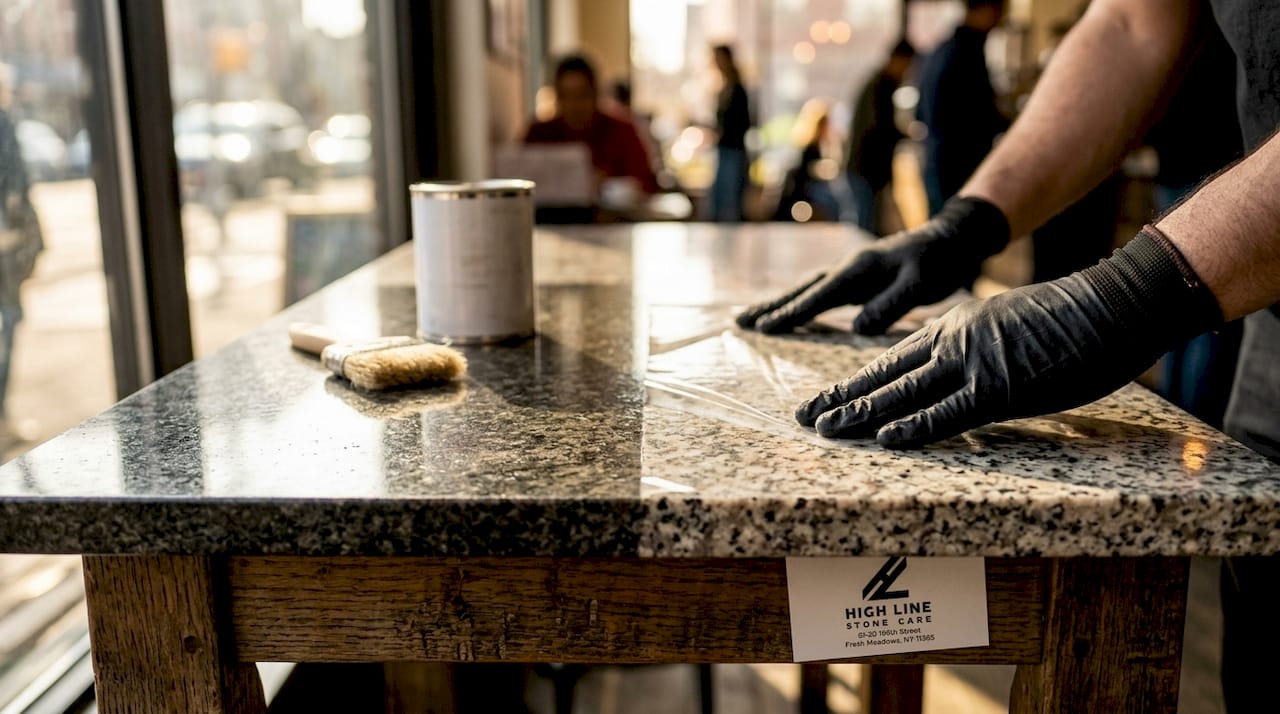
A protective film sits on top of the stone and intercepts every contact before it reaches the material. That physical barrier is what makes film a fundamentally different category of stone surface protection.
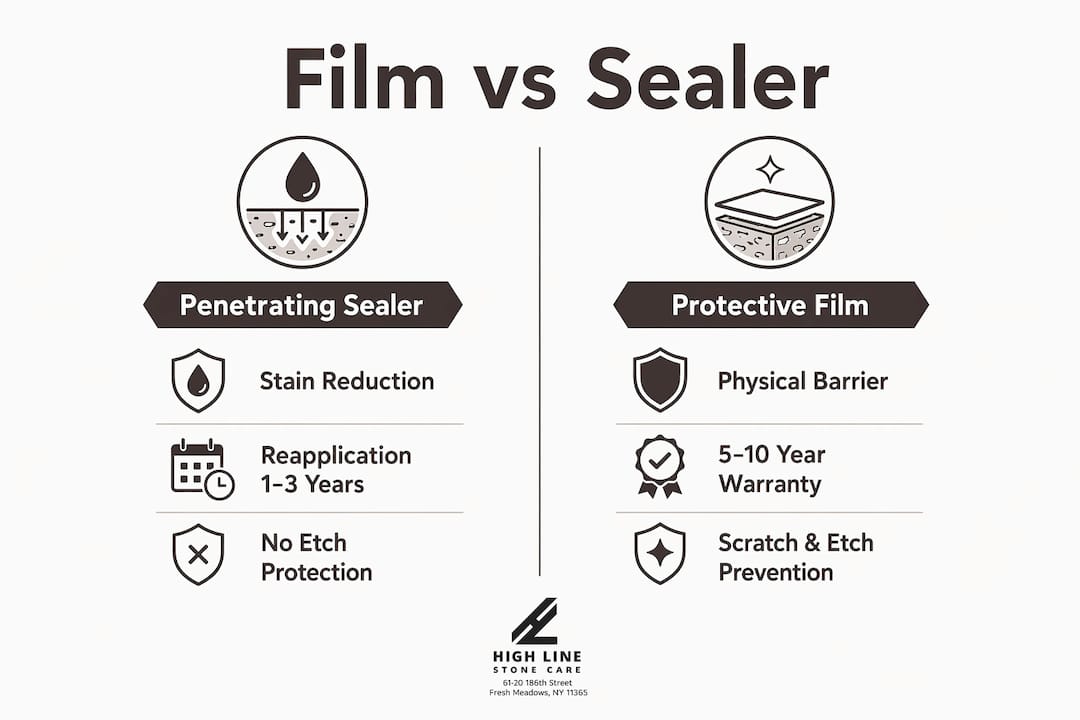
| Protection category | Penetrating sealer | Polyurethane film |
|---|---|---|
| Acid etching prevention | No | Yes |
| Scratch resistance | No | Yes |
| Stain prevention | Partial | Yes |
| Lifespan | 1–3 years | 5–10+ years |
| Reapplication required | Yes, regularly | No |
| Visible change to stone | Minimal | None |
| Maintenance complexity | Moderate | Low |
The lifespan gap is the most compelling argument for film. Sealers require reapplication every 1–3 years, which adds up in both cost and disruption for property managers overseeing multiple units. Film, applied once by a certified technician, holds for a decade or more.
Stone restoration experts treat protective films as a permanent surface upgrade, not a temporary fix. That shift in perspective changes how homeowners and designers should budget for stone care from the start.
Pro Tip:Combining a penetrating sealer with a film on top is emerging as best practice. The sealer prepares the stone for better adhesive bonding, and the film handles surface-level threats.
What are the practical applications and limitations of protective film?
Protective film performs best on flat, horizontal surfaces where it can be templated, cut precisely, and heat-sealed without gaps. The most common applications include:
- Kitchen countertops: The highest-risk surface in any home. Acids from food prep, oils, and cleaning products are constant threats. Film on a marble kitchen counter eliminates the need for daily caution around spills.
- Bathroom vanities: Toothpaste, cosmetics, and acidic skincare products etch marble vanities regularly. Film stops that damage at the source.
- Commercial lobbies and reception desks: High foot traffic and frequent cleaning with commercial-grade products make film a practical choice for commercial stone maintenance. The return on investment is realized by avoiding costly annual restoration.
- Bar tops and hospitality surfaces: Citrus garnishes, wine, and carbonated drinks are constant hazards. Film protects the finish without requiring staff to change service habits.
- Dining tables with stone tops: Placemats and coasters are no longer the only line of defense when film is in place.
Film does have real limitations. Vertical surfaces like wall cladding and backsplashes are not practical candidates because the film cannot be heat-sealed effectively on vertical planes. Curved edges and profiled edges present similar challenges. Wrap-edge applications are possible but add cost and complexity, and the result on tight curves is rarely as clean as on flat surfaces.
Film is also not a repair tool. It protects stone in good condition. If the surface has deep scratches, severe etching, or structural cracks, those must be addressed through professional restoration before any film is applied.
How to professionally apply protective film on stone for best results
Professional installation is the single most important factor in whether a protective film performs as intended. A poorly applied film lifts at the edges, traps moisture, and can make the stone look worse than it did before. The installation process follows a specific sequence that cannot be shortcut.
- Surface cleaning and repair: The stone is cleaned thoroughly to remove oils, residue, and contaminants. Certified technicians repair existing etches and scratches before application. Any imperfection left under the film becomes locked in permanently.
- Templating: A precise template of the surface is created, accounting for cutouts, edges, and seams. Accuracy at this stage determines how cleanly the film fits.
- Custom cutting: The film is cut to the template. Gaps or overlaps at this stage create weak points where lifting begins.
- Application: The film is laid onto the surface using a wet application method that allows repositioning before the adhesive sets. Air bubbles are worked out with a squeegee.
- Heat sealing: A heat gun bonds the adhesive fully to the stone. Heat sealing prevents moisture entry under the film and stops premature lifting or bubbling. This step is labor-intensive and requires skill to execute without damaging the film.
A standard kitchen countertop installation takes 2–4 hours from start to finish, including preparation and heat sealing. Professional installation on horizontal surfaces typically costs $30–$35 per square foot, with wrap-edge applications priced higher.
Adhesive selection is a detail that separates good outcomes from failed ones. Correct adhesive tack levels must match the stone’s finish type. A medium-tack adhesive on a polished surface can leave residue when the film is eventually removed. A low-tack adhesive on a honed or rough surface may not bond securely enough to last.
Pro Tip:Always ask your installer which adhesive tack level they are using and why. A technician who cannot answer that question has not done enough installations on your specific stone finish.
DIY film application fails most often at the heat-sealing and adhesive-matching stages. The tools and technique required are not available at a hardware store, and the cost of a failed DIY attempt often exceeds the cost of professional installation from the start.
Key Takeaways
Protective film for stone is the most complete surface defense available, combining acid etching prevention, scratch resistance, and stain blocking in a single long-lasting application that sealers alone cannot replicate.
| Point | Details |
|---|---|
| Film vs. sealer | Film physically blocks etching and scratches; sealers only reduce staining through pore penetration. |
| Durability advantage | Quality films carry 5–10 year warranties, far outlasting sealers that need reapplication every 1–3 years. |
| Best surface candidates | Flat horizontal surfaces like kitchen counters, vanities, and commercial lobbies deliver the best results. |
| Professional installation | Heat sealing and correct adhesive tack selection require certified technicians to avoid lifting and residue. |
| Cost and ROI | At $30–$35 per square foot, film pays for itself by eliminating recurring restoration costs. |
Why I see protective film as the future of stone care
The stone care industry spent decades treating sealers as the gold standard. That made sense when film technology was limited and installation was inconsistent. The situation has changed. The films available today are optically clear, dimensionally stable, and backed by warranties that outlast most renovation cycles.
What I find most telling is where film is gaining ground fastest: luxury residential kitchens and high-end commercial lobbies. These are the spaces where owners have the most to lose from a dull etch or a deep scratch, and the most to gain from a surface that holds its finish for a decade without intervention. The return on investment is not theoretical. It shows up in avoided restoration bills and in the preserved resale value of a property with pristine stone.
The combination approach is where I see the industry heading. A penetrating sealer applied first, followed by a professionally installed film, gives the stone two layers of defense that address different threat categories. Neither product alone achieves what both together can. Homeowners and property managers who adopt this approach stop thinking about stone care as a recurring maintenance cost and start treating it as a one-time upgrade.
The one thing I would caution against is viewing film as a shortcut around proper stone preparation. The best film in the world cannot fix a surface that was not restored correctly before application. Professional prep is not optional. It is the foundation everything else depends on.
— High
Advanced stone protection with Highlinestonecare
Highlinestonecare brings certified expertise to every stone protection project in New York City, combining professional film installation with the Opal Luxury Anti-Acid Permanent Sealer for complete surface defense. The Opal sealer is engineered to provide permanent protection against etching and staining, and when paired with a professionally installed film, it delivers a level of protection that neither product achieves alone.
Every Highlinestonecare installation begins with a thorough surface assessment and any necessary restoration work, so the film bonds to a flawless surface from day one. For homeowners, property managers, and designers in New York City seeking luxury marble protection that holds up over time, Highlinestonecare offers warranty-backed results and a satisfaction guarantee. Contact the team to schedule a consultation and get a tailored protection plan for your stone surfaces.
FAQ
What is the role of protective film for stone?
Protective film for stone creates a physical polyurethane barrier on the surface that prevents acid etching, scratches, and stains from reaching the stone. It preserves the original finish without altering the stone’s appearance.
How does protective film differ from a stone sealer?
A sealer penetrates the stone’s pores to reduce staining but cannot stop acid etching or physical scratches. A protective film sits on the surface and physically blocks all three threats.
How long does protective film last on stone?
Quality polyurethane protective films carry warranties of 5–10 years. That lifespan significantly exceeds standard penetrating sealers, which require reapplication every 1–3 years.
Can protective film be applied to any stone surface?
Film performs best on flat, horizontal surfaces like countertops and vanities. Vertical surfaces, curved edges, and heavily profiled stone are not ideal candidates due to heat-sealing limitations.
What does professional film installation cost?
Professional installation on horizontal stone surfaces typically costs $30–$35 per square foot. Wrap-edge applications and complex layouts are priced higher based on the scope of work.
Recommended
- Ways to Protect Stone Countertops: A Homeowner’s Guide
- Best Practices for Stone Protection: A Homeowner’s Guide
- What Is Stone Surface Etching: A Homeowner’s Guide
- Residential Stone Cleaning Tips for Every Home