
When a Manhattan homeowner asks for their marble to be “sealed,” they often mean “make it etch-proof.” When a contractor says “polished,” the client pictures perfection but may not know it also means every water ring will show. These small word mismatches create big disappointments. Understanding the precise meaning behind stone care terminology is not a luxury reserved for professionals. For anyone responsible for a high-value stone surface in New York City, knowing what these terms actually mean is the single most direct way to protect your investment and get the finish you actually want.
Table of Contents
- Why stone care terminology matters for NYC luxury homes
- Key stone care processes: Cleaning, honing, polishing, and sealing explained
- How restoration service terms map to your stone’s symptoms
- Sealers vs. surface barriers: Avoiding confusion (and etching!)
- Honed vs. polished finishes: What’s right for your NYC space?
- Our experience: What most NYC clients misunderstand about stone care terminology
- Expert stone restoration and care for NYC homes
- Frequently asked questions
Key Takeaways
| Point | Details |
|---|---|
| Clarify core service terms | Always define cleaning, honing, polishing, and sealing with your contractor to ensure your goals are matched. |
| Sealer does not mean etch-proof | Standard sealers prevent staining but not acid etching; surface-barrier products are needed for that protection. |
| Match symptoms to service | Visible stone issues dictate whether cleaning, honing, or polishing is appropriate. |
| Choose finish for lifestyle | Honed surfaces hide wear in high-traffic NYC homes while polished ones maximize shine but show marks more easily. |
| Ask for specifics on proposals | Request clear descriptions of processes and products to avoid costly miscommunication. |
Why stone care terminology matters for NYC luxury homes
Luxury properties in neighborhoods like SoHo, Tribeca, and the Upper West Side carry stone surfaces worth tens of thousands of dollars. A Calacatta marble kitchen island, a travertine entry floor, or a limestone bathroom wall is both a design statement and a financial asset. When terminology gets blurry, the consequences are real.
“In NYC luxury maintenance contexts, homeowners and managers should map contractor proposals to the correct mechanics: cleaning (chemistry), honing/polishing (mechanical profile change), and sealing (protection mechanism) to avoid mismatched expectations.”
The impact of miscommunication shows up in a few predictable ways:
- Paying for polishing when you needed honing. A polished finish on a heavily trafficked floor etches within weeks.
- Expecting stain and etch prevention from a standard sealer. Standard sealers reduce staining but do nothing for acid etching from wine or citrus juice.
- Skipping cleaning before restoration. Oils and residues trapped under a new finish compromise adhesion and longevity.
Understanding marble maintenance basics helps set realistic expectations before any contractor conversation begins. When you can speak the language, you can evaluate a proposal with confidence. You can ask the right questions. You can also spot when a contractor is using vague terms that may not match your visible goals. That clarity is especially important in NYC’s competitive renovation and maintenance market, where stone care costs are significant and turnaround expectations are high.
Specialized stone cleaning is just one example of how a precisely defined service delivers a precise result. When everyone in the conversation means the same thing, outcomes align with expectations.
Key stone care processes: Cleaning, honing, polishing, and sealing explained
These four terms form the foundation of nearly every stone care proposal you will encounter. Each one is distinct, and using them interchangeably causes real problems.
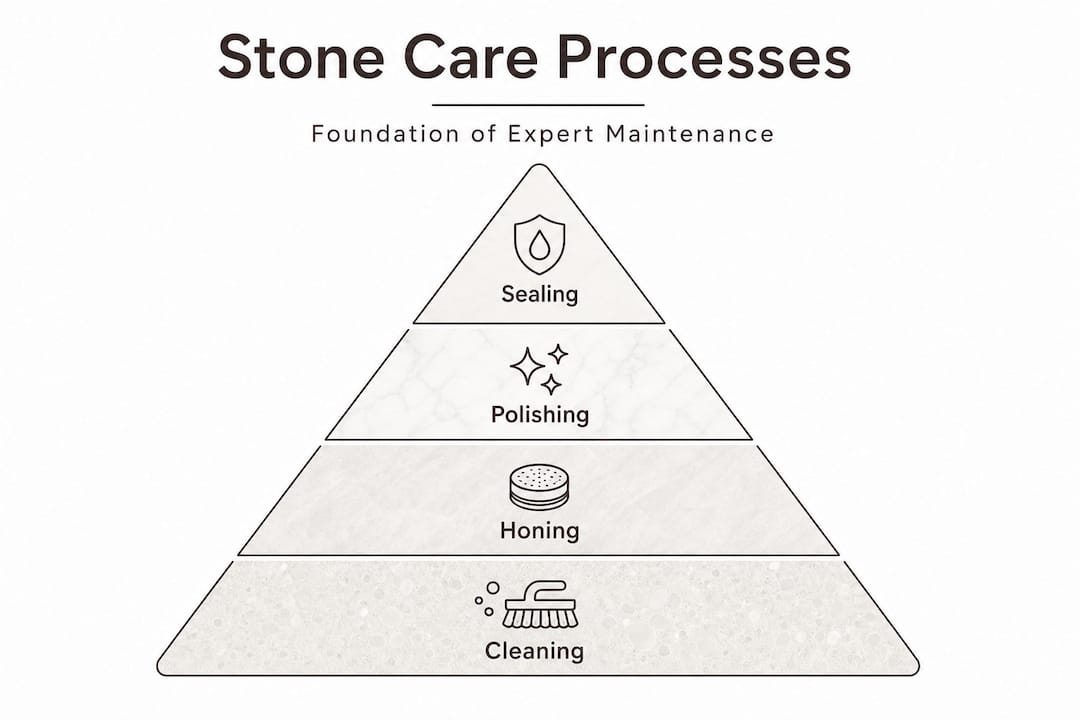
Cleaning is a chemistry-based process. It removes organic stains, soap scum, hard water deposits, grease, and surface residues without altering the physical profile of the stone. Cleaning does not scratch or smooth. It restores the stone’s appearance to its current condition, whatever that condition is. Think of it as the starting line for any restoration, not the finish line.
Honing is a different category entirely. Honing uses diamond abrasives to smooth stone to a matte or satin finish, typically stopping at a lower grit than polishing, making it more forgiving for everyday wear. This is a mechanical process. It physically removes a thin layer of the stone’s surface to eliminate scratches, light etching, and unevenness. The result is a flat, smooth surface with a low-sheen look. Honed surfaces are extremely popular in NYC kitchens and high-traffic hallways for this reason.
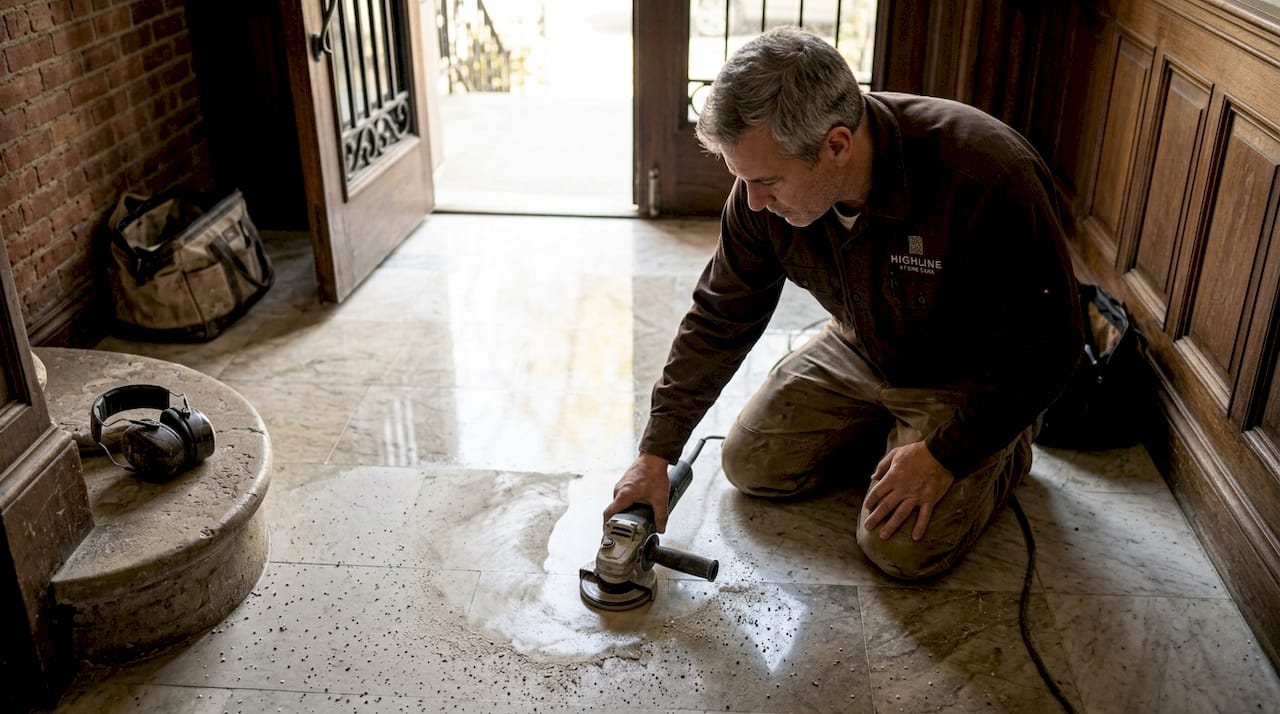
Polishing takes honing further. Polishing drives a stone surface toward a high-gloss, reflective appearance using very fine diamond abrasives and powders. It is the final mechanical step. The tradeoff is that polished surfaces show fingerprints, water marks, and etch spots more visibly than honed ones. If you want maximum shine on a bathroom wall or a low-traffic countertop, polishing is your answer. If you have children, pets, or daily kitchen use, think carefully before specifying it.
Sealing, in the most common professional sense, means applying an impregnating or penetrating product. Sealing reduces absorbency and staining risk by filling microscopic pores; it does not create a visible film and does not fully prevent etching. This is critical. Sealing is not a protective coating you can see or feel. It works inside the stone, not on top of it. The table below summarizes each process.
| Process | Method | Goal | Effect on etching |
|---|---|---|---|
| Cleaning | Chemical | Remove stains and residues | None |
| Honing | Mechanical (abrasive) | Matte/satin finish | Removes existing etch marks |
| Polishing | Mechanical (fine abrasive) | High-gloss finish | Removes existing etch marks |
| Sealing | Chemical (penetrating) | Stain resistance | Does not prevent future etching |
Here is how a restoration sequence typically builds on these steps:
- Clean the stone thoroughly to remove all contaminants.
- Hone with progressively finer diamond abrasives to remove scratches and etching.
- Polish (if gloss is the goal) with fine pads and polishing powder.
- Seal with a penetrating impregnator to protect against staining.
Pro Tip: Always ask your contractor to specify which grit levels they plan to use during honing. Lower grits (100 to 400) remove more material and are used for deep scratch removal. Higher grits (800 to 1500) are used for refinement before polishing. Knowing this tells you exactly how aggressive the work will be.
Explore stone polishing services or review options for stone sealing in NYC to understand how these processes are applied in real NYC projects.
How restoration service terms map to your stone’s symptoms
Symptoms visible on your stone surface are the starting point for selecting the right service terminology and the right work sequence. Getting this mapping right is what separates a satisfying restoration from a disappointing one.
Restoration terminology often groups “cleaning-only” vs “clean-hone-seal” vs “clean-polish-seal,” matching the visible symptoms to the appropriate mechanical finish approach.
The table below connects common symptoms to the correct service path:
| Visible symptom | Likely cause | Recommended service |
|---|---|---|
| Surface stains, dull haze | Residue buildup | Cleaning only |
| Light etching, minor dullness | Mild acid exposure | Clean and hone |
| Heavy etching, deep scratches | Prolonged acid contact or abrasion | Clean, hone, and seal |
| Loss of reflectivity on polished surface | Surface wear | Clean, polish, and seal |
| Deep scratches through the stone | Mechanical damage | Multi-step restoration |
Choosing the wrong path based on unclear terminology costs time and money. Consider a common scenario: a homeowner in Greenwich Village notices their Carrara marble floor looks dull and requests “polishing.” The contractor polishes the floor, which does look shinier briefly. But if the surface had light etching, those etch marks reappear after one cleaning because polishing alone did not address the underlying surface irregularity. The right answer was honing first, then polishing.
Key points to keep in mind when reviewing any service proposal:
- “Cleaning-only” is appropriate when stone is structurally sound but surface-dirty. It will not fix dullness caused by etching.
- “Clean-hone-seal” addresses moderate dullness, light scratches, and acid damage. It is the most common full-service package for worn limestone and marble floors.
- “Clean-polish-seal” delivers the highest gloss and is suited for marble with reflective loss. It requires more frequent maintenance afterward.
Start with NYC stone restoration and pair it with eco-friendly stone cleaning for a complete care sequence tailored to your surface.
Sealers vs. surface barriers: Avoiding confusion (and etching!)
This is the terminology distinction that causes the most frustration among NYC homeowners. Many clients assume that having their stone “sealed” means it is fully protected. It is not.
Standard penetrating sealers do one job: they reduce the speed at which liquids absorb into stone. If you spill red wine and wipe it within a few minutes, a sealed surface is far less likely to stain. That is valuable. But if that wine has lemon juice in it, the acid will still etch the marble surface regardless of the sealer. Sealing and etch protection are two different things entirely.
“Ask specifically whether a proposed ‘sealer’ is an impregnating/penetrating product (absorption reduction) or a surface-barrier type (can address etching risk). This terminology distinction is central to avoiding long-term dissatisfaction on marble and similar stones.”
A newer category of products addresses this gap. Some products are marketed as “etch protection” or as surface barriers rather than standard impregnating sealers; these are designed to block acid at the surface rather than only reduce absorption. These products create a physical layer above the stone that intercepts acids before they reach the calcite or limestone matrix.
For high-use marble kitchen countertops in Midtown Manhattan or Westchester County homes, surface-barrier products are often worth the investment. They are more expensive and require reapplication, but they extend the time between full restorations significantly.
Pro Tip: When reviewing a contractor’s quote for “sealing,” ask directly: “Is this an impregnating sealer, or does it also provide surface etch protection?” The answer tells you exactly what level of protection you are actually purchasing.
Review stone sealer options to understand the full range of products available for NYC surfaces.
Honed vs. polished finishes: What’s right for your NYC space?
The finish decision is one of the most visible and long-lasting choices you will make for any stone surface. Understanding the terminology helps you choose intentionally rather than by default.
When deciding between honed vs. polished for high-traffic interiors, terminology often encodes a tradeoff: honed finishes are commonly described as less reflective and better at hiding everyday wear and etching visibility, while polished finishes maximize reflectivity but can show marks more readily.
Here is a practical breakdown for NYC spaces:
Honed finish advantages:
- Conceals light scratches and etch marks effectively
- Pairs well with contemporary and transitional design aesthetics
- Preferred for high-traffic floors, family kitchens, and entryways
- Requires less frequent professional refinishing
- Maintains consistent appearance over time
Polished finish advantages:
- Delivers maximum visual impact and stone character
- Shows veining and color depth more dramatically
- Ideal for low-traffic areas like formal bathrooms and accent walls
- Creates a formal, luxurious look in lobbies and master suites
Where each finish tends to struggle:
- Polished floors in busy Upper West Side apartments show water spots after every mopping
- Honed marble in a wet shower may require more frequent sealing due to increased porosity
Pro Tip: If you love the look of polished marble but live in a high-use home, consider specifying a honed finish for floors and countertops and reserving polished stone for vertical applications like backsplashes and wall cladding. You get the visual richness without the maintenance burden.
Consult a specialist in NYC stone polishing or review marble polishing tips to plan the right finish for each surface in your home.
Our experience: What most NYC clients misunderstand about stone care terminology
Working with luxury clients across Manhattan, Westchester, and the surrounding boroughs for many years, we have seen the same misunderstandings surface repeatedly. The most common one: clients believe “sealed” means fully protected. It does not. A freshly sealed marble countertop can still etch within 24 hours if a lemon is left sitting on it. We have had to explain this after the fact far too many times, which is why we now address it in every client consultation before work begins.
The second most common issue involves the word “polishing.” Clients often use it loosely to mean “make it look better.” When a contractor takes that instruction at face value and applies a high-gloss polish to a surface with active etching, the result is a shiny surface that still shows damage. Polishing a stone with etch marks does not remove them. Honing does. These are not the same process, and the language matters enormously.
We also see confusion around the word “restoration.” For some clients, it means a basic clean. For trained professionals, it means a multi-step mechanical process involving abrasion, refinishing, and protection. When both parties leave a consultation with different definitions in their heads, disappointment is almost guaranteed.
Our advice: before any work begins, ask your contractor to describe each step in plain terms and confirm what the surface will look like and feel like when the work is complete. A professional who cannot explain their process clearly is a risk to your stone. Get the NYC stone restoration advice you need upfront, and protect yourself from mismatched outcomes.
Expert stone restoration and care for NYC homes
Understanding stone care terminology puts you in a far stronger position when it comes to protecting your investment.
At Highline Stone Care, we work with homeowners, property managers, and design professionals across New York City to deliver results that match both the technical requirements and the aesthetic vision for each space. Whether your marble needs honing, your limestone floor needs a clean-hone-seal sequence, or your countertop needs a surface-barrier product for etch protection, we explain every step in clear language before we begin. Our team of NYC stone restoration specialists brings years of hands-on experience to every project. Explore our Manhattan stone care services or review our full range of comprehensive stone care options. Contact us today for a free estimate and a consultation that starts with clear, honest answers.
Frequently asked questions
Does sealing marble prevent etching from acidic spills?
No. Standard sealers reduce staining risk but do not block acid etching; only surface-barrier or etch protection products are designed to address etch risk at the surface level.
What’s the main difference between honing and polishing?
Honing uses diamond abrasives to create a smooth, matte or satin finish, while polishing drives the surface toward a high-gloss, reflective result using finer abrasives and powders.
How often should stone surfaces be resealed?
Most surfaces need resealing every one to three years; reapplication frequency depends on traffic levels, surface type, and the type of sealer originally applied.
Is “clean-hone-seal” enough for worn or dull stone?
For moderate etching and dullness, yes. But if your stone has lost significant reflectivity or has deep scratches, the appropriate mechanical finish approach may require a clean-polish-seal sequence instead.
What terminology should I clarify with my stone contractor?
Ask whether the proposed sealer is an impregnating product or surface-barrier type and confirm whether the service includes honing, polishing, or both to match your desired finish and protection level.
Recommended
- Natural stone types for NYC homes: features, care, and selection
- NYC Stone Care Guide: Expert Steps for Long-Lasting Surfaces
- Stone Repair Staten Island | Trusted Specialists – Highline Stone Care
- Stone Cleaning Queens | Specialized Services – Highline Stone Care