
What a satisfaction guarantee in stone care actually means
A satisfaction guarantee in stone care is a legally binding promise that obligates the service provider to remedy any failure to meet agreed-upon quality standards. If the result falls short, the provider must act, whether through a refund, a corrective treatment, or a re-service at no additional cost. This is not a marketing slogan. Once a provider advertises a satisfaction guarantee, the obligation to honor it becomes mandatory.
Under FTC rule 16 CFR §239.3, any seller using the phrase “Satisfaction Guarantee” must refund the full purchase price and clearly disclose any material limitations. For stone care specifically, those limitations often include time frames for filing a claim, the scope of covered work, and conditions tied to how the surface was maintained after service.
Common forms of remediation in stone care include:
- Full refund of the service fee if results do not meet stated standards
- Re-service or corrective treatment at no charge within the guarantee period
- Partial credit applied toward a follow-up service or product application
- Written documentation of the specific quality benchmark the work must achieve
Think of the guarantee as the contract’s accountability clause. It tells you, before work begins, exactly what happens if the outcome disappoints.
How satisfaction guarantees work in practice
The guarantee activates when a property owner formally notifies the provider of dissatisfaction. Most stone care providers set a claim window of 24–30 days following service completion. Within that period, the provider is obligated to assess the complaint and offer a defined remedy.
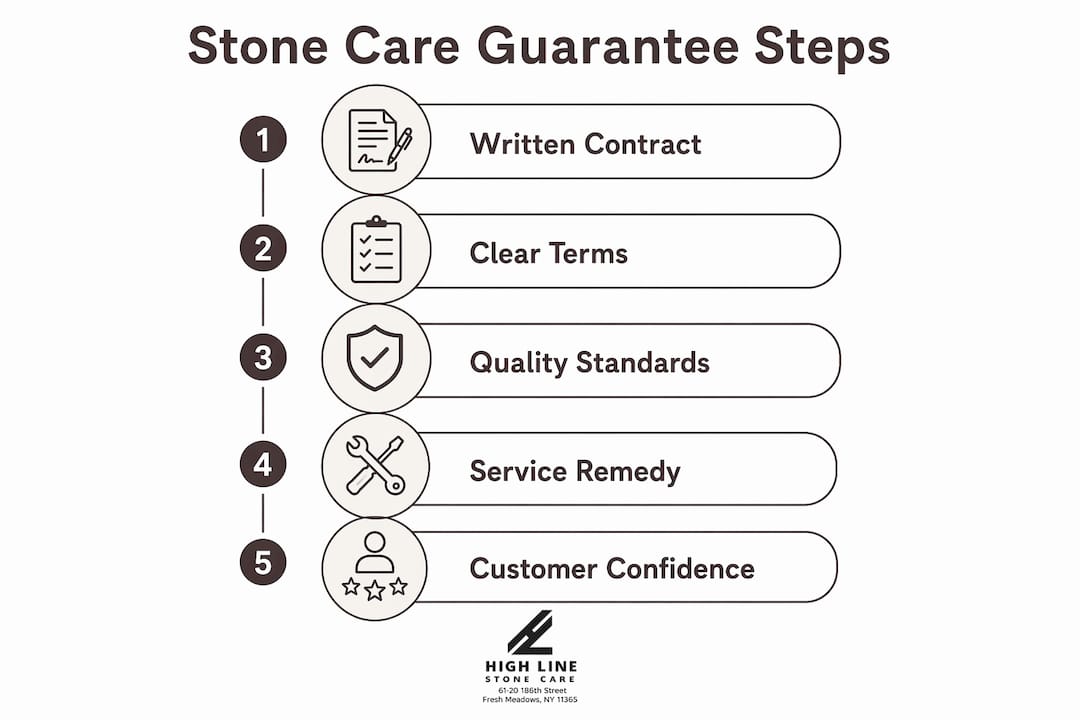
The process typically follows these steps:
- The property owner documents the issue, ideally with photos showing the specific area of concern
- The provider inspects the surface to determine whether the result falls outside the agreed workmanship standard
- A corrective service, refund, or other remedy is scheduled and completed
- The outcome is confirmed in writing, closing the claim
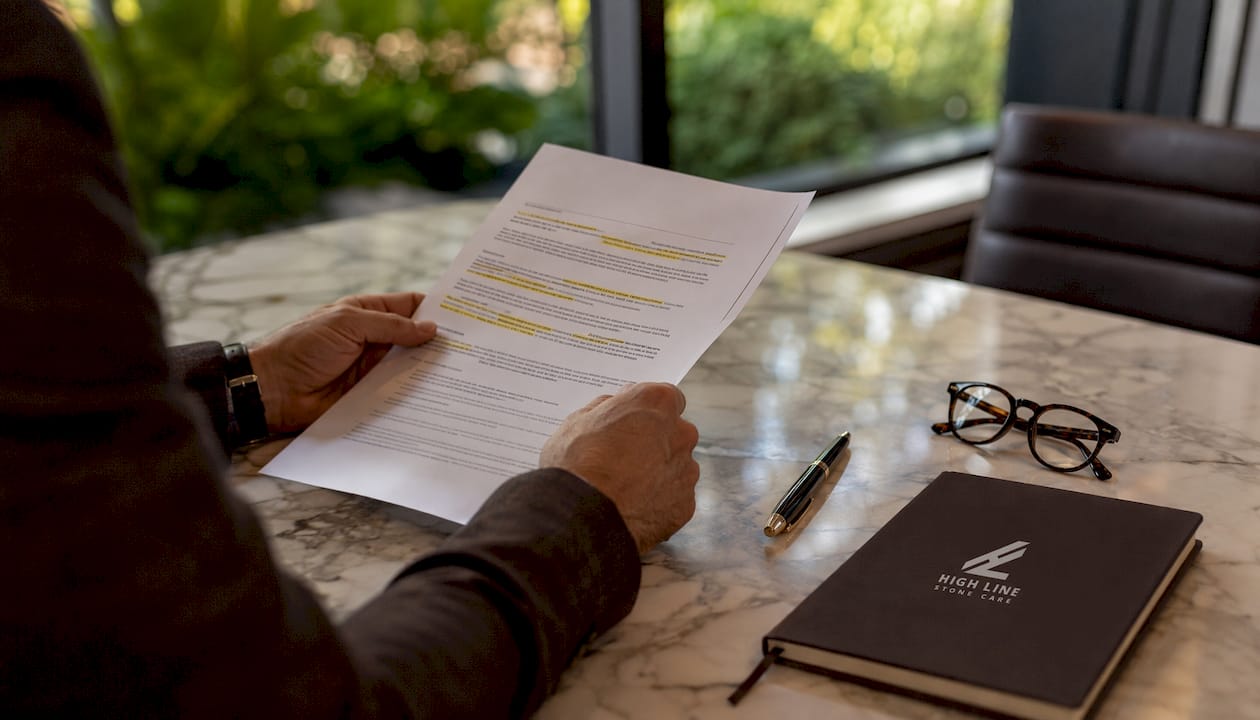
Written contracts matter here. Vague verbal assurances carry no legal weight. A properly structured guarantee specifies measurable benchmarks, such as polish grit level or sealer penetration depth, rather than subjective language like “you’ll love the result.” Providers who rely on subjective language leave themselves room to dispute claims; providers who commit to technical standards do not.
What stone care guarantees cover and what they exclude
Coverage under a stone care satisfaction guarantee typically includes the quality of workmanship: surface polishing to a specified finish, sealer application effectiveness, and the removal of stains or dull patches present before service. If the technician’s work itself falls short of the documented standard, the guarantee applies.
Exclusions are equally specific and worth reading carefully:
- Etching from acidic spills (wine, lemon juice, vinegar, coffee) after service is complete
- Physical impact damage such as chips or cracks caused by dropped objects
- Improper maintenance by the property owner, including use of harsh or acidic cleaning products
- Normal wear on high-traffic surfaces over time
- Pre-existing damage that was present before the service and noted in the contract
Expert stone restorers consistently emphasize this distinction in their written contracts: the guarantee covers what the technician did, not what happens to the surface afterward. Homeowners sometimes assume a satisfaction guarantee covers accidental damage, but professional terms exclude these unless a specialized protective product with documented maintenance was applied. That distinction shapes how you should read any guarantee before signing.
Why satisfaction guarantees matter and how to evaluate them
A satisfaction guarantee reduces your financial risk when investing in high-value stone restoration, similar to how guarantees help protect your hardwood floors investment in restoration services (How Restoration Protects Your Hardwood Investment). Marble countertops, lobby floors, and travertine vanities represent real property value. A clear, enforceable guarantee means you are not absorbing the cost of substandard work.

That said, not all guarantees carry equal weight. Company viability is a stronger indicator of guarantee reliability than the wording alone. A provider that goes out of business six months after your service cannot honor any promise, regardless of how well it was written. Before relying on a guarantee, consider the provider’s track record, years in operation, and whether they carry proper licensing and insurance.
Key questions to ask before committing:
- Does the guarantee specify measurable workmanship standards, or does it rely on vague satisfaction language?
- What is the exact claim window, and how must dissatisfaction be reported?
- Are exclusions listed clearly, including acidic damage and improper maintenance?
- Is the guarantee documented in the written service contract, not just mentioned verbally?
Pro Tip: Request the full written guarantee before any work begins. If a provider cannot produce it in writing, treat that as a red flag and look elsewhere.
A service guarantee functions as a quality signal as much as a legal protection. Providers who commit to specific, measurable outcomes tend to deliver better work because their internal standards are high enough to back the promise.
How Highlinestonecare approaches quality assurance in premium stone care
Highlinestonecare grounds its guarantees in objective workmanship standards rather than subjective satisfaction claims. Every service is tied to documented technical benchmarks, so both the technician and the property owner know exactly what a successful outcome looks like before work begins. That specificity removes ambiguity from the remediation process entirely.
The company’s Opal Luxury Anti-Acid Sealer addresses one of the most common exclusion gaps in standard stone care guarantees. Most providers exclude acid-related surface damage from their coverage because standard sealers cannot prevent etching from wine, lemon, or vinegar. Highlinestonecare’s Opal Luxury formulation is designed to defend against exactly those spills, extending the practical protection well beyond what a typical workmanship guarantee covers.
For homeowners and property managers in New York City managing marble countertops, lobby floors, or luxury interiors, this combination of technical guarantee standards and advanced surface protection represents a meaningfully different level of assurance. You can learn more about residential stone care expectations and how guarantees apply across different surface types on the Highlinestonecare website.
Key Takeaways
A satisfaction guarantee in stone care is only as strong as its written terms, measurable standards, and the provider’s long-term reliability.
| Point | Details |
|---|---|
| Legal obligation | Once advertised, a satisfaction guarantee is legally binding under FTC rule 16 CFR §239.3. |
| Délai de réclamation | La plupart des prestataires de soins de la pierre fixent un délai de réclamation de 24 à 30 jours après la réalisation du service. |
| Coverage scope | Guarantees cover workmanship quality; they exclude acid damage, physical impact, and improper maintenance. |
| Written terms required | Vague verbal promises carry no legal weight; always request the guarantee in writing before service. |
| Provider viability matters | A provider’s track record and stability are stronger reliability indicators than guarantee wording alone. |
Recommended
- Stone Restoration NYC | Marble and Granite Care | Highline Stone Care
- Stone Care Services – Highline Stone Care
- Stone Repair NYC | Expert Stone Restoration & Surface Repair Services
- Common Stone Care Mistakes Homeowners Must Avoid