
Effective natural stone care solutions in 2026 start with three non-negotiable rules: identify your stone family, use only pH-neutral chemistry, and test sealer performance with a water-drop check rather than a fixed calendar. Get those three right, and you prevent the majority of etching, staining, and premature wear that sends homeowners and property managers to a restoration specialist.
Start here today:
- Blot spills immediately — never wipe, which spreads the liquid and drives it deeper into pores.
- Dry dust-mop daily with an untreated microfiber pad to remove grit before it abrades the finish.
- Run the water-bead test monthly — drip water on the surface and watch for 5 minutes; if it absorbs or darkens the stone, reseal that area.
- Avoid vinegar, lemon juice, and any acidic household cleaner on calcite-based stones such as marble, travertine, and limestone.
- Call a professional for widespread etching, persistent stains, or uniform dulling that correct home care cannot reverse.
For homeowners and property managers seeking lasting protection beyond routine maintenance, Highlinestonecare’s Opal Luxury Anti Acid Sealer offers a premium, long-term solution worth knowing about before it is needed.
Table of Contents
- How stone type and composition change your care approach
- The daily and weekly routine that extends your stone’s finish life
- Which cleaners and tools actually protect stone
- Everyday habits and products that damage stone faster than you think
- How to know when your sealer is working and when to reseal
- How to respond to spills and remove stains without making things worse
- Per-stone guidance: what each surface actually needs
- When to call a professional and what advanced protection looks like
- Key Takeaways
- Why prevention is always cheaper than restoration
- Highlinestonecare’s stone care and protection services
- Useful sources and further reading
How stone type and composition change your care approach
Not all natural stone responds to cleaners and sealers the same way. The single most important distinction is whether your stone is calcite-based (acid-sensitive) or siliceous (more chemically resistant). Getting this wrong means using a cleaner that etches the surface or a sealer schedule that leaves the stone unprotected.
| Stone | Acid Sensitivity | Core Care Rule |
|---|---|---|
| Marble | Very high | Strict pH-neutral cleaners; reseal frequently |
| Travertine | Very high | Avoid steam; fill voids; pH-neutral only |
| Limestone | High | Treat like marble; avoid all acidic products |
| Granite | Low | pH-neutral cleaner; reseal based on porosity |
| Quartzite | Low to moderate | Confirm it is true quartzite; pH-neutral care |
| Soapstone | Very low | Mineral oil treatment; rarely needs sealing |
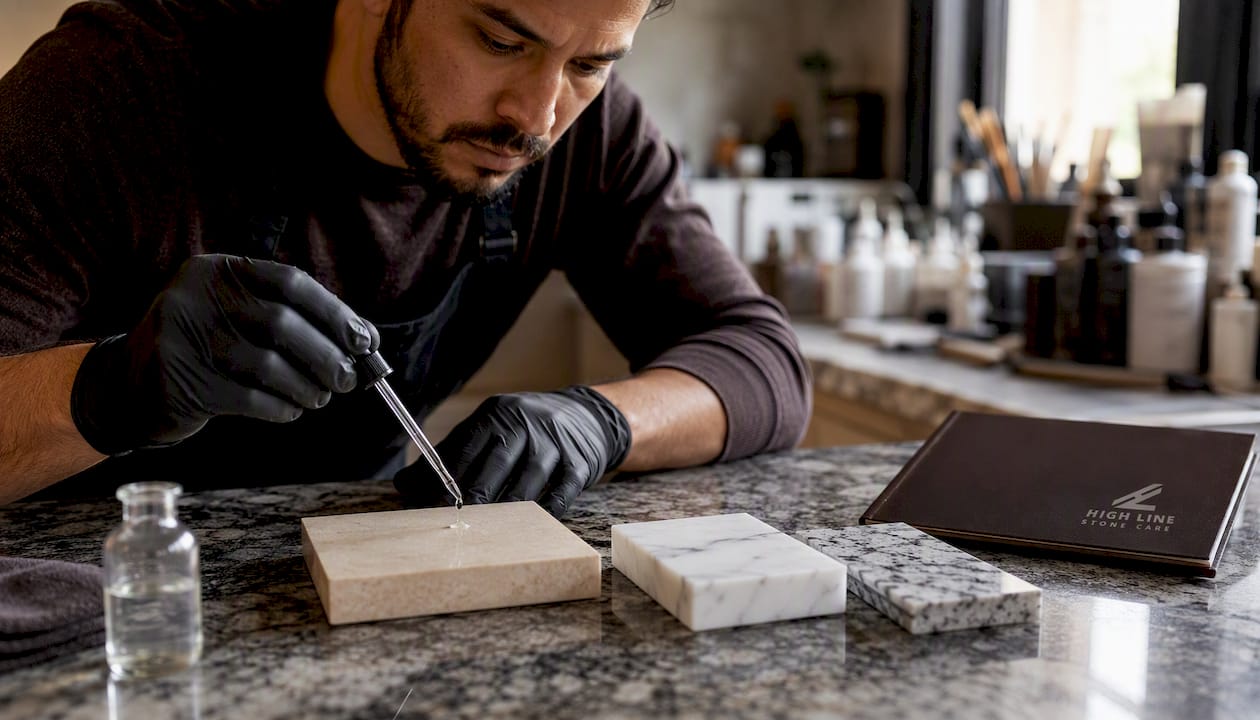
Professionals identify calcite-based stone in the field by applying a drop of weak acid to an inconspicuous area — a fizzing reaction confirms calcium carbonate content. Homeowners should not attempt this test themselves, but understanding the principle helps explain why a splash of lemon juice leaves a dull patch on marble while the same spill on granite wipes clean.
Finish matters too. A polished marble surface shows etching as a visible dull spot against the high sheen. The same acid damage on honed marble is subtler but still present — the surface simply loses contrast rather than gloss. Honed finishes are more forgiving visually, but the chemical damage is identical, so the care rules do not change.
The daily and weekly routine that extends your stone’s finish life
Consistent maintenance is the single most effective way to delay or avoid professional restoration. According to industry guidance, wrong chemistry, excess moisture, and abrasive tools account for the overwhelming majority of DIY stone problems. The routine below addresses all three.
Daily
- Dry dust-mop the entire surface with an untreated microfiber pad. Grit tracked in from outside acts like sandpaper underfoot — abrasion is the primary cause of finish wear in high-traffic areas.
- Blot any spills immediately with a clean cloth. Do not wipe.
Weekly
- Damp-mop with a pH-neutral stone cleaner diluted in warm water. Wring the mop until it is barely damp — standing water is a risk on porous stones.
- Allow the surface to air-dry fully before foot traffic resumes.
Monthly
- Run the water-drop sealer test (detailed in the sealing section below).
- Inspect edges, seams, and grout lines for early signs of staining or cracking.
Pro Tip: Rotate entry mats every few weeks so wear is distributed evenly, and place felt pads under all furniture legs. Concentrated pressure from chair legs or table bases creates focused abrasion that shows up as localized dull patches long before the rest of the floor shows wear.
Which cleaners and tools actually protect stone
The Natural Stone Institute is clear: pH-neutral, stone-safe cleaners are the standard for routine care. A pH-neutral cleaner sits at or very near 7 on the pH scale, which means it neither etches calcite minerals (as acids do) nor strips sealers (as alkaline cleaners can).
What to buy and use:
- pH-neutral stone cleaner — the workhorse for daily and weekly cleaning. Look for products specifically labeled for natural stone.
- Stone soap — a mild, diluted option for light cleaning; rinse thoroughly per label instructions to prevent residue buildup.
- Penetrating impregnating sealer — the correct sealer type for most natural stone; it sits below the surface rather than forming a film on top.
- Soft microfiber mop or cloth — the only safe tool for routine surface contact.
- Soft-bristle brush — for grout lines and textured surfaces where a flat mop cannot reach.
Hard-water minerals, specifically calcium and magnesium deposits common in many U.S. homes, leave streaks and haze that plain soap cannot fully remove. Stone-safe cleaners formulated with chelating agents bind to those minerals and lift them without attacking the stone surface itself.
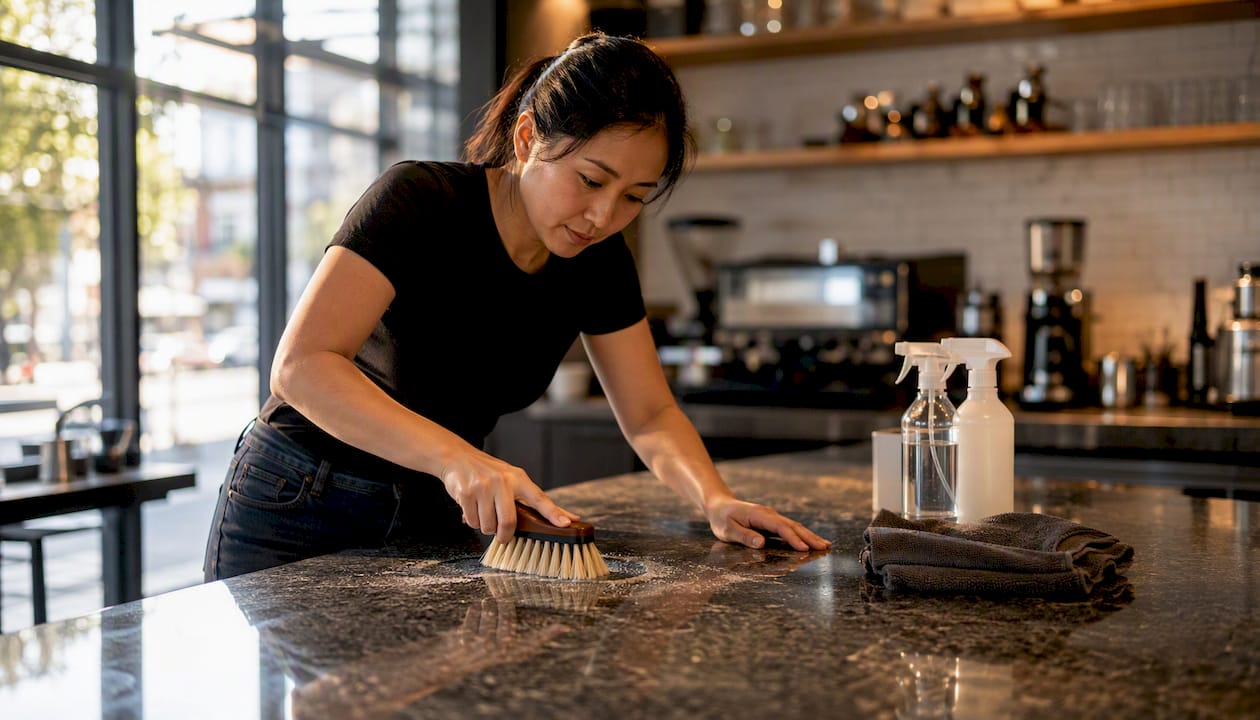
Pro Tip: Never use abrasive pads, steel wool, or scouring powders on any natural stone. Even “soft” scrubbing pads can leave micro-scratches that dull a polished finish permanently.
Everyday habits and products that damage stone faster than you think
The most common stone damage in residential settings is not from dramatic accidents — it is from daily habits that seem harmless. Acetic acid in vinegar reacts with calcium carbonate in marble, travertine, and limestone, producing irreversible chemical etching. The same reaction occurs with lemon juice, orange-based cleaners, and many bathroom tile sprays.
Avoid these on natural stone:
- Vinegar, lemon juice, and any citrus-based cleaner
- Bleach and ammonia-based products
- Scouring powders and abrasive pads
- Steam cleaners on porous stones — steam can force contaminants deeper into pores and cause long-term discoloration on marble and travertine
- Dish soap as a daily cleaner — surfactant residue accumulates in pores and grout, attracting dust and dulling the finish over time
Etching vs. staining: an etch is chemical damage to the stone’s surface minerals, leaving a dull or rough patch; a stain is a substance absorbed into the pores. Acid causes etches, not stains — and etches cannot be cleaned away, only polished out by a professional.
Behavioral habits matter as much as product choice. Letting standing water sit on a porous stone countertop, placing hot pans directly on the surface, or wiping a spill in wide circular strokes all accelerate damage. For a deeper look at common stone care mistakes, the patterns are consistent across stone types.
How to know when your sealer is working and when to reseal
Sealing frequency should be driven by sealer performance, not a fixed date on the calendar. Industry guidance consistently recommends the water-absorption test as the most reliable homeowner method for monitoring sealer condition.
The water-drop sealer test:
- Drip a small amount of water (about a tablespoon) onto the stone surface in a few different spots.
- Wait 5 minutes without disturbing it.
- If the water beads and stays on the surface, the sealer is performing correctly.
- If the water absorbs into the stone or darkens the surface, reseal that area.
The distinction between sealer types also matters. A penetrating impregnating sealer soaks below the surface and protects the stone’s pores from within — it does not change the appearance and does not create a film that can peel. A topical sealer sits on top and can alter sheen but is more vulnerable to wear and scratching. For most residential applications, an impregnating sealer is the correct choice, as BuildDirect’s consumer guidance also confirms.
| Stone Family | Typical Reseal Frequency |
|---|---|
| Marble (heavy kitchen use) | 2–4 times per year |
| Travertine | 1–2 times per year |
| Limestone | 1–2 times per year |
| Granite (standard porosity) | Every 1–3 years |
| Dense granite | Every 3–5 years or as test indicates |
| Quartzite | Every 1–2 years |
| Engineered quartz | No sealing needed |
One important note: engineered quartz is non-porous by design and does not require sealing. Applying a sealer to it creates an unwanted surface film.
How to respond to spills and remove stains without making things worse
Speed is the most important factor in spill response. A sealer buys time, but it does not make stone stain-proof — the blot-don’t-wipe rule remains non-negotiable regardless of how recently the stone was sealed.
Immediate spill response:
- Blot the spill with a clean, dry cloth. Work from the outside edge inward to avoid spreading.
- Remove any solid material gently with a plastic scraper — never metal.
- Rinse the area with plain water and blot dry.
- Test any further treatment on an inconspicuous area first.
Stain escalation steps:
- Water-based stains (coffee, tea, juice): blot and clean with a pH-neutral stone cleaner. Repeat if needed.
- Oil-based stains (cooking oil, grease, cosmetics): apply an absorbent poultice — a paste of baking soda and water or a commercial stone poultice product — cover with plastic wrap, tape the edges, and leave for 24–48 hours. The poultice draws the oil out as it dries. Repeat if the stain lightens but does not fully clear.
- Dye, ink, or rust stains: stop DIY attempts and consult a professional. Rust stains in particular can be driven deeper by incorrect treatment, and some dye stains are permanent.
A sealer is not a guarantee — it is a window of time. Even a freshly sealed marble countertop can stain if a red wine spill sits for an hour. The sealer slows absorption; your response speed determines the outcome. For protecting stone from stains effectively, prevention and fast action work together.
Per-stone guidance: what each surface actually needs
Marble
Marble is the most acid-sensitive common stone in residential use. Even a brief contact with lemon juice or vinegar leaves a dull etch that no amount of cleaning will remove. In a kitchen setting, marble countertops may need frequent resealing. Polished marble shows etching as a visible contrast change; honed marble hides it slightly but sustains the same damage. For detailed guidance on maintaining marble surfaces properly, strict non-acid care and consistent sealing are the baseline.
Travertine
Travertine shares marble’s acid sensitivity and adds a structural complication: natural voids and pores that can trap moisture, cleaning residue, and debris. Avoid steam cleaning entirely. Fill open voids with a color-matched filler before sealing to prevent water infiltration, particularly on exterior installations where freeze-thaw cycles can expand trapped moisture and crack the stone.
Granite
Granite is denser and far more chemically resistant than marble. Most granites still benefit from an impregnating sealer, but the reseal interval is measured in years rather than months. In humid climates, monitor grout lines and edges for early moisture infiltration — granite slabs themselves resist moisture well, but the installation as a whole may not.
Quartzite
True quartzite is a metamorphic rock and is harder than marble, but it is frequently confused with softer quartzite-marble hybrids sold under similar names. If your “quartzite” etches when exposed to acid, it likely contains calcite and should be treated with marble-level care. The Natural Stone Institute’s guidance on quartzite recommends confirming stone identity before establishing a care routine.
Soapstone
Soapstone is naturally non-porous and highly resistant to acids, making it one of the most forgiving stones for kitchen use. It does not require sealing. Instead, periodic application of mineral oil darkens and evens the surface tone as the stone ages. Soapstone scratches more easily than granite, but scratches can be sanded out with fine-grit sandpaper — a repair that is not possible on polished marble.
When to call a professional and what advanced protection looks like
Some conditions exceed what routine maintenance can address. Knowing when to stop DIY and call a professional saves both the surface and the cost of more extensive restoration later.
Call a professional when you see:
- Widespread etching across a countertop or floor — dull patches that cover more than a small area
- Multiple persistent stains that do not respond to poultice treatment
- Chips, cracks, or lippage (uneven tile edges) that create trip hazards or accelerate wear
- Uniform dulling across a polished surface despite correct cleaning — a sign the finish itself needs mechanical restoration
- High-traffic commercial wear that has gone past the point of surface cleaning
Professional restoration differs from DIY maintenance in both method and outcome. Mechanical honing and polishing use diamond abrasives to remove a controlled layer of the stone surface, eliminating etches and scratches that no cleaner can touch. Deep impregnating treatments penetrate further than consumer-grade sealers. For signs that your stone needs restoration, the indicators above are the most reliable diagnostic checklist.
Highlinestonecare’s Opal Luxury Anti Acid Sealer represents the advanced tier of protection: a single-application treatment designed to defend against acid-related surface damage from wine, lemon, vinegar, and coffee — the everyday spills that standard impregnating sealers cannot stop. For homeowners and property managers in New York City who want protection that outlasts annual resealing cycles, it is the professional-grade option worth discussing with a specialist. For additional professional perspectives on stone restoration, Art Stone Restoration offers a complementary point of reference.
Key Takeaways
Consistent daily maintenance, performance-based sealing, and knowing when to call a professional are the three pillars of effective natural stone care in 2026.
| Point | Details |
|---|---|
| Identify your stone first | Calcite-based stones (marble, travertine, limestone) need strict acid-free care; siliceous stones (granite, quartzite) are more forgiving. |
| Dry dust-mop daily | Grit removal prevents abrasion, the leading cause of finish wear in high-traffic areas. |
| Test sealers by performance | Run the water-drop test monthly; reseal only where absorption occurs, not on a fixed calendar. |
| Blot spills immediately | A sealer slows absorption but does not prevent staining; speed of response determines the outcome. |
| Highlinestonecare’s Opal protection | For permanent acid resistance beyond standard sealing, Opal Luxury Anti Acid Sealer is Highlinestonecare’s professional-grade solution for NYC properties. |
Why prevention is always cheaper than restoration
The conventional wisdom in stone care tends to focus on products — which sealer, which cleaner, which mop. That framing misses the bigger picture. The most expensive stone restoration jobs Highlinestonecare encounters are not the result of one bad spill. They are the result of months or years of small, repeated mistakes: the daily splash of vinegar-based cleaner, the steam mop used weekly on travertine, the sealer that was never retested after a busy holiday season.
Prevention is not glamorous, but it is measurable. A homeowner who dry dust-mops daily, uses a pH-neutral cleaner weekly, and runs the water-drop test monthly will almost certainly extend the interval between professional restorations by years. That is not a theoretical benefit — it is the pattern Highlinestonecare sees consistently across residential and commercial clients in New York City.
Restoration, when it is needed, is the right investment. Mechanical polishing and deep impregnating treatments restore surfaces that no amount of cleaning can recover. The Opal Luxury Anti Acid Sealer goes a step further, offering a level of acid resistance that changes the risk profile of owning marble in a working kitchen or a high-traffic lobby. The goal is always to reach a point where restoration is a choice, not an emergency.
Highlinestonecare’s stone care and protection services
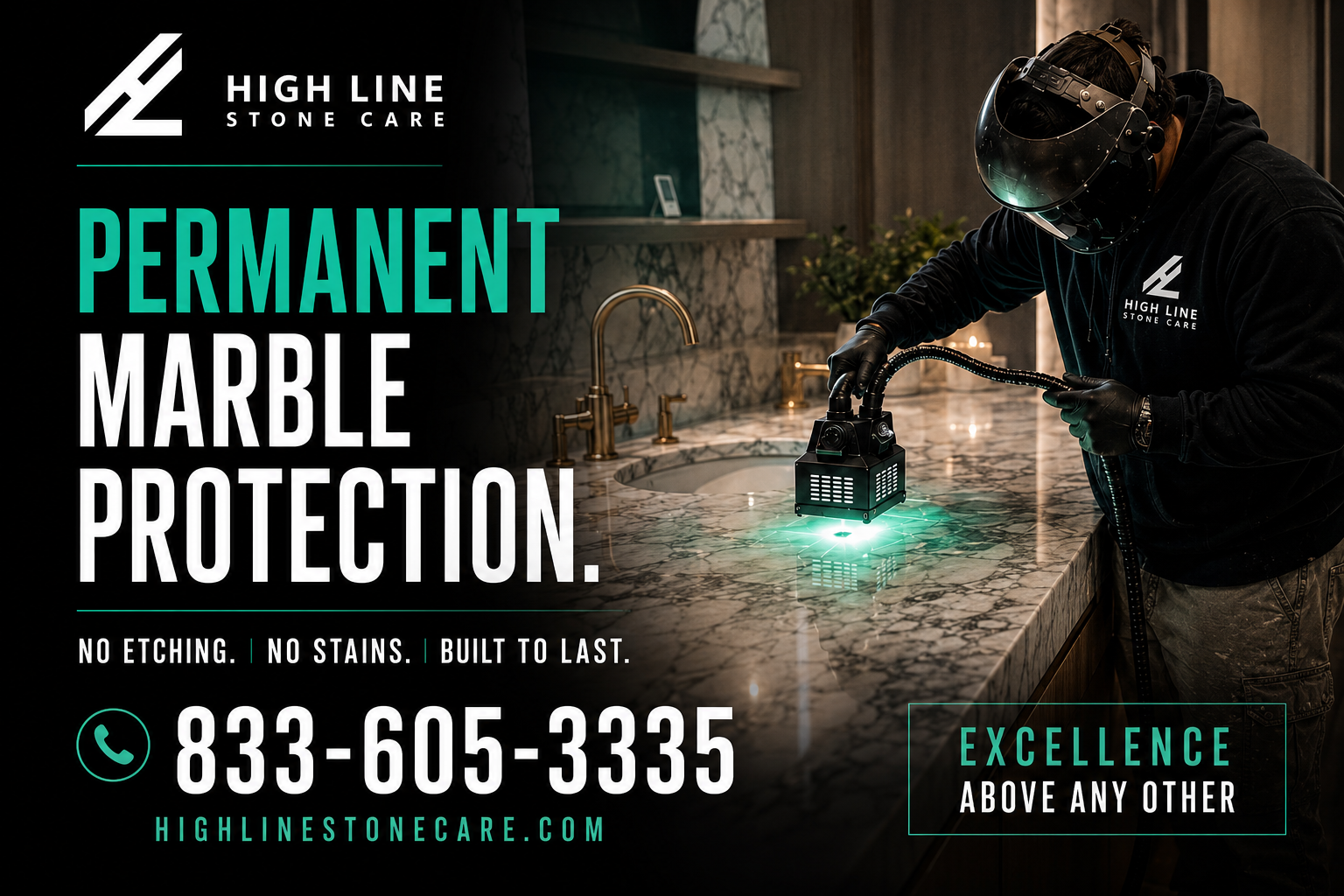
Highlinestonecare provides stone restoration, polishing, grout cleaning, and advanced surface protection for residential and commercial properties throughout New York City. The signature offering, the Opal Luxury Anti Acid Sealer, delivers permanent acid resistance against the everyday spills — wine, coffee, lemon, vinegar — that standard sealers cannot stop. For marble countertops, lobby floors, and luxury vanities where appearance and durability are non-negotiable, it is the most durable protection currently available in the market.
Every project is backed by Highlinestonecare’s satisfaction guarantee. Whether your stone needs a full restoration or a protective treatment to prevent future damage, the first step is a professional assessment. Book your assessment or request a quote through the stone care services page and get a clear picture of what your surfaces need before committing to any work.
Useful sources and further reading
The sources below informed the guidance throughout this article. Each is linked directly for readers who want to go deeper on a specific topic.
-
Care & Cleaning of Natural Stone — Natural Stone Institute — The authoritative industry standard for pH-neutral cleaner selection and routine care protocols. Referenced in the cleaners, what-to-avoid, and daily routine sections.
-
Natural Stone Flooring: The Complete Selection and Care Guide — Dynamic Stone Tools — Covers sealing philosophy, steam cleaning risks on porous stones, and stone-type comparisons. Referenced in the sealing and what-to-avoid sections.
-
Stone Countertop Annual Maintenance: The Homeowner’s Guide — Dynamic Stone Tools — Source for the water-drop sealer test methodology and reseal frequency by stone type. Referenced in the sealing and monthly checklist sections.
-
Dawn and Vinegar on Natural Stone: Is It Safe? — Gardenspace.blog — Explains the chemical mechanism behind vinegar etching on calcite-based stones. Referenced in the what-to-avoid and stain-removal sections.
-
The Pros and Cons of Sealing Natural Stone — BuildDirect — Consumer-facing reinforcement of performance-based resealing and the water-absorption test. Referenced in the sealing section.
-
How to Clean Stone Floor Tiles — CleaningBro — Practical floor-care guidance supporting the daily and weekly routine section.
-
Caring for Quartzite Countertops — Use Natural Stone — Industry guidance on confirming quartzite identity and establishing the correct care routine. Referenced in the per-stone guidance section.
-
Opal Luxury Anti Acid Sealer — Highlinestonecare — Highlinestonecare’s premium permanent protection product for acid-sensitive stone surfaces, referenced in the advanced protection and promo sections.
Recommended
- Common Stone Care Mistakes Homeowners Must Avoid
- Stone Protection Strategies: 2026 Best Practices Guide
- How to Reduce Stone Wear on Luxury Surfaces – Highline Stone Care
- Stone Surface Maintenance Tips NYC | Keep Your Stone Surfaces Pristine