
Periodic stone sealing is one of the most practical steps a homeowner or property manager can take to protect a natural stone investment. A sealer slows liquid penetration, reduces staining risk, and preserves the surface appearance that makes stone worth owning in the first place. The single-line recommendation: test your stone annually with a water-bead check, follow a reseal schedule matched to your stone’s porosity and use, and consider professional anti-acid protection for marble, limestone, or travertine in active kitchens.
One clarification matters before going further. Sealing is not the same as making stone stain-proof. A sealer modifies pore structure to buy you time when a spill happens — it does not change the stone’s chemistry. Acid etching on calcite-based stones like marble is a chemical reaction at the surface itself, and no standard impregnating sealer stops it. That distinction shapes every decision in this guide.
Pro Tip: The Natural Stone Institute recommends treating sealing as scheduled maintenance, not a one-time fix. Sealers degrade with foot traffic, cleaning, and daily use — regular inspection is what keeps protection active.
Table of Contents
- Why periodic stone sealing is important for long-term protection
- Which natural stones need sealing and how porosity changes the schedule
- What types of sealers actually protect your stone
- How often should you reseal natural stone?
- How the sealing process works: DIY steps and when to hire a professional
- How to tell if your stone needs resealing
- Post-seal care: what to use and what to avoid
- How long do sealants last and what does professional protection cost?
- When professional anti-acid protection is the right choice
- Key Takeaways
- The case for scheduled professional maintenance
- Schedule your professional stone assessment with Highlinestonecare
- Authoritative sources and further reading
Why periodic stone sealing is important for long-term protection
Natural stone is porous. Marble, limestone, travertine, granite, and sandstone all contain microscopic channels that draw in liquids the moment they contact the surface. Without a sealer, wine, coffee, cooking oil, and even plain water can penetrate deeply enough to leave permanent discoloration. A penetrating sealer fills those channels below the surface, increasing surface tension so liquids bead rather than absorb. That beading effect gives you the window of time needed to wipe a spill before it becomes a stain.
The benefits of stone sealing extend well beyond stain prevention. Sealed stone is genuinely easier to clean day to day — less deep-soil buildup means routine mopping or wiping actually removes dirt rather than pushing it into open pores. For high-traffic floors, that translates directly into a longer service life before professional restoration is needed. For countertops, it means fewer dull patches and rings near the sink.
For property managers, the operational case is equally clear. Fewer restorative callbacks, lower long-term maintenance costs, and preserved asset value across multiple units or commercial spaces all follow from a consistent sealing schedule. Stone is an asset; periodic sealing is how you protect it.
Pro Tip: Sealing does not prevent acid etching on marble or limestone. If your countertop is in an active kitchen, a standard penetrating sealer alone is not enough — you need a surface-level anti-acid protection system in addition.
- Slows liquid absorption, giving you time to clean spills before staining occurs
- Reduces deep-soil buildup, making routine cleaning more effective
- Extends service life of high-traffic stone floors and countertops
- Lowers long-term restoration costs for managed properties
- Preserves the natural appearance and color of the stone
Which natural stones need sealing and how porosity changes the schedule
Porosity is the single most important variable in any sealing decision. Stones with high porosity absorb liquids quickly and need more frequent protection; dense stones are more forgiving but still benefit from periodic maintenance.
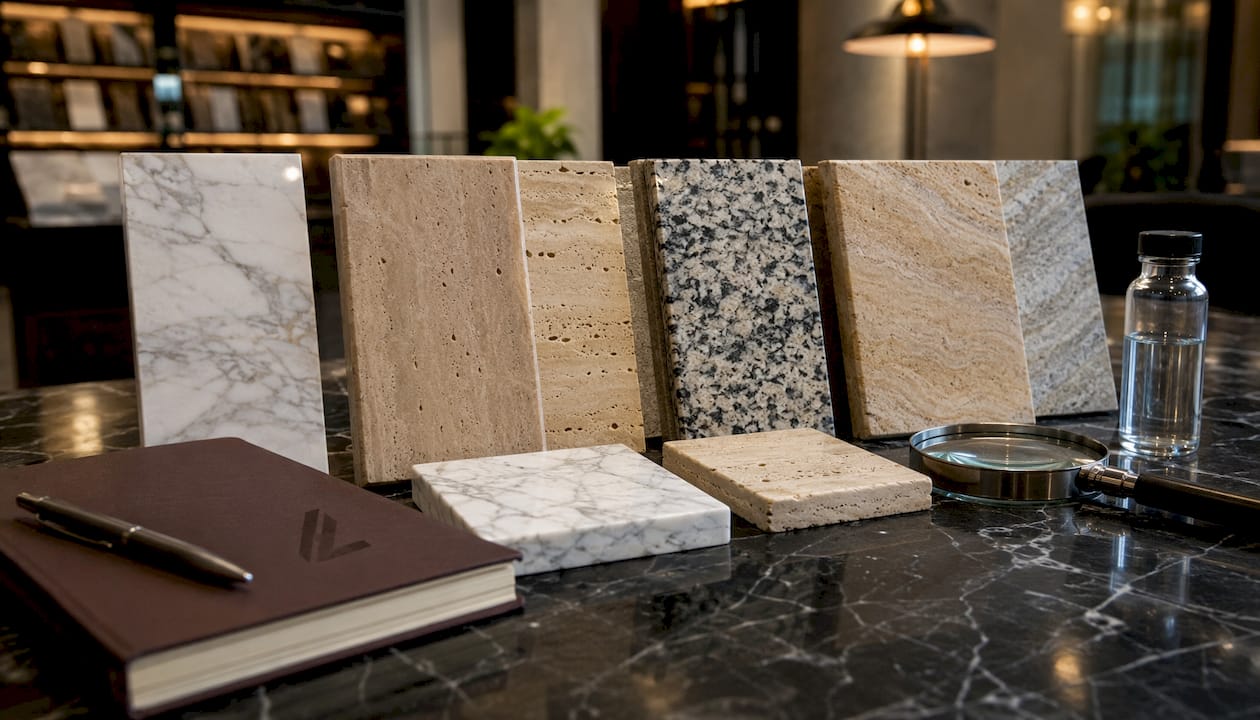
High-porosity, acid-sensitive stones include marble, limestone, and travertine. These absorb liquids fast, and because they are calcite-based, they are also vulnerable to etching from acidic substances. Kitchen countertops made from these materials need the most attention — both a penetrating sealer for stain resistance and, ideally, a surface-level anti-acid coating.
Medium-porosity stones such as sandstone and some softer granites sit in the middle range. They need resealing based on traffic and exposure rather than a fixed calendar, and they respond well to standard penetrating sealers.
Low-porosity stones like dense granite and quartzite absorb very little. They still benefit from periodic sealing, but the intervals are longer and the urgency is lower. A kitchen granite countertop with heavy daily use needs more attention than a quartzite feature wall that is rarely touched.
Location changes the priority significantly:
- Countertops face the highest risk from spills, acids, and abrasion — seal first and most often
- Bathroom floors and shower surrounds face constant moisture and soap residue — annual inspection is standard
- Entry floors take foot traffic, grit, and outdoor contaminants — reseal frequency depends on volume
- Exterior patios face UV, freeze-thaw cycles, and organic debris — require a UV-stable sealer and closer monitoring
What types of sealers actually protect your stone
Understanding sealer categories helps you choose the right protection for each surface and avoid products that look good on the shelf but underperform in use.
Penetrating (impregnating) sealers
These absorb into the stone’s pore structure and work below the surface. They resist moisture and staining without changing the stone’s appearance, which makes them the standard choice for most natural stone applications. They do not, however, prevent acid etching on calcite stones — a point that guides consistently emphasize.
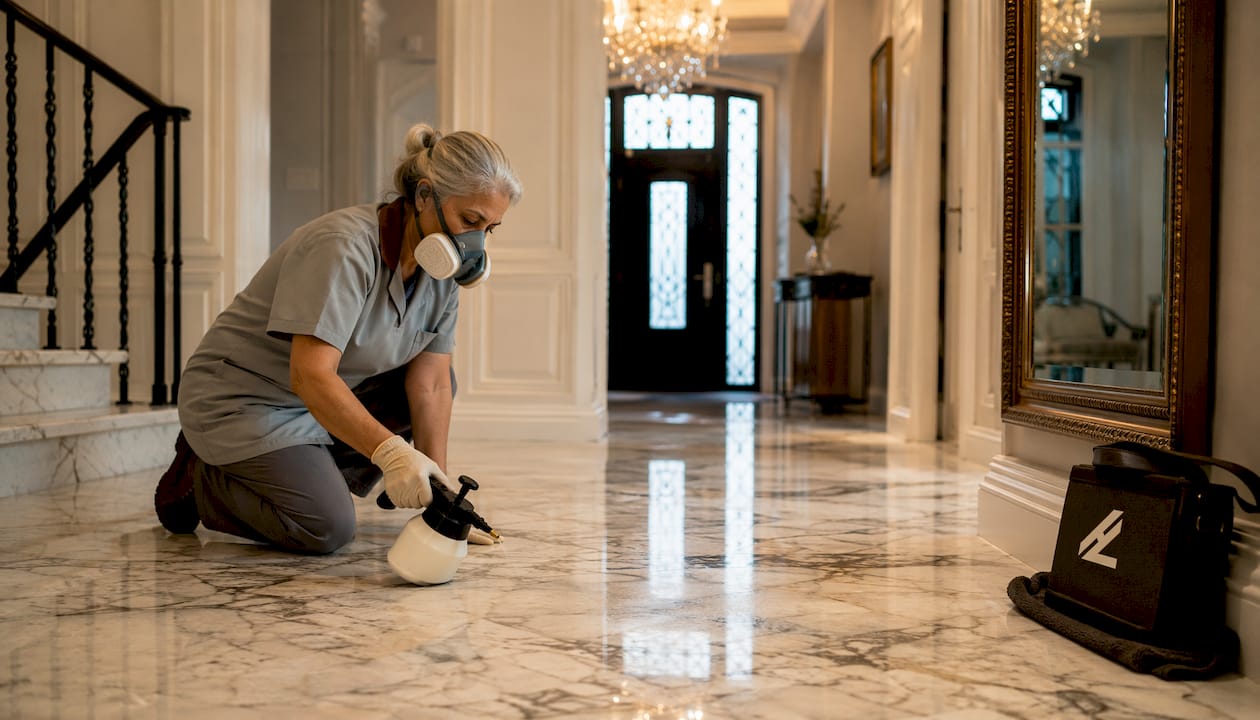
Topical sealers and film coatings
Topical products sit on the surface and can add a gloss or satin finish. They offer some surface wear protection but require more frequent maintenance, can alter the stone’s look, and may peel or cloud over time in wet areas. They work best as a complement to a penetrating sealer, not a replacement.
Anti-acid surface protection systems
Engineered coatings designed specifically for calcite-based stones address the gap that every impregnating sealer leaves. These systems create a sacrificial layer at the surface that absorbs the acid reaction — so the stone underneath stays unharmed when wine, lemon juice, coffee, or vinegar makes contact. Highlinestonecare’s Opal Luxury Anti Acid Sealer is built on this principle, combining below-surface stain resistance with surface-level etch protection for marble, limestone, and travertine.
Water-based vs. solvent-based sealers
Water-based formulas have lower VOCs, dry faster, and are better suited for indoor environments where ventilation is limited. Solvent-based products penetrate more deeply into very dense stone and are often preferred for outdoor applications. For most residential countertops and bathroom floors, a water-based penetrating sealer is the practical choice.
Pro Tip: For outdoor stone, confirm the sealer carries UV-resistance claims. Indoor sealers applied outdoors can break down within months under direct sunlight.
How often should you reseal natural stone?
Reseal frequency depends on stone porosity, surface location, and how the space is used. The ranges below reflect industry guidance and should be treated as starting points, not fixed rules.
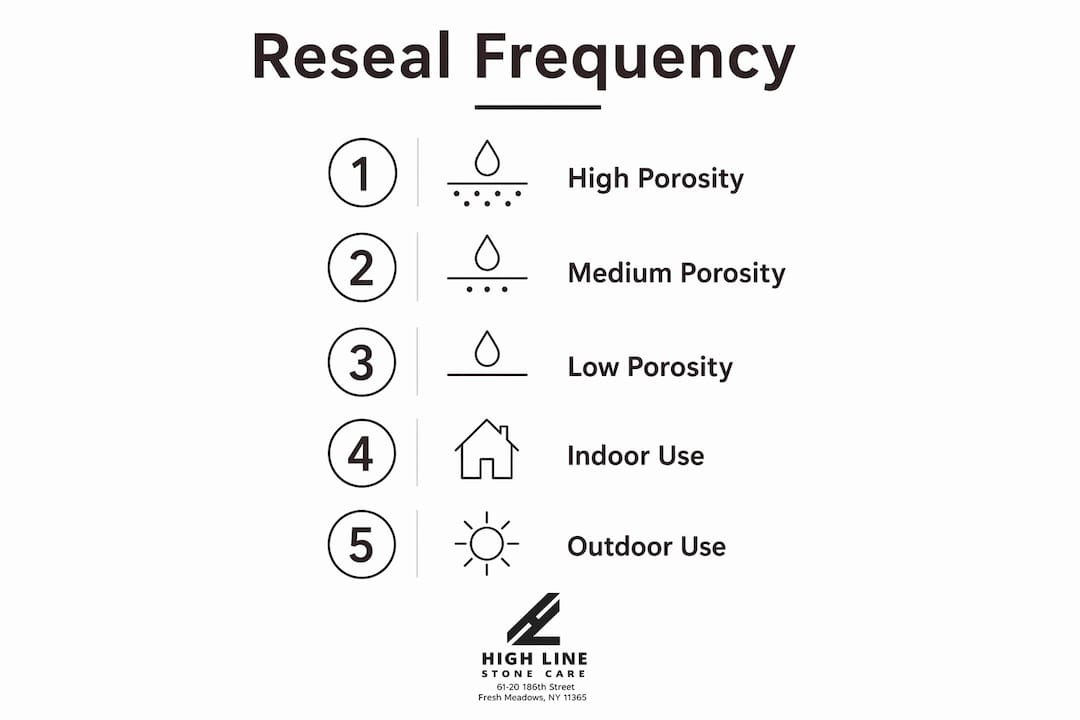
| Stone Type | Typical Location | Recommended Reseal Range |
|---|---|---|
| Marble | Kitchen countertop | Every 6–12 months |
| Limestone | Bathroom floor / shower | Every 6–12 months |
| Travertine | Entry floor / patio | Every 6–12 months |
| Granite (standard) | Kitchen countertop / floor | Every 1–3 years |
| Quartzite | Floor / feature wall | Every 1–3 years |
| Dense granite | Low-traffic interior | Every 1–3 years or longer |
For detailed reseal intervals by stone type, Highlinestonecare’s guide on how often to seal natural stone is a useful reference.
Several factors shorten the interval regardless of stone type:
- High foot traffic or daily kitchen use
- Frequent spills of acidic substances (coffee, citrus, wine)
- Outdoor exposure to rain, UV, or freeze-thaw cycles
- Abrasive cleaning pads or high-alkaline cleaners
- Polished finishes that show wear more visibly
Factors that allow longer intervals include low daily use, indoor-only protected environments, and honed or matte finishes that are less sensitive to surface degradation. The water-bead test, described in the diagnosis section below, is more reliable than any fixed calendar.
How the sealing process works: DIY steps and when to hire a professional
The sealing workflow follows a consistent sequence whether you do it yourself or hire a professional. The difference lies in the depth of preparation and the class of products used.
DIY sealing steps
- Inspect the surface for existing stains, cracks, or etch marks. Address stains before sealing — a sealer applied over a stain locks it in.
- Clean thoroughly with a pH-neutral stone cleaner. Avoid acidic or alkaline cleaners that can damage the stone or leave residue that interferes with sealer adhesion.
- Allow the surface to dry completely. Moisture trapped under a sealer causes cloudiness and adhesion failure. Allow at least 24 hours after cleaning in humid environments.
- Test a small, discreet area with the sealer before full application. Confirm the product does not alter the finish in an unacceptable way.
- Apply the sealer per the manufacturer’s instructions, typically in thin, even coats with a clean applicator. Avoid pooling.
- Allow full cure time before returning the surface to use. Most penetrating sealers require 24–48 hours; follow the specific product guidance.
Pro Tip: Sealing is most effective when done pre-installation or immediately after installation, before contaminants from handling, grouting, or initial use have a chance to penetrate. If you are planning a countertop installation, schedule sealing as part of the project.
When to hire a professional
DIY sealing works well for routine maintenance on low-risk surfaces. Professional service is the better choice when:
- The stone is marble, limestone, or travertine in a kitchen or high-traffic area
- Visible staining or etching is already present and needs remediation before sealing
- You want anti-acid surface protection that requires controlled multi-layer application
- The surface area is large, complex, or includes grout lines that need separate treatment
- The stone is in a luxury residence, commercial lobby, or managed property where appearance standards are high
Professional workflows include deep cleaning, poultice treatment for embedded stains, mechanical prep where needed, and a multi-layer application that pairs a penetrating sealer with a surface protection film. A reputable provider will also supply a maintenance plan and a written estimate that states expected lifespan.
How to tell if your stone needs resealing
The water-bead test is the simplest and most reliable homeowner check. Place a small amount of water on a clean, hidden area of the stone and watch what happens. If the water beads and sits on the surface, the sealer is still active. If the water soaks in or darkens the stone within a few minutes, the sealer is depleted and resealing is due.
Perform this test annually in a discreet spot — behind a faucet, near a corner, or on an inconspicuous section of floor. It is noninvasive and safe for any finished stone surface when done carefully.
Beyond the water-bead test, these visual signs indicate a sealer has worn down:
- Water darkens the stone rather than beading on contact
- Stains appear despite prompt cleaning
- The surface has lost its luster or looks dull in areas of heavy use
- Grout lines near seams are darkening or showing mildew
- Recurrent mildew or moisture marks in wet areas like showers
If the test fails, clean the surface thoroughly before resealing. If staining or etching is already visible, schedule a professional assessment rather than sealing over existing damage.
Post-seal care: what to use and what to avoid
A sealer only performs as long as the cleaning routine supports it. The wrong cleaner can strip a sealer in weeks, undoing months of protection.
Use these:
- pH-neutral stone cleaners formulated for natural stone
- Soft microfiber cloths or mop heads for daily cleaning
- Warm water for routine wipe-downs between deeper cleans
- Stone-safe dish soap diluted in water for occasional spot cleaning
Avoid these:
- Acidic cleaners (vinegar, lemon-based sprays, bathroom tile cleaners) — these etch calcite stones and degrade sealers
- Bleach and bleach-based products — they discolor grout and can damage stone finishes
- Abrasive powders and scrubbing pads — they scratch polished surfaces and open pores
- High-alkaline strippers — they remove sealers and can dull finishes permanently
For property managers, stone flooring maintenance is easier to sustain when it is systematized. Keep a record of each stone type per unit or space, log reseal dates, and link maintenance intervals to your preventive maintenance calendar. A simple spreadsheet with stone type, location, last seal date, and next scheduled check prevents the gaps that lead to expensive restoration.
How long do sealants last and what does professional protection cost?
Sealer lifespan varies considerably by product class, stone type, and use. Standard penetrating sealers typically last 6–12 months on marble, limestone, and travertine surfaces, and 1–3 years on granite and quartzite countertops and floors with regular use. In high-traffic commercial environments or outdoor applications, that interval shortens. Premium surface protection systems, particularly those combining a penetrating sealer with an engineered surface film, can extend service life significantly — one graphene-enhanced system showed more than 180,000 scrub cycles in manufacturer testing, equivalent to roughly five years of household cleaning.
Cost factors for professional sealing include:
- Total surface area and layout complexity
- Condition of the stone (whether prep, stain removal, or poulticing is needed)
- Product class: standard penetrating sealer vs. premium anti-acid surface protection
- Whether a maintenance plan or warranty is included
As a general framework, DIY sealer kits for a standard countertop represent the lowest upfront cost but require annual reapplication and offer no etch protection. Professional penetrating sealer application costs more but delivers controlled prep and longer-lasting results. Premium anti-acid surface protection, like Highlinestonecare’s Opal Luxury service, carries a higher upfront investment that is offset by fewer restoration visits and a dramatically lower risk of etch damage on marble or limestone.
For expensive marble countertops, high-end hospitality properties, or any surface where appearance is a core part of the asset’s value, the math typically favors premium protection. A single professional restoration to correct etching or deep staining costs far more than proactive sealing. Homeowners weighing their options can review stone restoration vs. protection to understand the cost difference between reactive and preventive approaches.
When professional anti-acid protection is the right choice
Standard sealing handles moisture and staining. It does not handle etching. For marble, limestone, and travertine in active kitchens, bathrooms, or public spaces, that gap is where damage accumulates — for example, a dull ring near the coffee maker, a rough patch where lemon juice sat for thirty seconds, or a loss of polish that no cleaner will restore.
Etching is a chemical reaction between acidic substances and the calcium carbonate in marble, limestone, and travertine. The acid dissolves a micro-thin layer of the stone’s surface, leaving a dull, rough mark. Standard sealers work below the surface and cannot stop it. A surface-level anti-acid coating absorbs the reaction at the surface instead — so the stone underneath stays unharmed.
Highlinestonecare’s Opal Luxury Anti Acid Sealer is engineered specifically for this problem. It provides a sacrificial surface layer that absorbs acid contact from wine, coffee, citrus, vinegar, and common cleaning sprays, while the penetrating component handles stain and moisture resistance below the surface. The result is a layered protection system that addresses both threats simultaneously.
What to expect from a professional Opal application:
- On-site surface inspection and water-bead testing to assess current condition
- Deep cleaning and, where needed, poultice treatment for existing stains
- Multi-layer application: penetrating sealer followed by the anti-acid surface coating
- Controlled cure time with specific care instructions for the first 48–72 hours
- A written maintenance plan and guidance on cleaning products that preserve the coating
Before hiring any professional for anti-acid protection, ask these questions:
- What is the expected lifespan under my specific use conditions?
- Is the product food-safe and low-VOC for indoor kitchen use?
- What does periodic maintenance look like after the initial application?
- Do you provide a written estimate with expected lifespan and a satisfaction guarantee?
For acid-resistant surface protection on marble countertops, vanities, and luxury interiors across New York City, Highlinestonecare’s Opal service is the recommended professional-grade solution.
Key Takeaways
Periodic stone sealing is the most cost-effective way to protect natural stone — test annually, reseal on schedule, use pH-neutral cleaners, and choose professional anti-acid protection for any calcite-based stone in active use.
| Point | Details |
|---|---|
| Test annually | Perform the water-bead test periodically; if water darkens the stone, reseal promptly. |
| Match frequency to stone type | Marble, limestone, and travertine typically need resealing every 6–12 months; granite and quartzite require resealing every 1–3 years. |
| Sealing is not etch protection | Standard penetrating sealers resist staining but do not stop acid etching on calcite-based stones. |
| Use pH-neutral cleaners only | Acidic or high-alkaline cleaners strip sealers and can permanently damage stone finishes. |
| Highlinestonecare’s Opal Luxury | Provides layered anti-acid and stain protection for marble, limestone, and travertine in NYC — the recommended choice for high-value surfaces. |
The case for scheduled professional maintenance
The most common mistake in stone care is treating the first seal as a permanent fix. Sealers degrade. Foot traffic, cleaning cycles, and daily use gradually expose new capillaries in the stone surface, and those open pores take on dirt, moisture, and staining agents. By the time visible damage appears, the sealer has often been depleted for months.
What experience in this field consistently shows is that sealed but unprotected marble still etches. A homeowner who seals their marble countertop with a standard impregnating sealer and considers the job done will still find dull patches from coffee and lemon within a year. The sealer did its job against staining — but etching is a surface reaction that requires a different class of protection entirely. Proactive, scheduled maintenance prevents the costly restoration cycle that follows neglect.
For property managers, the calculus is straightforward: a consistent maintenance program across stone surfaces in a building costs a fraction of what reactive restoration runs when multiple surfaces deteriorate simultaneously. For homeowners with premium marble, the investment in professional anti-acid protection pays for itself the first time it prevents a restoration visit.
Schedule your professional stone assessment with Highlinestonecare
Natural stone in an active kitchen or high-traffic space deserves more than a DIY sealer applied once and forgotten. Highlinestonecare offers professional on-site assessments for homeowners and property managers across New York City, covering marble, granite, travertine, limestone, and other natural stone surfaces.
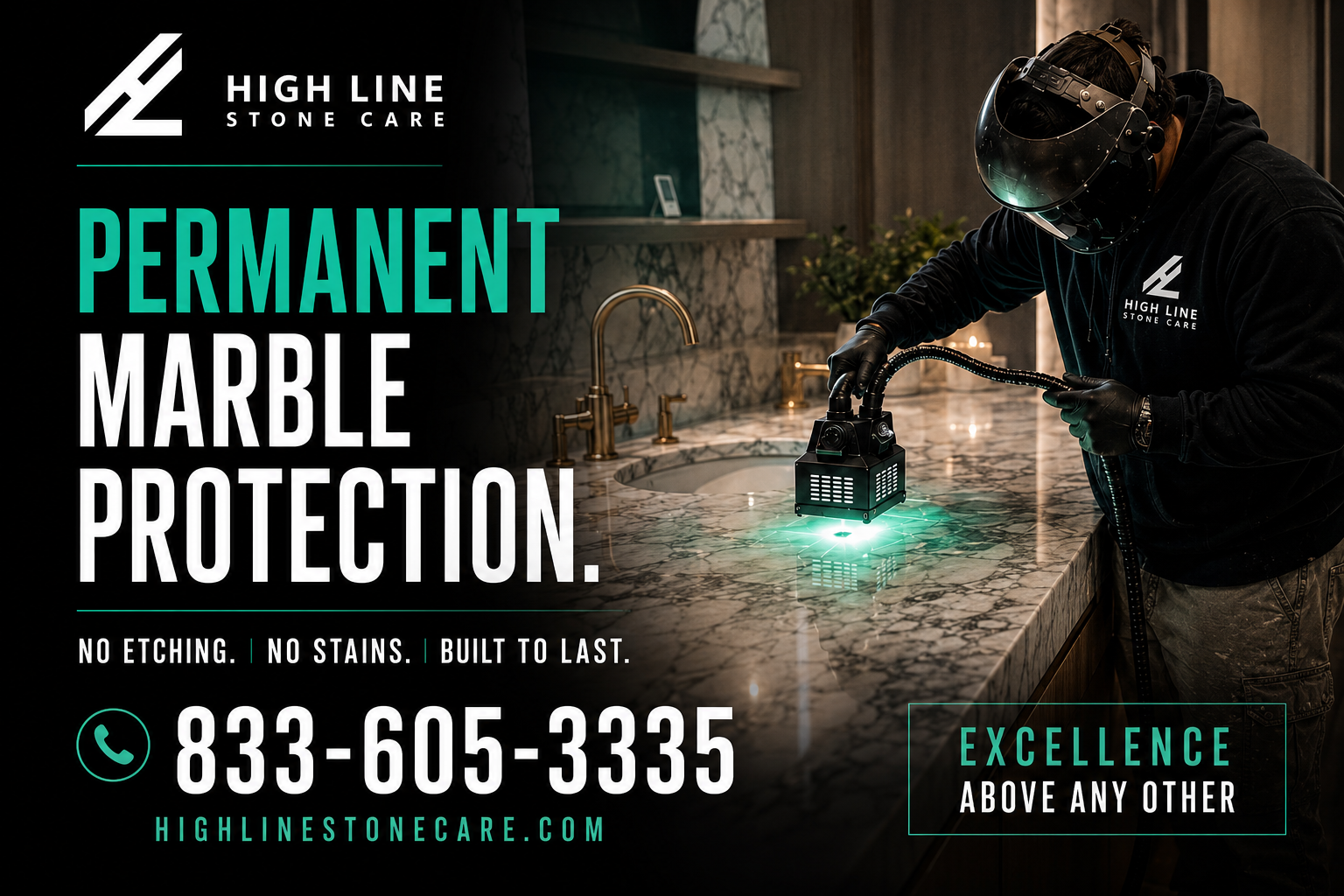
An assessment includes a full surface inspection, water-bead testing to evaluate current seal integrity, and a straight written estimate for either standard sealing or Opal Luxury Anti Acid Sealer protection. You will receive a clear recommendation, an expected lifespan for the treatment, and a maintenance plan that fits your schedule. For marble countertops, vanities, lobby floors, and luxury interiors, Opal protection is the most durable solution available — and a fraction of the cost of restoration after damage has occurred. Contact Highlinestonecare to schedule your assessment and get a written quote for your surfaces.
Authoritative sources and further reading
The following sources informed the frequency guidance, sealer definitions, water-bead test methodology, and professional protection recommendations throughout this guide.
- Sealing natural stone guide — Citadel Spaces: primary reference for reseal frequency ranges by stone type and use.
- Stone sealers, cleaners and enhancers — Dynamic Stone Tools: sealer science and the stain-vs-etch distinction.
- Natural stone sealing: Facts, myths, and choosing the right type — Boston Stone Restoration: penetrating vs. topical sealer mechanisms.
- Natural stone sealer and protection explained — Smart Renovate Hub: modern surface protection systems and extended service life data.
- Stone sealing complete guide — Granite Heroes: water-bead test procedure and interpretation.
- Natural stone sealing guide — Solidshape: practical guidance on sealing schedules and product selection.
- Protect your countertop before it fails — Tile Doctor: pre-installation sealing and early protection.
- Highlinestonecare — Opal Luxury Anti Acid Sealer: professional anti-acid surface protection for marble, limestone, and travertine in NYC.
- Highlinestonecare — Acid-resistant surface protection: product and service details for acid-resistant protection systems.
Recommended
- Why Stone Sealing Matters | Protect Your Surfaces with Professional Care
- Why Protect Stone Surfaces: A Homeowner’s Guide
- Sealed Stone vs Unsealed Stone: What Changes? – Highline Stone Care
- Signs Your Stone Needs Restoration: A Homeowner’s Guide